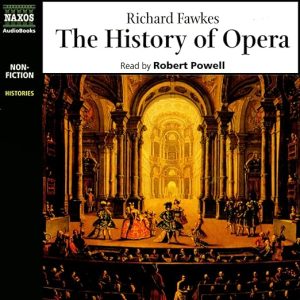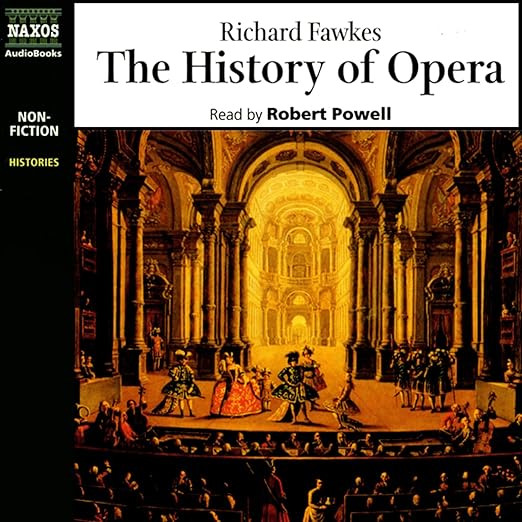
Naxos released this audiobook in 1999, and it has outlasted most of what shipped alongside it for one structural reason: it is not really a reading. The History of Opera runs five hours and seventeen minutes with Robert Powell credited, and threaded through the text are more than a hundred musical examples, performed by Naxos artists and by voices from the early twentieth century including Enrico Caruso and Fyodor Chaliapin. Richard Fawkes wrote a survey. The production turned that survey into a documentary.
An Art Form Blamed for Real Riots
Fawkes opens with the line attributed to Moliere about opera being the most expensive noise known to man, and the whole book proceeds in that register: affectionate, faintly amused, unwilling to treat the art form as sacred. The through line is not aesthetics but trouble. Opera has been censored, banned, blamed for riots, and credited in one case with helping win a nation its freedom, and Fawkes keeps returning to the fact that a form this artificial kept provoking real political consequences.
Michele Lackey, writing in January 2014 as a self-described novice, called it a concise history and said the combination of narrative and samples made the subject approachable for the first time. That is the correct verdict on the design. The chronology moves from sixteenth-century beginnings toward a present that holds, as Fawkes puts it, as many musical styles as composers to invent them, and the compression never leaves a beginner stranded without a reference point.
Personalities carry the middle stretch. The book is candid that opera history is largely a history of temperamental composers and even more temperamental singers, and Fawkes lets the anecdotes do work that pure musicology would not. The book is not building an argument about the form so much as demonstrating why people kept building opera houses for it despite the expense, the scandal and the very high chance of failure on opening night.
Minerva Calls It Good Quality Recording
The musical illustration is the reason this title still holds up. A printed history of opera can describe a vocal line or the scale of an orchestral climax; this one plays them. Patricia, five stars in April 2014, gets at the specific pleasure of that: the obscure operas that survive today only as a single famous aria, encountered here with the aria attached rather than as a footnote. The same response bought three copies, kept one and gave two away, and praised the research and the recordings together.
Publisher identity does unusual work here. Naxos drew the examples from its own artists, a point the description states outright, and a house able to reach into its own catalogue can illustrate a claim at the moment it makes it rather than building the text around whatever it was permitted to use. Whatever the commercial logic behind that arrangement, the effect on the listening is direct. Excerpts arrive casually, often mid-paragraph, and the book never once has to tell you to go find a recording of something elsewhere.
Hearing the excerpts also changes what the historical claims mean. Reading that a singer changed what audiences expected is information. Hearing Enrico Caruso positioned inside the argument is evidence, complete with the surface noise of the era the transfer came from. A century-old transfer will never sound like a modern studio capture, and the book is better for that. You can hear the distance, and the distance is part of the history.
Minerva's February 2017 note runs six words and still says something useful about the production: good quality recording, and very interesting. Recording quality is not a trivial compliment on a title that has to move between spoken narrative and archival music dozens of times without jarring the ear. The transitions are the hardest engineering problem this format has, and they are handled cleanly enough that they stop registering after the first half hour.
Ten Ratings, Most Reviews Under Six Words
Four centuries at this length means names arrive fast. Composers get a paragraph, sometimes a sentence, and whole national traditions pass in a few minutes. Anyone hoping to come away able to place fifty operas in order will need something considerably longer, and anyone already fluent will find the pace closer to a survey course than to scholarship. The compression is a deliberate feature of the Naxos format, not a failure of ambition.
The evidence base on the product page is also very small. Only ten ratings support the 4.7 average, and all five visible responses file at the top of the scale, which means at least one account nobody can read graded it well below the others. Katherine S. Ward's entire contribution from September 2015 is two words. Three of the five run to six words or fewer. Enthusiasm is unanimous; detail is almost absent.
Age is the last thing to weigh. This production dates from the final days of 1999, so the last quarter century of opera, including everything that changed about staging, streaming and casting since then, is simply outside its scope. The history it tells stops where it stops. That takes nothing at all away from the early chapters, but a listener wanting a contemporary picture of the art form should expect to supplement it.
Perfect Before Your First Night at the Opera
Beginners are the ideal audience, and specifically beginners who have bought a ticket. If you are attending your first performance in a month and want to arrive knowing why the form exists, why people shout at it, and what a great vocal line is supposed to do, five hours buys you exactly that. It also travels well as a gift for anybody in that position, which several accounts here effectively confirm by having done it.
Curious listeners who like their history sung rather than summarized will get more from this than from a longer, drier survey. The music is not decoration around the text; it is the argument. I came away with a list of recordings to chase rather than a list of facts, which strikes me as the right outcome for an introduction.
A specialist already fluent in the repertory will find the pace brisk to the point of skimming, and anyone expecting a conventional cover-to-cover narration should understand that the excerpts interrupt the prose constantly by design. Neither of those is a defect. Both are worth knowing before you start, because the format decides whether this title feels generous or restless, and it decides it inside the first ten minutes.
Frequently Asked Questions
Does the audiobook actually play opera, or only describe it?
It plays it. Musical excerpts are woven directly into the text, performed by Naxos artists alongside historic voices such as Enrico Caruso and Fyodor Chaliapin. They are structural rather than decorative, which is why the running time covers far more ground than the same span of plain prose could manage.
Is this audiobook suitable for someone who has never seen an opera?
That is precisely its audience. No musical training is assumed anywhere, technical vocabulary gets defined at the moment it appears, and the chronology is built for somebody starting from zero. Hearing an excerpt immediately after the claim it supports removes the main barrier for a beginner, which is having no sound attached to the terminology.