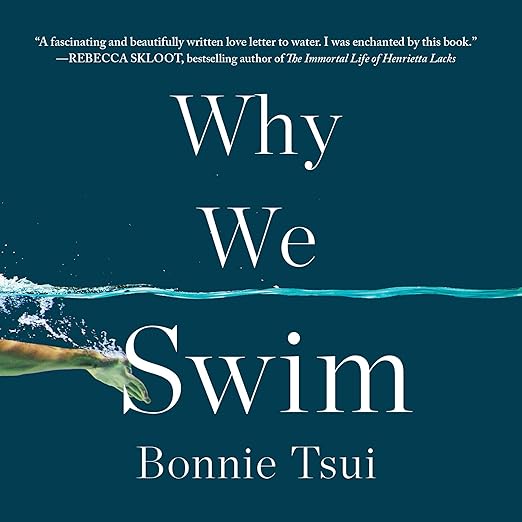
Bonnie Tsui opens her audiobook Why We Swim, narrated by Angie Kane, with a simple biological fact: unlike other animals drawn to water, humans are not natural-born swimmers. We have to be taught. That single premise - delivered in Kane's measured, reflective voice - gives the entire six hours and thirty-five minutes of cultural history, personal memoir, and adventure journalism its organizing tension. Every swimmer in these pages entered the water by choice, against their biology, and kept going for reasons Tsui spends the whole book trying to articulate.
Tsui is a regular contributor to the New York Times and a swimmer herself, and the book is most alive when those two identities converge. The chapter on cold-water swimming builds from reported journalism into something closer to personal confession, as she writes about her own practice of swimming in San Francisco Bay and what the cold does to her thinking. One reviewer - an aquatics program director who has swum all their life - described this as an eye-opening read about the water culture spanning generations and nations. That summary is accurate but undersells how specifically the book earns that response. Tsui is not writing about swimming in general; she is writing about the particular psychological state water creates, the way immersion quiets a noisy mind, and she traces that state through multiple cultural traditions with enough rigor that the claim feels substantiated rather than merely asserted.
The samurai swimming material is especially strong. She connects the development of specific strokes to military necessity in feudal Japan and follows that lineage forward to contemporary practitioners who maintain the forms as a living tradition. The Baghdad swim club section, where members convened in Saddam Hussein's palace pool during one of the most violent periods in modern Iraqi history, is one of those reported passages that justifies a whole book - it demonstrates that the human need for water does not stop during political catastrophe, that people will find their way to a pool even when the city around it is burning. Kane handles that section and the Icelandic fisherman's six-hour wintry survival swim with the same controlled delivery, tightening slightly in the tensest passages without becoming theatrical. The performance mirrors the writing's discipline.
What Works
Tsui covers Olympic training culture, the science of flow states, open-water adventurers, therapeutic swimmers, and the entirely separate world of competitive traditions spanning centuries. In print, that range can make the book feel scattered; in audio, Kane's consistent voice provides connective tissue between sections, and the forward momentum of listening carries through transitions that might pause a print reader. At six hours and thirty-five minutes, the book lands in a productive middle length for nonfiction audio - long enough to develop its themes fully, short enough that a listener can hold the whole structure in mind across a few sessions.
The flow-state chapters in the middle section earn their placement. By the time Tsui reaches the more theoretical material about Mihaly Csikszentmihalyi's research, she has established enough specific examples that the psychology feels grounded rather than abstract. Another reviewer described Tsui as an eloquent writer who brings enjoyment and challenges of swimming to light through introspection, serious research, and experience, noting that reading it created a persistent longing for the water. That quality - of a book that makes you want to do the thing it describes - is rare in nonfiction and suggests the audio format will carry the same effect. The book also does something useful for non-swimmers: it makes the compulsion to enter water legible without requiring the listener to share it. A reviewer named David Almeida noted that Tsui captures the love and respect swimmers have for water, and that reciprocal quality - explaining a passion to those outside it without condescension - is one of the book's real achievements.
Things to Know Before Starting Why We Swim
One listener who gave four rather than five stars noted the prose leans lyrical in places, and Kane's measured delivery leans into that lyricism. If you prefer nonfiction with a harder journalistic edge, the audiobook's tone may read as contemplative to the point of slowness in certain passages, particularly in the more personal essay sections between the reported chapters. The book's structure is essayistic rather than linear - it does not build toward a single destination but accumulates meaning laterally across its chapters. That is a defensible structural choice, but it means the book rewards patient, associative listening rather than a drive toward resolution. Listeners who need a propulsive narrative throughout should calibrate their expectations accordingly.
The low rating count for this audiobook suggests it has not yet been widely reviewed as an audio experience specifically, so buyers are working primarily from print edition praise. The print version has a strong critical track record, and the content transfers intact into Kane's performance - but the specific audio experience remains less documented than the book's overall reputation would suggest. Prospective listeners who are strong swimmers themselves may also find that Tsui's explanations of what water feels like will occasionally read as understatement rather than revelation; the book's intended audience includes the swimmer who has never tried to put the feeling into words.
Who It's For
This audiobook is for swimmers of any level who have wondered what draws them back to the water, for readers who enjoy the blend of personal essay, cultural history, and adventure narrative that writers like Susan Orlean or David Grann practice, and for anyone curious about the anthropology of human performance states. It rewards listeners comfortable with an essayistic structure that circles its subject. Skip it if you need a training manual or a linear sports biography; this is a meditation on a practice, not a guide to improving one.
Questions Listeners Ask
How does Angie Kane handle the tonal range in this audiobook, from adventure narrative to philosophical reflection?
Kane is consistent and controlled rather than showy. She adjusts pace and intensity between sections without breaking the reflective mood, and her delivery of tense passages - the shipwreck sequence especially - is grounded rather than theatrical.
Can this audiobook be listened to in short sessions, or does it require long uninterrupted blocks?
The essayistic structure works well in short sessions. Each chapter functions as a mostly self-contained exploration of a specific aspect of swimming culture, so listeners can pause between chapters without losing a continuous narrative thread.