
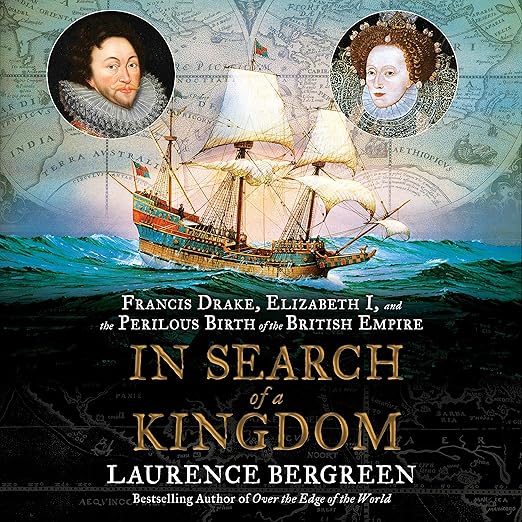
Francis Drake spent his career being called things: El Draque by furious Spaniards who put a bounty on his head, the queen's own pirate by the government that quietly funded him, a jumped-up commoner by the aristocrats forced to sail under his command. Laurence Bergreen, the acclaimed biographer of Magellan, Columbus, and Marco Polo, structures this audiobook around a genuinely useful choice: rather than marching through Drake's raids and voyages in strict order, he braids Drake's story together with Elizabeth I's and Philip of Spain's, so a listener always understands whose interests a given plundered galleon actually served.
Thirteen hours and twenty-five minutes cover a career that runs from jobbing privateer to the first captain in history to complete a successful circumnavigation, in 1580, to the vice admiral who helped break the supposedly invincible Spanish Armada eight years later. A supplemental enhancement PDF accompanies the audiobook for listeners who want maps and portraits alongside the narration.
A Closer Look at In Search of a Kingdom
One reviewer's assessment lines up closely with what I heard: rather than dry chronological event-listing, Bergreen builds the book around three specific people whose decisions altered the outcome of history, Elizabeth, Drake, and Philip, which keeps the narrative anchored in motive and personality rather than dates and battle counts alone.
Michael Page narrates with real experience in demanding long-form audio, the Gentleman Bastard Sequence and the Unsinkable middle-grade thriller series both on his resume, and his track record for full character inhabitation and clean differentiation across an ensemble is a genuine asset here, where the cast spans Drake's crew, the Spanish court, and Elizabeth's own inner circle. This specific nonfiction genre, narrative history built around real historical figures, is a departure from his fiction work rather than a confirmed strength, so treat the crossover as a reasonable bet rather than a guarantee.
The title itself carries a double meaning worth noting: on one level, it names England's own emerging imperial ambition under Elizabeth, a small island kingdom reaching for global reach; on another, it tracks Drake's own personal search for status and fortune, a commoner's son clawing his way toward a knighthood few of his birth could expect. Bergreen keeps both meanings in view throughout rather than favoring one over the other.
Bergreen's prior biographies give him real comparative range to draw on, and the book leans on that experience: parallels to Magellan's own voyage surface naturally when Drake's circumnavigation comes up, without the book ever feeling like a rehash of Bergreen's earlier work. His own bibliography backs up the synopsis's claim directly: Over the Edge of the World took on Magellan's circumnavigation, Marco Polo: From Venice to Xanadu covered the medieval explorer, and Columbus: The Four Voyages handled the more contested legacy of the Genoese navigator. In Search of a Kingdom slots Drake into that same lineage of single-figure adventure biography, and the comparative expertise shows in how confidently the book handles the technical realities of sixteenth-century sailing.
What Makes In Search of a Kingdom Worth Hearing
Drake's actual biography reads like fiction on its own terms: commoner-born pirate turned trusted royal instrument, a man Elizabeth used to bankroll her government while maintaining just enough deniability to avoid open war with Spain for years longer than the raids alone would have allowed.
Privateering itself is worth understanding as a specific legal category rather than simple piracy, and the book makes this distinction clear: a privateer operated under royal sanction, which meant Drake's raids against Spanish shipping were, from the English crown's perspective, a legitimate extension of state policy rather than freelance criminality, even as Spain understandably saw the exact same actions as piracy outright.
The circumnavigation itself, reaching Patagonia, the Pacific coast of what is now California and Oregon, the Spice Islands, Java, and Africa aboard the Golden Hind, gets the kind of vivid narrative treatment a listener wants from adventure history rather than a dry itinerary of ports visited.
The Armada's defeat in 1588 gets treated with the weight it deserves as a hinge point in European history, not just an English military victory but the moment that ended any realistic Spanish hope of invading England and reasserting Catholic control, reshaping the balance of naval power in the Atlantic for a generation afterward.
One reviewer calls Drake history's kindest pirate, a nice, slightly ironic framing the book itself seems aware of. Drake's personal charisma and loyalty to his own crew coexisted with a career built on violence and plunder against Spanish ships and settlements, and the book does not try to resolve that tension into something simpler than it actually was.
Drake's own ending carries a strange resonance the book uses well: he died of dysentery off Panama in 1596 and was buried at sea in a lead coffin whose exact location has never been found, despite periodic expeditions over the centuries specifically searching for it. A man who spent his career mapping and claiming corners of the world unknown to England ended up in an unmarked, unrecovered grave himself, and Bergreen lets that irony close the book without overstating it.
Things to Know Before Starting In Search of a Kingdom
Thirteen and a half hours of narrative history demands real patience, and because the book interweaves three separate figures' storylines rather than following one continuous thread, listeners need to track Elizabeth's court politics and Philip's Spanish maneuvering alongside Drake's own voyages rather than following a single throughline start to finish.
Michael Page's fiction background is a genuine asset for character voice and pacing, but this is his first entry in this file tied to narrative nonfiction specifically, so listeners with strong preferences about nonfiction narration style should sample a chapter before committing to the full runtime.
The single attached five-star review with minimal detail, a brief recommend highly, adds less confidence than the two longer, more substantive reviews. Weight the detailed reviews more heavily than the numeric rating average alone when deciding whether this is for you.
Who Laurence Bergreen Is Writing For
Readers of adventure-driven narrative history, fans of Bergreen's earlier Magellan and Columbus biographies specifically, and anyone drawn to Tudor-era political intrigue alongside high-seas adventure will find exactly what they are looking for here.
Skip it if you want a tightly focused single-subject biography rather than an interwoven three-figure narrative, or if dense sixteenth-century geopolitics without much simplification sounds like a slog rather than a draw.







