
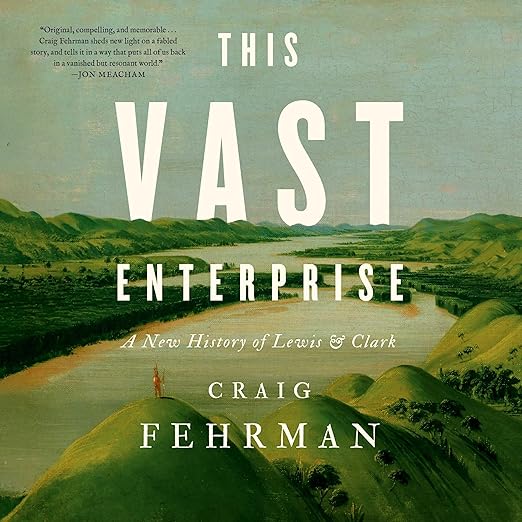
Five years, more than thirty archives, over a hundred interviews and Indigenous oral history passed down across generations: the description of this fifteen-hour audiobook leads with its method before it tells you a single thing that happens. That ordering is deliberate, and it is the most honest signal on the page. This Vast Enterprise is a research book first, an adventure second, and Jason Culp has to make the research move. The publisher's copy bills it as a major revisionist history and the first fresh account in a generation, which sets a bar the fifteen hours then have to clear.
Chapters Move Through Wolf Calf and York
Each chapter moves to a different person's point of view. That single structural decision is what separates this from every other account of the expedition, and it is what a listener should understand before starting. John Ordway, a working-class soldier who fought grizzlies and towed the captains' hulking barge. Wolf Calf, a Blackfoot teenager who watched a friend die in a fight with Lewis and his men. York, the Black man Clark enslaved, who in his own chapters finds ways to make choices in an era that allowed him almost none. Black Buffalo, whose strategy the book uses to overturn a standard reading of Lakota-American diplomacy.
A College Notebook That Rearranges the Portrait
Two discoveries carry the revisionist claim, and both are specific enough to check. Craig Fehrman says Thomas Jefferson's secret political maneuvers to fund the expedition appear here for the first time, presented as a case study in presidential power. And Clark, generally handed down as a folksy Kentuckian, turns out to have been a student of the Enlightenment: Fehrman found his college notebook, and no previous biographer had even realized he went to college. A single notebook rearranging a two-century-old portrait is the sort of find that justifies five years in archives.
Underneath all of it sits one argument, stated plainly near the end of the description. The success of the expedition depended on far more than the two men whose names it carries, and the captains are best understood as people who needed help. Fifteen hours is enough room to prove that slowly, through eight thousand miles of rapids, mountains, hailstorms, frostbite, rattlesnakes and Spanish cavalry, instead of asserting it once in an introduction and moving on. The expedition returns in 1806 carrying a story about itself, and the book spends its length showing where that story bent.
A Change of Register the Listener Feels
A rotating point of view suits audio better than it suits the page. On paper a chapter break is a piece of white space you can skim past; spoken, a change of vantage arrives as a change of register, and the listener feels the handover. Jason Culp is credited alone for all of it, which means one voice has to distinguish a Blackfoot teenager, an enslaved man, a working-class private, a Lakota leader and a sitting president across fifteen hours without a cast to lean on.
Four endorsements arrive before the book describes itself, which tells you how the publisher is positioning it. Jon Meacham calls the treatment original and memorable. Hampton Sides says the expedition finally appears in living technicolor. Garrett M. Graff calls the portrait vivid. The New York Times supplies the only quotation with numbers in it, crediting an impressive mountain of research across dozens of archives, more than a hundred interviews and Indigenous oral histories carried down through generations. When the press quote is the specific one, the specificity is the selling point.
York and Wolf Calf are the two chapters most likely to change how a listener hears the rest. Both are people the standard version of this story keeps at the edge of the frame, and giving each a point of view rather than a paragraph is a structural argument, not a gesture. Sacajawea, whom the description assumes everyone already knows, is folded back into a working group of people whose contributions the captains depended on, which is a quieter revision but probably the more useful one. Fehrman balances the adventure against the humanity of the people inside it, and the description is candid that both descriptions of the captains, courageous and distorted, contain some truth.
No Star Badge, No Written Response at All
No star badge appears on this listing, and not one written response sits beneath it. Everything a prospective listener can learn comes from the publisher's copy and from four endorsers the publisher chose to quote. That is not a criticism of the book, but it does mean the usual second opinion is unavailable, including on the one thing endorsers never address: what fifteen hours of Jason Culp actually sound like across a dozen shifting vantage points.
Filing is the second thing to notice. The listing places a heavily archival revisionist history under biographies and memoirs and, simultaneously, under sports and outdoors, with a tag reading Adventurers, Explorers and Survival. A browser arriving from the survival shelf expecting grizzlies and frostbite will get some of both, but will also get presidential fundraising machinations and a close reading of a college notebook. The categories oversell the adventure and undersell the argument.
Fifteen hours with a new narrator perspective every chapter also means names arrive quickly and keep arriving: Ordway, Wolf Calf, Black Buffalo, York, Sacajawea, Meriwether Lewis, William Clark, Jefferson, plus the archival figures behind them. Print gives you a page to flip back to. Audio does not, and a listener who drifts for a minute during a handover can lose track of whose eyes the next scene belongs to. This is a book worth listening to attentively, not in the background.
Come Already Knowing the Outline
Readers of narrative history who like watching a familiar story get taken apart with documents will find plenty to hold. So will anyone who already knows the expedition well enough to feel the rearrangement happening, since the pleasure of revisionism depends on knowing the version being revised. Listeners interested in how Indigenous oral history sits alongside archival research within a single trade history will find that method running through the whole book and not just one chapter.
Listeners wanting a straight chronological trek, one guiding voice and a clean heroic arc should be warned that the book is built to refuse all three. The same applies to anyone hoping for a short introduction to the expedition, because fifteen hours of contested detail is the opposite of a primer. Come to it knowing the outline already, and the corrections land where they are supposed to.
Common Questions
Does this audiobook assume you already know the Lewis and Clark story?
It helps considerably. The description takes for granted that you know Sacajawea and that the standard heroic version exists, because the whole project is a correction to that version. A listener meeting the expedition for the first time will follow the narrative fine but will miss what makes the reframing interesting.
What can a listener rely on when an audiobook carries no ratings or reviews?
The listing carries neither a star badge nor a single customer comment, so the page offers no independent signal at all. What remains is publisher copy plus four quoted endorsements, from Jon Meacham, Hampton Sides, Garrett M. Graff and a press review. None of them speaks to the narration.







