
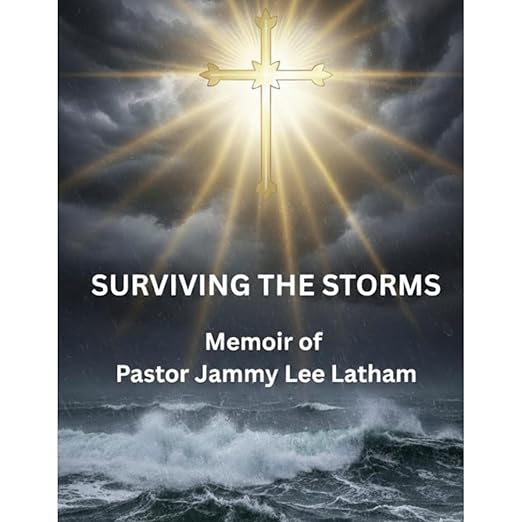
A half-hour memoir read by a synthetic voice is an unusual thing to encounter on any audiobook page, and this listing supplies almost nothing else to weigh it against. The runtime is twenty-nine minutes. The narrator credit reads Virtual Voice, not any person's name. Surviving the Storms was published on March 12, 2026 and carries no rating, no counted votes and not one written response. The description is candid about its subject and admirably brief. What the page does not do is prepare a buyer for how strange that combination of length and generated narration proves in practice.
The Same Prosody for Fierce Winds and Boilerplate
Pastor Jammy Lee Latham gives the whole book in four sentences of description, and they repay close reading because they are all the information available anywhere on this page. The memoir is presented as a testament to surviving the many storms life has thrown my way. Two sources of hardship are named, the shadows of grief and the weight of physical trauma, and one source of support, the faith of a family. The closing line is a citation, not a summary, a promise drawn from Psalm 34:1 that praise shall continually be in my mouth. What that adds up to is a testimony in the specific sense a congregation would recognize, and not an autobiography in any conventional shape.
Virtual Voice in the narrator field means the recording was generated rather than performed, and on a memoir that is a harder trade than it would be on a reference title or a procedural manual. The material here is grief and physical trauma recounted in the first person. Its force, if it has any, lives in the places where a human reader would slow, break, or refuse to break. A generated voice makes none of those choices, because it has no reading of the material to express. It applies the same even prosody to a sentence about the fiercest winds and to a line of publisher boilerplate, and no sample commentary exists on this page to show how well the particular system handles the difference.
Attribution Over Analysis, Gratitude Over Argument
Faith is the organizing principle here, stated without hedging or apology. The description credits the unwavering power of God's belief with carrying the author through, and reports having seen His hand protect me when the winds were at their fiercest. That is the register throughout: attribution over analysis, gratitude in place of argument, first person all the way through. If you have been looking for an account that treats faith as the explanation instead of as a subject to be examined from outside, this is written from squarely inside that position and makes no attempt to translate itself for anyone standing beyond it. Half an hour is a plausible length for such a testimony, which is to say the runtime looks like a choice, not an omission.
Brevity is the strongest asset this record has. Twenty-nine minutes asks almost nothing of a listener, which matters a great deal for material that could be difficult to sit with at length. Somebody deep in their own grief can finish the whole thing inside a single walk. A small group can play it and still have most of an hour left over to talk about what they heard. And unlike a three-hundred-page memoir, a book this short cannot pad: whatever made it in has to be the part the author most wanted said aloud. That constraint tends to concentrate a text, and it is the honest argument for a book this brief, and not an excuse for one.
A Numeral Standing Where 'I' Belongs
Shelving is the first real oddity. This title is filed under biographies and memoirs, which fits, and simultaneously under sports and outdoors with a tag reading adventurers, explorers and survival, which does not fit at all. Nothing in the description involves an expedition, a mountain, or weather in any literal sense. The storms are metaphorical, they are named in the title, and a classification system appears to have taken them at face value. The practical cost is real in both directions: someone browsing survival narratives lands here expecting a book this has never claimed to be, and someone actually hunting for spiritual memoir may never come across it at all, since it sits on a shelf they have no reason to visit.
Errors in the copy compound that impression, and in a text this short they are easy to spot. The second sentence of the description reads that, through the shadows of grief and the weight of physical trauma, 1 was never alone, with a numeral standing where the first-person pronoun belongs. It is a small slip, and it is exactly the kind that signals a text sent to publication without a proofreading pass. The publisher line reads Exclusive Publishing by Tanisha Mackin, a service credit, not a house name most buyers will recognize. And the page carries no rating, no counted votes and no written response of any kind, so for a March 2026 release no independent signal exists yet.
Twenty-Nine Minutes, a Pamphlet or a Book
Congregations, study groups and anyone working through loss inside a faith framework are the natural audience, and the fit is exact, not approximate. A half-hour first-person account of grief and physical trauma answered by family and by belief is a recognizable form with a recognizable purpose, and the runtime makes it easy to try without much deliberation. Listeners who value the particular comfort of hearing somebody say plainly that they were never alone will find that stated here without qualification and without the apparatus of argument around it. That is what the description promises, and the listing gives no cause to doubt it delivers on those terms.
Listeners who need a human voice should wait for one. Synthetic narration on a testimony is the single place where the format's flatness works hardest against the material, since the whole value of the thing rests on somebody sounding like they lived it. Anyone arriving from a survival narrative should also pass, since the shelving misleads and the storms are figurative from the title onward. Pass as well if twenty-nine minutes reads to you as a pamphlet instead of a book, which is a fair reading the page never troubles to argue against. Everyone else is risking half an hour on a testimony that says precisely what it set out to say.
At a Glance
- Big ideas: grief and recovery, physical trauma, faith as a sustaining force, family support
- Atmosphere: Plainspoken and grateful, over in one sitting
- Worth it?: Twenty-nine minutes of testimony, worth trying only if a generated reading is acceptable to you.







