
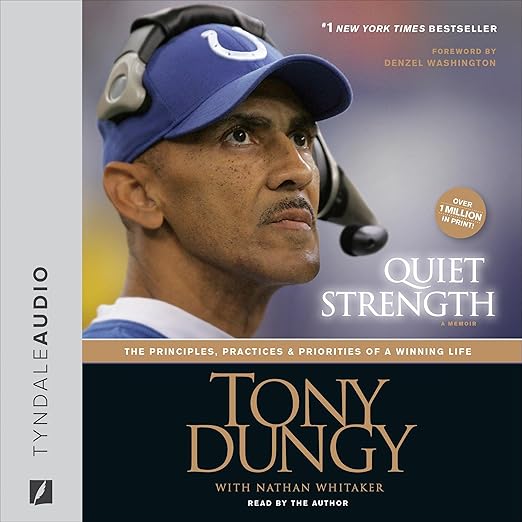
- Narrator: Dungy reading his own memoir gives the book an intimacy that a professional narrator could not manufacture; he speaks the way he apparently coaches, measured and direct.
- Subjects: Faith integrated with professional life, leadership without intimidation, family as non-negotiable priority
- Tone: Reflective and quietly inspiring without self-congratulation
- Bottom line: Quiet Strength is the rare sports memoir that makes its argument through lived example rather than declaration, and Dungy's voice as narrator is inseparable from the book's effect.
I do not follow professional football closely enough to have come to Quiet Strength through fandom, but the book kept appearing in discussions of leadership memoirs written by people who actually lead, as opposed to those written by people who have thought carefully about the concept of leadership. After spending five hours with Tony Dungy narrating his own story, I understand why it keeps appearing in those lists. This is a book about a particular way of being, and Dungy is living proof that the approach works.
The premise is implicit rather than stated: Dungy became the first African American head coach to win a Super Bowl, Super Bowl XLI in 2007, without screaming at players, without profanity, without demanding that football come before anything else in their lives, and without compromising his faith to suit the professional context he worked in. The book's question, which it answers through story rather than argument, is how that was possible.
The Review
Dungy structures the memoir chronologically, moving from his Michigan childhood through his playing career, his coaching tenure at Tampa Bay where he built a defense that reached the Super Bowl under Jon Gruden after Dungy's firing, and finally to Indianapolis and the championship. The Tampa Bay section is the longest and, in some ways, the most instructive. Dungy built something real there that he did not get to see completed. How he processed that professionally and personally is more revealing about his actual character than the Super Bowl victory.
One reviewer who was a dedicated Colts fan expected the book to be dry and was surprised by how engaging it was, noting unexpected humor alongside the inspiration. That resonates. Dungy has a quiet wit that surfaces throughout the narrative, usually at his own expense. He is not a man who takes himself too seriously, which is part of what makes the book trustworthy.
The broader argument Dungy is making, that you can lead effectively and decently at the same time, and that those two things are not in tension, is simple but not simplistic. He offers it through specific decisions and specific situations rather than through abstraction, which is why it lands. He does not say calm leadership is more effective. He shows you the Tampa Bay defense and the Indianapolis offense and lets you draw the conclusion.
The foreword from Denzel Washington establishes what many readers already sense about Dungy: that his public persona matches his private one, which is not always the case with figures of his visibility. Dungy narrating his own book deepens this. There is no performance in his delivery. He sounds like someone telling you about his life, not presenting a carefully curated version of it. The result is a memoir that feels genuinely intimate despite covering events that were played out in national media.
At five hours and nineteen minutes, the runtime is appropriate for the material. The book does not need to be longer. Dungy makes his points by showing rather than elaborating, and the concision reflects the same discipline that apparently characterizes his coaching.
Before You Commit to Quiet Strength
The faith elements are substantial. This is not a book where religion appears as background texture. Dungy's Christian faith is central to his decision-making, his resilience through professional setbacks, and his parenting. He discusses it in the way the title suggests: without evangelizing, without demanding agreement, but also without minimizing its role in his life. Readers who are comfortable with this context will find the integration thoughtful. Readers who are not may find the book better as a leadership study than as a personal inspiration.
One reviewer noted that the book helped a young family member become a co-captain of a football team and contributed to a championship. That kind of specific, practical application speaks to the transferability of Dungy's principles beyond the professional context.
Is This One for You?
Sports fans who want more than game recollection from their athlete memoirs. Leaders and managers who want to think about what authority looks like without intimidation. Readers interested in the intersection of Christian faith and professional life handled with intelligence and without coercion. Listeners who grew up with the Colts or followed Dungy's career at Tampa Bay will find additional resonance, but the memoir works fully for those without that background.
Before You Listen
How does Dungy handle the Tampa Bay firing, which was followed by that team winning the Super Bowl under his successor?
With notable restraint and honesty. He acknowledges the difficulty without self-pity and does not diminish what the Tampa Bay team accomplished after he left. This section is one of the more revealing passages in the book precisely because of what Dungy does not say.
Is the foreword by Denzel Washington part of the audiobook narration?
The foreword from Denzel Washington is included in the book. The audiobook listing does not specify who reads the foreword, so listeners should expect it may be read by Dungy himself or included as separate material.
Does Quiet Strength address the death of Dungy's son James?
The death of his son James, which occurred in 2005 between the Tampa Bay and Colts chapters of his career, is addressed in the memoir. Dungy discusses it as part of his broader reflection on faith, family, and what it means to succeed. Listeners should be aware the content is present and treated with honesty.







