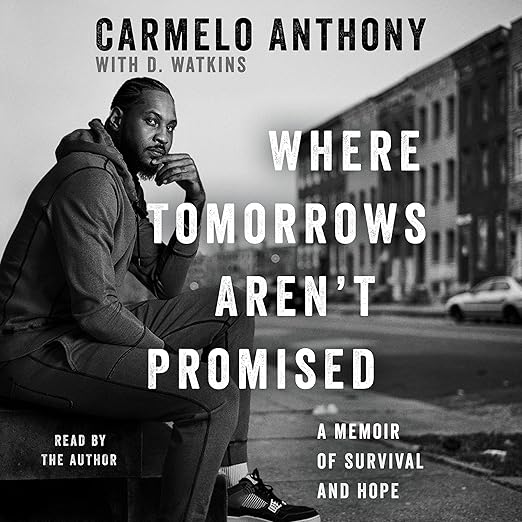
Quick Take
- Read by: Carmelo Anthony narrating his own memoir is the only format that makes complete sense for this material; his voice carries direct experience without the remove of a professional actor's interpretation.
- At its heart: Survival in systemic poverty, the violence of institutional neglect, the specific mentorship and family bonds that redirect a life
- Vibe: Raw, unsparing, and deeply personal
- Short version: Anthony's self-narrated account of Red Hook and Baltimore's Murphy Homes is primarily a survival memoir rather than a sports biography, and that ordering makes it more valuable than most athlete autobiographies.
Carmelo Anthony's childhood view was bounded by the hoopers and hustlers he watched from the side window of his family's first-floor project apartment in Red Hook, Brooklyn. The world as he understood it was not larger than that view, and his ambitions at the time did not exceed it. This audiobook, narrated by Anthony himself and running just under five hours, covers the years between that window and the 2003 NBA Draft at Madison Square Garden, and it treats those years with the precision of someone still working out how the distance between those two points was crossed at all.
What We Made of It
The title and subtitle announce the book's governing reality before the first chapter begins: in the Red Hook projects and Baltimore's Murphy Homes, also documented as the setting of HBO's The Wire, tomorrow was not guaranteed. Anthony grew up navigating an environment where the deaths of closely held loved ones were recurring rather than exceptional events, where the education system either ignored or actively exploited the children it was nominally serving, and where survival required a constant threat assessment that does not simply disengage when circumstances change. The memoir does not offer Anthony's eventual NBA career as the redemption of that childhood. It treats the childhood as a complete reality with its own logic and its own people, and the basketball as one of several possible trajectories that happened to work out rather than as the predetermined arc of a special person's life.
Anthony narrating his own work is not merely a commercial decision. Reviewer NyasaK makes the point that you do not need to be a basketball fan to connect with this book, and that observation is only possible because Anthony's self-narration makes the pre-NBA sections carry their full weight independently of any sports context. A professional narrator reading Anthony's description of dribbling past vial caps and needles on the asphalt court at Murphy Homes, where dealers lined one side and kids playing Double Dutch lined the other, would produce a different kind of distance from the material. Anthony's own voice makes it documentary rather than literary. These are places he was in. These are people he knew by name.
Why Listen to Where Tomorrows Aren't Promised
The audiobook is under five hours, which is short for a memoir of this scope, and that brevity is a deliberate formal choice rather than a missing-content problem. Anthony covers Red Hook and Baltimore not as a comprehensive sociological account but as a series of specific memories: the particular mentor on the corner, the exact decision point, the specific person whose death changed his understanding of what was possible. The compression produces an intensity that extended retrospection would diffuse. Reviewer NyasaK accurately identifies the book's real subjects as love and family, belief in self and others, gratitude, and surviving trauma, and those subjects are served better by the short format than by the expansive self-examination that longer memoirs tend toward.
The 2003 NBA Draft framing device, Anthony arriving at Madison Square Garden and asking himself how a kid from these places got here, is the structural hinge the memoir builds toward. But where most sports memoirs treat that moment of arrival as the emotional destination, Anthony uses it as a lens to look backward. The draft scene registers as genuine bewilderment rather than triumphalism, an emotional register that is unusual for a professional athlete memoir and that Anthony's narration, not performance-polished but emotionally direct, carries with authenticity. Reviewer Amazon Customer notes that the memoir captivates from start to finish because of how Anthony opens up about struggles and triumphs both on and off the court, and the self-narration is what makes that openness feel real rather than crafted. The self-narrated format also means the memoir is not mediated through a ghostwriter's smoothing of rough edges or an actor's interpretive choices about how an emotion should sound. What arrives through the audio is as close to the direct source of the experience as the format allows, and that directness is the production's most irreducible value.
What Might Not Land
The memoir ends at the 2003 NBA Draft, meaning the entire professional career, the championships pursued, the Olympic gold medals, the trade controversies, is outside this book's scope. Listeners expecting a full career retrospective will find the audiobook stops deliberately before that story begins. This is the book about the formation, not the achievement. Listeners who approach it as such will find the brevity precisely right; listeners wanting the full NBA arc need a different source.
Anthony is direct about the violence and loss that surrounded him growing up, and those sections are not softened for comfort. Deaths of loved ones are described plainly. His account of navigating an education system that ignored and exploited him is specific enough to be uncomfortable. These are not embellishments for emotional effect; they are the conditions without which the rest of the story makes no sense, and Anthony treats them as such. The balance the audiobook strikes, between the weight of those specific circumstances and the forward momentum that eventually moves Anthony through them, is difficult to maintain across a short runtime. Most memoirs of this kind either dwell in the trauma or rush past it toward redemption. Anthony does neither, which gives the audiobook a structural integrity that matches the emotional honesty of its narration.
The Right Listener for Where Tomorrows Aren't Promised
This audiobook is for listeners who want the pre-fame formation story without the career highlight reel. It works for anyone interested in accounts of surviving systemic poverty told with specificity and without sentimentality, regardless of basketball knowledge. Listeners who approach celebrity memoirs expecting polished distance or motivational uplift will find Anthony's register more direct and harder-edged than the genre norm, which is precisely the quality that makes it worth four hours and fifty-eight minutes.
Common Questions
Does Carmelo Anthony narrate this audiobook himself?
Yes. Anthony narrates the entire production himself, and the self-narration is the audiobook's strongest quality. His voice carries the material without professional performance polish, which makes the pre-NBA sections feel documentary rather than dramatized.
Is Where Tomorrows Aren't Promised audiobook only for basketball fans?
No. The book is primarily about growing up in systemic poverty, navigating violence and institutional neglect, and the specific relationships that redirect a life. Basketball is the outcome, not the subject. Listeners with no NBA investment will find it as compelling as sports fans do.