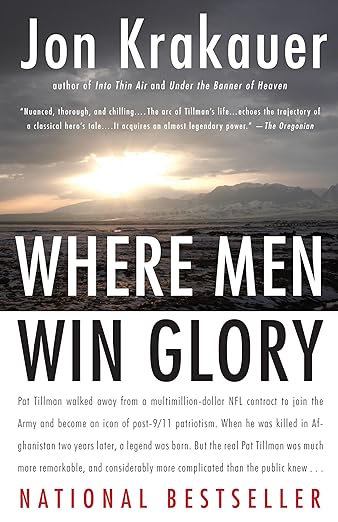
Why does a man walk away from a multimillion-dollar NFL contract to enlist, and what does that decision reveal about how a country constructs its myths of sacrifice? Jon Krakauer's audiobook about Pat Tillman sits at the intersection of biography, military history, and media criticism, and it refuses to let any of those frames dominate completely. Tillman is the center of the book, but Krakauer is also writing about how the American government chose to use his death, how the Army covered up the friendly fire circumstances for five weeks while his name was deployed in public speeches, and what that gap between the private person and the public martyr reveals about the institutions that created him. Scott Brick narrates with the measured authority that Krakauer's investigative journalism requires.
Tillman himself resists the mythology Krakauer is simultaneously dismantling. He was a complex person who called the Iraq war 'illegal as hell' in private correspondence while still completing his three-year commitment. He was driven by notions of duty and masculine pride that he also subjected to genuine scrutiny. He was not the simple patriotic icon the post-mortem coverage made him, and Krakauer is careful to present the contradictions honestly rather than replacing one simplified narrative with another. The real Tillman is more interesting than the martyr, and that is Krakauer's central argument.
The structural choice of weaving Tillman's biography with a history of Afghanistan is essential to the book's argument. Without that larger context, Tillman's death is a tragedy. Within it, the friendly fire incident and the institutional cover-up that followed become readable as something that reveals how military and political systems process inconvenient truths. Krakauer gives you both scales simultaneously, and Brick's narration keeps the transition between them clear without flattening the tonal difference between biography and geopolitical history.
Krakauer's investigative method here is the same one he used in Into Thin Air and Into the Wild: sustained close attention to a specific person and event that opens outward into something much larger. Where Men Win Glory is his most politically engaged book, and the anger that runs underneath the precision is never allowed to distort the factual record he is building.
What Jon Krakauer Gets Right
Scott Brick is one of the most reliable narrators for this kind of investigative nonfiction. He does not editorialize through tone, he does not let his evident sympathy with Tillman distort the neutral register that Krakauer's methodology requires, and his pacing through the complex interleaving of biography and geopolitical history keeps both threads accessible. For a book that covers an enormous amount of factual ground across multiple time periods and institutional layers, the audio version requires a narrator who can be trusted to keep the listener oriented without sacrificing pace. Brick does that consistently throughout.
The audiobook is also a more powerful format than print for certain sections of this book, particularly the account of the firefight in which Tillman died and the chaotic, evolving understanding of what had happened in its immediate aftermath. Brick's narration of those sections carries an urgency that print can suggest but audio delivers more directly. Krakauer is a writer who understands how to build narrative momentum in investigative nonfiction, and those skills translate exceptionally well to the audio medium.
Where Jon Krakauer Loses Some Ground
Listeners who come to this audiobook expecting a straightforward sports biography, drawn by Tillman's NFL career, may find the Afghanistan history sections initially surprising in their scope. Krakauer spends significant time establishing the country's history through the twentieth century, the Soviet invasion, the rise of the Taliban, and the context that makes the post-9/11 American intervention comprehensible as a political decision. This is not a digression but an argument: Tillman's death is only fully legible against that background, and the cover-up is only shocking if you understand what the Army was trying to protect and why that protection felt necessary to the people making those decisions.
The book's treatment of the Army's institutional behavior in the weeks after Tillman's death is detailed and unsparing. Krakauer documents the chain of command decisions and communications that kept the friendly fire information from Tillman's family and the public, and the portrait that emerges is of an institution protecting itself rather than honoring the person whose name it was using. Some listeners find this dimension of the book disturbing in ways that go beyond the tragedy of Tillman's death itself.
Who Should Pick Up Where Men Win Glory
This audiobook is essential for listeners interested in the real history of the post-9/11 wars, in the gap between how the American military presents itself publicly and how it functions institutionally, and in biography that refuses to simplify its subject. Fans of Krakauer's previous investigative books will recognize his method here. Where Men Win Glory is his most demanding work in terms of the historical context it requires the reader to hold, and Brick's narration is what makes that demand manageable.
For sports readers who followed Tillman's career and are looking for a book that honors his complexity, this audiobook delivers that while asking more of its listeners than a conventional sports biography would. The investigation into how his death was managed, obscured, and then partially corrected is the part of the story that most sports biographies would not tell, and Krakauer tells it with precision. Brick keeps the material moving across the full thirteen-hour runtime.
Where Men Win Glory is also a book about what soldiers are asked to be for a country and what the country owes them in return, and the answer Krakauer documents is uncomfortable. That discomfort is not incidental to the listening experience. It is the point.
Good to Know
Do I need to be familiar with Afghanistan's history to follow this audiobook?
No. Krakauer builds the necessary context into the narrative, spending significant time on Afghanistan's history through the twentieth century. Prior knowledge enriches the experience, but the audiobook is self-contained.
How does this audiobook compare to Krakauer's other books for listeners who are new to his work?
Where Men Win Glory is his most politically engaged and investigatively complex work. Into Thin Air and Into the Wild are more purely narrative and may be more accessible starting points. However, listeners drawn specifically to the Tillman story will find this audiobook fully rewarding without prior Krakauer experience.