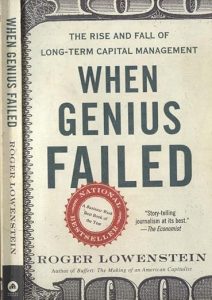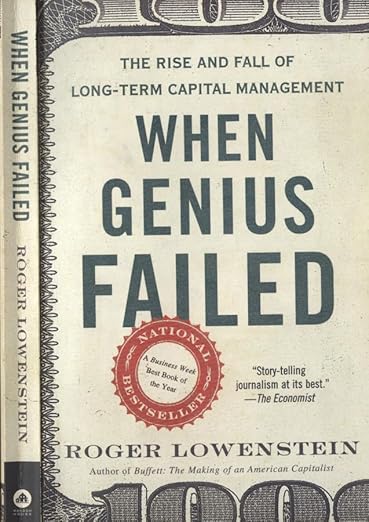
Random House sits in the publisher slot, an ISBN occupies room a production credit could have used, and the date given reads January 1, 2000. Every field on this page was lifted from a paperback. What you are buying instead is nine hours and twelve minutes of audiobook about the most instructive financial collapse of the 1990s, sold from a listing with almost nothing to say about the recording. Worth knowing before you press play, since it shapes what can be checked in advance and what cannot.
Roger Lowenstein had one of the great business stories of the era to work with, and the reporting knows it. John Meriwether spent the 1980s at Salomon Brothers building what the copy calls the best and brainiest bond arbitrage group in the world, a shy midwesterner surrounded by PhDs who gave him something the description calls filial devotion and who made him spectacular money. A scandal involving one of his traders ended that in 1991. His team spent two years convinced their chief had been treated unfairly, and in 1993 he came back with an offer.
That offer became Long-Term Capital Management, and the shape of what follows is visible from the first minutes. Meriwether gathered his former disciples plus a handful of academic economists, two of them future Nobel winners, and opened in Greenwich, Connecticut, miles from the pandemonium of Wall Street. The firm treated the big investment banks with open disdain. Those same banks lined up to finance it on the sweetest terms available, which is the detail that tells you everything about how reputation functioned in that decade.
Nine Hours of Dramatic Irony, No Charts Needed
Character is what makes this work as audio, and Lowenstein builds it patiently. The story is not really about arbitrage spreads; it is about a group of extremely intelligent people who believed their models had tamed risk itself and could let them bet on the future with something close to mathematical certainty. Belief is a human subject. Listening to it accumulate, in a room full of people whose credentials made doubt feel unnecessary, is far more compelling than any account of the trades themselves could be.
Dramatic irony does the rest of the work. The title tells you how this ends before the first chapter starts, which converts every confident decision into something you listen to with a wince, and that tension holds across nine hours without a single reveal being needed. Investors handed over millions on the strength of the cast list. The fund promised that simultaneous positions would cancel each other's risk. Knowing the destination makes the early triumphs land as warnings rather than as achievements.
Narrative nonfiction is also the format that survives audio best, and this book is narrative all the way down. No charts need consulting, no equations require staring at, and the technical vocabulary arrives inside scenes rather than in exhibits. Nine hours and twelve minutes sits at ordinary length for a trade hardback of this kind, and the reporting is dense enough that the runtime never feels like padding.
Mangled Punctuation and a Duplicated Byline
Now the damage. The description on this record has had its punctuation mechanically removed: apostrophes and periods are simply gone, so it offers phrases like plotted their boss s return, a group of Ph D certified arbitrageurs, and Long Term s aura, running sentence into sentence with nothing to mark where one stops. It also breaks off mid-clause while describing how little concern the partners had about borrowing. None of that reflects the book. All of it reflects a page nobody has read since it was generated.
Two fields deserve a closer look as well. The title field carries no subtitle, though the description is entirely about the rise of one hedge fund, so anyone searching for the fund by name may never reach this page. And the reader field repeats the byline exactly. On a record where the publisher, the language and the identifier all come from a paperback, a reading credit that simply duplicates the author line is the weakest kind of evidence, and no other field on the page corroborates it.
Vintage matters too. This is reporting on events of the 1990s, published as a book at the turn of the century, and nothing on the record indicates a later edition, an afterword or updated material. Everything that has happened in finance since arrives from the listener rather than the text. That is not a defect. It does mean the parallels people usually reach for when recommending this title are parallels you will be drawing yourself, unassisted.
Watching Smart People Fail in Slow Motion
This one lands for anyone who likes watching smart people walk into a wall in slow motion, which is a broader audience than the finance shelf implies. No trading background is needed. The pleasures on offer are the pleasures of a good disaster narrative: a founder with a grievance, a loyal circle who followed him out of one firm and into another, prestige operating as collateral, and an institution so certain of its own arithmetic that nobody asked what happened if the arithmetic was wrong.
Give it a miss if you want the mechanics explained rather than dramatized, since the interest here sits with the people rather than with the positions, or if you need a current book about current markets, because this one stops where its own decade stops. Buyers who require certainty about the edition should also check the details panel before purchase, given how little of this page describes the recording rather than the paperback that preceded it.
Questions Listeners Ask
How long is the When Genius Failed audiobook and what does the listing actually confirm?
The runtime given is nine hours and twelve minutes. Almost everything else on the record belongs to the printed edition: a Random House publisher line, an ISBN, and a date of January 1, 2000. No production credit, no recording date and no abridgment statement appear anywhere.
Do I need a finance background to follow this audiobook?
No. The description pitches a story about people rather than a technical account, following a trader from Salomon Brothers into a hedge fund he built with academic economists. Terms like arbitrage and hedging arrive inside the narrative, so anyone comfortable with a business story will keep up.
Does the description explain how Long-Term Capital Management ended?
It does not. The text stops mid-sentence while describing how freely the partners borrowed, so the collapse promised by the title is never reached in the copy. Anyone hoping the product page will summarize the outcome will have to take the title at its word instead.
Is this the complete book, and does the recording come with any print extras?
No abridgment statement appears anywhere on the record, and the runtime is consistent with a full trade nonfiction title. No companion file, appendix or notes are listed either, which costs little in a book driven by people and decisions rather than by tables and exhibits.