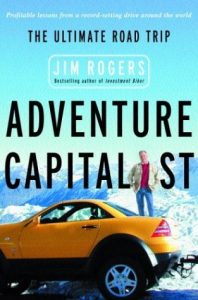
Jim Rogers set the Guinness World Record for the longest continuous car journey, covering 116 countries between 1999 and 2001 in a custom-built sunburst-yellow Mercedes convertible alongside his fiancee Paige Parker, starting on January 1st from Iceland. That is the kind of fact that establishes the frame immediately. Adventure Capitalist is not a conventional investment book that happens to involve travel. It is a road journey of unusual ambition documented by someone whose professional lens is permanently set to economic and political analysis, and the combination produces something that no standard finance audiobook or standard travel memoir can replicate on its own.
At twelve hours and eight minutes, Paul Boehmer's narration carries Rogers's observations across 116 countries without the exhaustion that travelogue format can sometimes produce in audio. Boehmer works with the sprawling structure by maintaining consistent forward momentum, respecting the episodic nature of the journey without treating each country as a discrete segment. The investment observations, which Rogers embeds throughout rather than reserving for a final analysis chapter, feel like genuine in-the-moment assessments rather than retrospective analysis put together after the fact.
Talking to Black Marketeers Instead of Ministers
Rogers's method of economic understanding is unambiguous: he distrusts briefings and favors conversations with black marketeers and brothel madams over meetings with foreign ministers. That approach, which he states directly and defends without apology, shapes every country portrait in the book. He is looking for what is actually happening in an economy, not the official presentation, and the ground-level access that comes from driving through rather than flying in is the enabling condition for that kind of observation. Time magazine called him the Indiana Jones of finance, and the label fits the methodology.
The investment predictions embedded throughout the book are numerous, and their track record is mixed in ways that have become clearer with the passage of time since the journey. His early call on China's twenty-first-century dominance was correct. His prediction about the euro being doomed to fail was not, at least not in the timeline he implied. His commodity bull market call, which was early by some years, eventually proved accurate. Rogers presents these assessments with the confidence of someone who knows he will be wrong on some and right on others and thinks that calling shots directly is more useful than hedging everything into uselessness.
Boehmer Keeps a Straight Face Through Sudan and Angola
The travelogue dimension of the book is engaging partly because Rogers writes about places with the combination of genuine curiosity and frank judgment that most travel writers avoid. He drove through war zones, Sudan, Congo, Angola, East Timor, at a time when those were not safe destinations, and his accounts are neither sensationalized nor sanitized. The culinary adventures, silkworms and iguanas and grasshoppers and crocodile, are narrated with the same pragmatic directness as the political assessments. Boehmer delivers all of it with an appropriate absence of dramatic inflation.
Multiple reviewers specifically cite Angola as an example of Rogers seeing investment potential where conventional wisdom saw only risk. That pattern of contrarian assessment, identifying value in places widely written off, is the book's most consistent intellectual contribution. Even where his specific predictions have aged imperfectly, the method of seeking ground-level reality against received geopolitical narrative remains instructive. One longtime Rogers follower identifies Adventure Capitalist as his favorite of all Rogers's books, and the breadth of the journey explains why: it is the fullest expression of his methodology applied across the widest possible range of contexts.
A 2003 Snapshot Now Read as History
The book was published in 2003 based on a journey from 1999 to 2001, which means readers should approach its specific political and economic predictions as a historical document rather than current guidance. Many of the country assessments, particularly regarding Central Asian states, South American economies, and Southeast Asian markets, describe conditions that have changed substantially. That temporal distance does not reduce the book's value. It converts it from prescriptive to analytical, asking listeners to evaluate Rogers's framework against what actually happened rather than simply accepting his conclusions.
The structure follows the journey geographically rather than thematically, which means the insights are embedded chronologically across twelve hours rather than organized by investment category or country type. Readers expecting a structured investment thesis will need to extract those observations from the travel narrative. That is not a weakness so much as a feature of the project: Rogers's point is that the travel and the investment observation are inseparable, that you cannot understand a market from a database.
Investment Biker Fans Will Want This Next
Investors with global perspective who want a first-person, ground-level account of how economies look from inside their borders, filtered through one of the more successful contrarian investment minds of the late twentieth century, will find this audiobook consistently rewarding. Rogers fans who have read Investment Biker will find Adventure Capitalist broader in geography and bolder in its predictions. Armchair travelers drawn to accounts of remote, difficult regions described without the defensive hedging of cautious travel writing will find Rogers's directness refreshing.
Listeners expecting a systematic investment framework or structured financial advice will find the travelogue format disappoints those expectations. The observations are brilliant in parts and dated in others, and they require the listener to do the analytical work of separating durable methodology from period-specific calls. If Rogers's brand of opinionated globalism does not appeal on the first chapter, twelve hours will not change that assessment. Boehmer's narration is a real asset across the full runtime, keeping the episodic structure from losing momentum during the longer country stretches and maintaining Rogers's voice with enough authority that the contrarian confidence never tips into bluster.
Frequently Asked Questions
Does Paul Boehmer's narration do justice to Jim Rogers's particular voice and opinions in this audiobook?
Boehmer brings steady authority and strong pacing to Rogers's dense, opinionated material. Rogers has a distinctive rhetorical style, confident and contrarian, that benefits from a narrator who delivers it without irony or excessive drama. Boehmer stays within the travel-journalism register throughout, which serves the material well across twelve hours.
How should listeners approach the investment predictions in the Adventure Capitalist audiobook given that it was recorded over twenty years ago?
As a historical record and a methodology study rather than current guidance. Some of Rogers's calls, including China's economic rise and the commodity bull market, proved correct over time. Others, like the euro prediction, did not pan out as described. The book is more valuable for the framework of ground-level economic observation than for any specific prediction.
Is the Adventure Capitalist audiobook better approached as a travelogue or as an investment book?
Both simultaneously, which is the point of the project. The investment observations are embedded in the travel narrative and cannot be cleanly separated from it. Rogers's thesis is that you understand markets by moving through them at ground level, so the travelogue is the investment methodology made physical. Readers who want to separate the two will find the format resists that separation by design.
Does a listener need to have read Rogers's earlier book Investment Biker before listening to the Adventure Capitalist audiobook?
No prior reading is required. Adventure Capitalist stands alone as an account of a different journey. Readers familiar with Investment Biker will recognize the format and Rogers's observational method. Both books share the same approach at different scales, but Adventure Capitalist covers greater geographic breadth and makes bolder macroeconomic calls.