
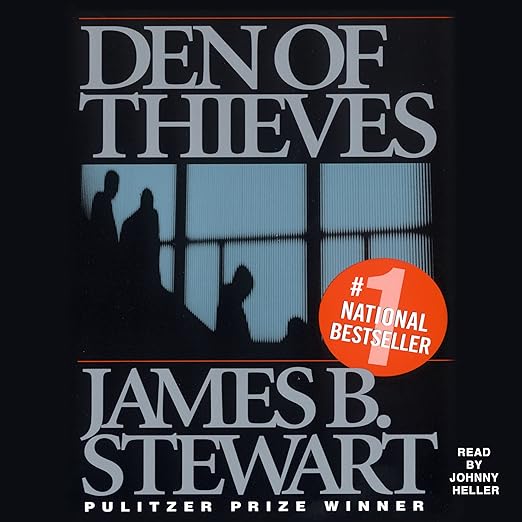
James B. Stewart won a Pulitzer Prize before writing this audiobook, and the synopsis leans on that credential directly, crediting him with showing 'for the first time' how four of Wall Street's biggest names in the 1980s, Michael Milken, Ivan Boesky, Martin Siegel, and Dennis Levine, built what it calls 'the greatest insider-trading ring in financial history,' and nearly walked away with billions before 'a team of downtrodden detectives' triumphed over 'some of America's most expensive lawyers' to bring the four men to justice.
Ken B's review adds a detail the synopsis leaves out: Stewart himself was 'a Wall Street Journal reporter' who covered these same financiers' 'criminal actions' in real time before turning the material into this book. Stephan Campbell's review traces that timeline even further, crediting Stewart with exposing the four men's conduct roughly twenty-five years after his original Journal coverage began, a level of firsthand access melmwood's review credits with making the account 'incredibly detailed and wonderfully laid out.'
Melmwood's own account does raise one specific caveat worth noting inside an otherwise glowing review: a suspicion that some of Stewart's quotes are 'not 100% accurate but rather word-of-mouth,' a rare moment of pushback rather than uncomplicated praise. It is a fair thing to flag in a book built substantially on reconstructed dialogue and courtroom testimony rather than recordings, and Stephan Campbell's review situates those same four figures inside a wider web of 'quid pro quo relationships,' language that echoes the synopsis's own description of insider trading as a systemic problem rather than four isolated bad actors.
One rating stands behind the 4.5 shown on this listing, and a single whole-star vote cannot produce a decimal average like that under any counting method, so the badge does not reconcile with its own vote count. Five separate written reviews sit below that single counted rating, four perfect fives and one four-star account from Ken B, which makes the gap between the counter and the visible activity on this page unusually wide for a book this well documented elsewhere.
Johnny Heller narrates nearly twenty hours covering a cast of real financiers, courtroom proceedings, and grand jury testimony, a demanding assignment given how many named figures, Milken, Boesky, Siegel, Levine, and the investigators pursuing them, move through the story. Whether that reading serves the material well is not something any of the five accounts addresses; all five stay fixed on Stewart's reporting and the case itself.
The Author Seems to Read Your Mind
Melmwood frames this as essential listening for anyone interested in Wall Street history, ranking it above 'Liar's Poker,' a previous favorite in the same category, specifically for how thoroughly Stewart traces the backgrounds of nearly every figure involved. Izzy's review goes further, describing the experience as one where the author seems to have 'read your mind' by anticipating exactly the questions a listener would have at each turn, and closes by recommending it directly to anyone trying to understand 'how the world of finance work.'
Financial specifics carry real weight throughout: Ken B notes the account is 'fact based and documented from public sources' rather than speculative, comparing the finished result to 'a good movie script' built from courtroom records and newspaper coverage rather than invention. For listeners who want their true crime grounded in trading records and grand jury transcripts rather than dramatized guesswork, that sourcing is the book's clearest selling point.
The Condition Was as Described, Nothing Else
Charles Perdue's review, the newest on file, arrived February 2, 2026, and it reads like a note about a used paperback rather than a nearly twenty-hour audiobook: 'The condition was as described,' with no mention of Stewart's writing, the financial scandal, or Johnny Heller's narration at all. It is a reminder that a five-star rating on this page does not always mean the reviewer engaged with the actual content, financial or otherwise, sitting behind the cover art.
Four genre tags stack up on this listing at once, Biographies & Memoirs, Business & Careers, Money & Finance, and Mystery, Thriller & Suspense, reflecting how thoroughly the book straddles categories, part financial history, part courtroom drama, part character study of Milken, Boesky, Siegel, and Levine. A listener searching under just one of those genres might miss it entirely, since nothing about the listing privileges one classification over the others. The synopsis closes by calling the finished book 'a portrait of human nature, big business, and crime of unparalleled proportions,' a description broad enough to cover the courtroom procedural, the character study, and the financial history all at once.
More than one review also breaks off before a full conclusion: melmwood's account cuts out mid-word discussing whether Stewart's quotes hold up, and Stephan Campbell's cuts out mid-word describing the 'groundwork of greed' the book traces. Treat both as partial impressions rather than complete verdicts on the book's own reliability.
Steer Clear if Nearly Twenty Hours Feels Tedious
Readers of financial true crime, especially anyone who has already read 'Liar's Poker' and wants a companion account of the same Wall Street era, are the clear audience melmwood's review has in mind. Business and finance listeners who want scandal explained through actual grand jury transcripts and trading records, rather than a dramatized retelling, will find exactly what Stewart, and Ken B's review, both describe. Simon & Schuster Audio backs the release, and the $0.00 price tag says nothing about the scope of a production covering nearly twenty hours of original reporting distilled from grand jury transcripts, interviews, and actual trading records.
Steer clear if courtroom-level financial detail across nearly twenty hours sounds tedious rather than compelling: this rewards patience with names, dates, and trading mechanics more than it delivers fast-moving thriller pacing.
Good to Know
Does this audiobook require a background in finance to follow the insider trading scheme?
Not according to the reviews on file: Ken B specifically praises how the book stays 'fact based and documented' without assuming specialized knowledge, and Izzy credits Stewart with anticipating exactly the questions a general listener would have. The story is built around named individuals and courtroom events rather than technical trading theory, which keeps it accessible.
Why does this audiobook show only one rating despite five written reviews?
That gap goes unexplained on the page itself: a single counted vote cannot mathematically produce the 4.5 average shown, yet five written accounts, four of them perfect fives, sit visibly below it. No further arithmetic will change what's actually there, one counted rating and five detailed reviews that the listing never reconciles.
Is the true crime label accurate for this audiobook, or is it more of a business biography?
Both, honestly: the listing carries four genre tags at once, including Business & Careers, Money & Finance, and Mystery, Thriller & Suspense alongside Biographies & Memoirs. The book itself blends courtroom drama with detailed financial history, so listeners approaching it purely as a business text or purely as true crime will each find plenty of what they came for.
Will listeners need to read Liar's Poker first to understand this audiobook?
No, though reviewer melmwood mentions it as a point of comparison, calling this book a new favorite that surpasses that earlier one. The two are separate accounts of the same Wall Street era rather than connected volumes, so this audiobook stands on its own without requiring outside reading.







