
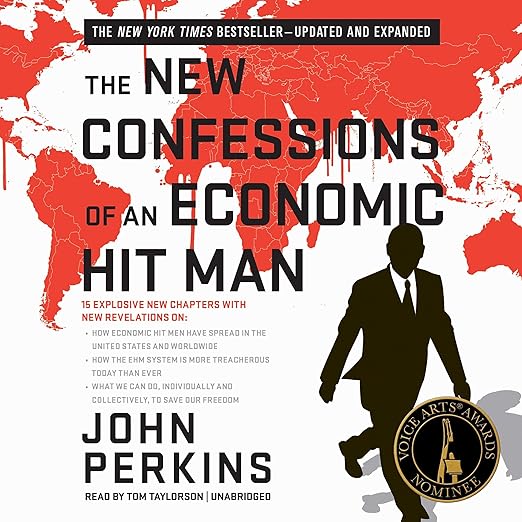
Fifteen new chapters separate this audiobook from whatever earlier edition made Perkins' book a New York Times best seller in the first place, and the synopsis is upfront about the goal: not just an update, but an expansion. The tactics that once targeted only distant, strategically useful countries are now, in Perkins' own account, active inside the United States as well, which is the specific claim this new material is built to support.
The U.S. Playbook China Is Now Following
Perkins defines his own former job plainly in the synopsis: an economic hit man is a highly paid professional who helps cheat countries out of enormous sums using "fraudulent financial reports, rigged elections, payoffs, extortion, sex, and murder." His personal tool of choice was debt, specifically talking strategically important countries into borrowing far more than they could handle for "development" projects that mostly served wealthy interests while pushing the borrowing nation deeper into poverty. Once a country owes that much, the synopsis argues, it can be controlled through the debt itself rather than through anything as visible as occupation. BobSK's review points to a specific claim from inside the book itself that the shorter synopsis never mentions: that China is now "following the footsteps of the U.S." and using the same approach on "poor and unsuspecting countries," which the review treats as confirmation that the pattern Perkins describes has simply changed which country is running the playbook.
Newer material in this edition pushes that argument further, applying the same "death economy" framework Perkins describes to the domestic United States rather than treating it as an export-only phenomenon, a shift the synopsis frames directly as evidence that "the cancer has metastasized." Fear and debt are named as the two engines driving the whole system, alongside a longer list that includes "false economics, bribes, surveillance, deception, debt, coups, assassinations, and unbridled military power." The synopsis does pivot away from pure despair by its close, promising "dozens of specific, concrete suggestions for actions all of us can take" toward what Perkins calls a life economy instead. Whether that turn toward solutions lands depends heavily on how convinced a listener already is by the diagnosis that comes before it.
Taylorson Keeps Twelve Hours of Argument Listenable
Tom Taylorson narrates alone across twelve hours and twenty-two minutes of dense political and financial argument, a format that rewards a narrator who can keep long chains of geopolitical reasoning legible without either rushing past the detail or draining the urgency out of it. Content this dependent on specific facts, dates, and figures needs a steady hand to stay listenable across a runtime this long, since a narrator who leans too hard into outrage risks flattening the argument into a single note stretched across twelve hours.
Reviewers who came in already primed for the book's argument found plenty to confirm it. BobSK writes plainly that the material was "not an eye opener" personally, framing it instead as validation of suspicions already held, and draws a direct line to present-day China "following the footsteps of the U.S." in exactly the pattern Perkins describes. Guapx takes a more measured position, praising the "substantial list of sources" Perkins provides to back up the claims and noting that the book balances its darker material with "lots of practical steps we can make to see lasting transformation," calling the overall message "clear and compelling" even while flagging some rough edges elsewhere. Ammar Salahuddin's shorter review lands on a similar note, describing the book as "incredibly informative" about how capitalism and conquest are more intertwined than a casual reader might assume.
Jetting Around the World After the Wealth Arrived
Reception is not uniformly airtight, either. Guapx, despite praising the sourcing, also calls the "writing quality... average" and suggests the author "borders on hubris" at points, a real tension between admiring the argument and being skeptical of its messenger. Tom Connor's three-star review pushes harder in that direction, accusing Perkins of a specific hypocrisy: jetting around the world preaching environmentalism, in Connor's telling, only after accumulating substantial wealth from the very system the book condemns, and drawing an unflattering comparison to Al Gore along the way. That accusation does not appear anywhere in the synopsis, which makes it a useful reminder that the marketing copy and the actual listener reaction to the book are not always telling the same story.
A single review, from macr88, is worth reading with extra caution rather than as a straightforward account of the book. It refers to the material at one point as "this movie," calls the judicial system corrupt in terms that drift well past anything Perkins' synopsis actually claims, and cites something called the "Supreme Saw of the Land," phrasing that does not match any legal terminology the rest of the record uses. Whatever prompted that particular review, it reads as only loosely connected to the audiobook the other four reviews describe, and a listener should weigh it accordingly rather than as a fifth confirming voice.
The Ideal Listener Already Suspects Most of This
Readers already inclined to distrust international lending institutions, or curious about the mechanics behind sovereign debt as a tool of leverage, will find a narrator willing to name names and describe specific tactics rather than speak only in generalities. The updated material aimed at the United States gives returning readers of the earlier edition a genuine reason to revisit the book rather than just a repackaged reissue. Ammar Salahuddin's brief review suggests the core argument also lands with listeners who are simply curious about the relationship between capitalism and global power more broadly, without needing prior background in international finance to follow along.
Readers who want rigorously neutral economic analysis, free of a strong personal point of view, should factor in Guapx's warning about occasional hubris before committing twelve-plus hours to one man's account of his own career. Anyone hoping for polished literary prose over blunt, information-dense argument may also find the writing serviceable rather than memorable, per that same review. BobSK's account suggests the ideal listener already suspects most of this and wants the specifics filled in, rather than someone hoping to be persuaded from a neutral starting point.
At a Glance
- Voice: Tom Taylorson narrates alone across twelve-plus hours of dense financial and political argument, with no co-narrator to share the load.
- Big ideas: Sovereign debt as leverage, corporate imperialism, the death economy versus the life economy
- Atmosphere: Urgent, dense, and unapologetically one-sided
- Worth it?: Better for listeners who already suspect the worst about global finance than for anyone hoping to be persuaded from scratch.
What does this audiobook add to the earlier edition of Perkins' book?
The synopsis describes fifteen new chapters that extend the original argument into the present day, focused specifically on economic hit man tactics now operating inside the United States rather than only in strategically targeted foreign countries. The newer material also expands on what Perkins calls a death economy, paired with his proposed alternative, a life economy.
Does this audiobook require background knowledge of international finance to follow?
Not based on the reviews available. Ammar Salahuddin's account suggests the core argument about capitalism and conquest comes through clearly without specialist knowledge, though the twelve-hour-plus runtime does move through a lot of specific detail, so listeners unfamiliar with the general subject may want to stay attentive rather than listen passively.
Should listeners trust every review attached to this audiobook equally?
Probably not. One review, from macr88, refers to the material as a movie at one point and cites a phrase, Supreme Saw of the Land, that does not match standard legal terminology anywhere else in the record. The other four reviews describe a consistent, if debated, nonfiction account, which makes that one outlier worth reading skeptically.







