
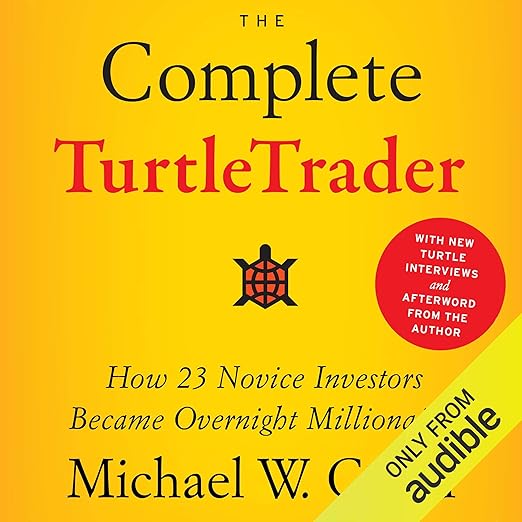
I came across the Turtle Trading story years ago in a footnote in another trading book, and the description was impossible to dismiss: a veteran trader runs a classified ad in the Wall Street Journal asking ordinary people to apply to trade futures with his money, teaches them his rules over two weeks, then sets them loose with a million dollars each. The whole thing sounded like a thought experiment someone had accidentally made real. The Complete TurtleTrader is the first account of that experiment built on actual interviews with the participants, and the result is stranger and more instructive than the legend suggests.
Richard Dennis made his initial fortune in commodity futures during the 1970s and early 1980s, operating on the conviction that great trading was a learnable skill rather than innate talent. His partner William Eckhardt was skeptical. The bet they made to settle the question generated the Turtle experiment, which eventually produced $100 million in profits for Dennis from the recruits he trained. Michael W. Covel, who runs TurtleTrader.com and has spent years tracking the participants, builds the story from these primary sources rather than secondhand accounts.
The book succeeds because Covel understands that the Turtle story is not really about trading rules. It is about what happens when a rigorous system meets human psychology at scale, and why some people who learned the identical rules thrived while others failed. The recruits included a professional blackjack player, a pianist, a fantasy game designer, and a number of people with no financial background whatsoever. They were bright and driven, as one reviewer noted, but the ambition required to survive the selection process was itself a pre-screen for certain characteristics. The nature versus nurture question the experiment was designed to answer turns out to be more complicated than either Dennis or Eckhardt initially framed it.
The trading mechanics themselves are explained clearly enough that readers without financial backgrounds can follow the principles, though Covel is less interested in making you a Turtle than in helping you understand why the system worked and where individual variation entered the picture. One reviewer who had spent years reading investment books specifically praised the chapter that breaks down how position sizing and risk management actually functioned.
What Stands Out
Joel Richards narrates with the clarity and pacing that financial history requires. The book covers a substantial timeline, from Dennis's early career through the experiment itself and into the subsequent lives of the individual Turtles, and Richards keeps the momentum consistent across ten hours. The storytelling quality is high enough that one reviewer described the book as entertaining independently of its financial content, which is accurate. The human material is genuinely interesting.
Covel's decision to interview the Turtles on the record gives the book a specificity that trading mythology usually lacks. Individual stories diverge sharply: some Turtles became enormously successful hedge fund managers; others had more complicated trajectories. The follow-through adds a layer of accountability to the experiment's conclusions that secondhand accounts cannot provide.
Weak Spots in The Complete TurtleTrader
One thoughtful reviewer noted skepticism about the book's conclusion that nurture definitively beats nature across the board, arguing that the students selected were already both bright and highly motivated, and that this selection effect complicates the experiment's claim. That is a fair reading of the data, and Covel does not entirely escape this critique. The experiment showed that skills can be taught to highly selected individuals. Whether those same rules would work for an arbitrary sample of applicants is a different question.
The book includes accompanying reference material noted in the Audible listing, available in the listener's library. This is worth accessing if you want the actual trading parameters referenced during the audio.
Best Suited For
Anyone curious about the psychology of financial markets without needing technical training to access the story. Investors and traders who want historical perspective on systematic versus discretionary approaches. Readers who enjoy financial narratives in the tradition of Liar's Poker or The Big Short, where the human story carries as much weight as the mechanics. The book is accessible enough for complete financial novices; one reviewer described it as specifically for non-traders who can still find it highly entertaining and informative. That claim holds up.







