Quick Take
- Narration: Joe Ochman delivers Taleb’s combative, discursive prose with steady clarity, navigating the tonal swings between polemic and parable without losing the listener.
- Themes: The limits of prediction, narrative fallacy and hindsight bias, robustness in the face of radical uncertainty
- Mood: Provocative and energizing, occasionally maddening in the best sense
- Verdict: One of the genuinely consequential books in popular epistemology, made more useful in this second edition by the added essay on robustness and fragility.
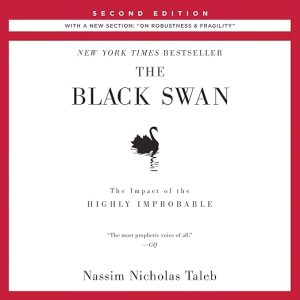
I first read The Black Swan during a period when I was reviewing a lot of business and finance titles for a cultural magazine, and I was primed to be skeptical. Books that promise to change the way you see the world usually change very little. What Nassim Nicholas Taleb actually delivered was something rarer: a sustained argument that made me uncomfortable with how I construct explanations for things after they have already happened.
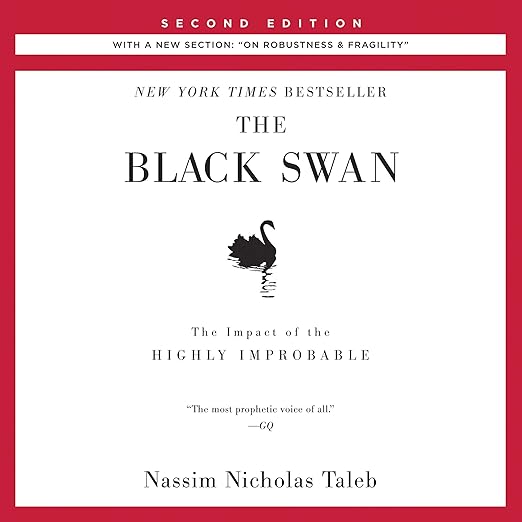
I came back to it in audio form recently, specifically to hear how the second edition material holds up. The added essay, On Robustness and Fragility, sits at the back of the main text and represents Taleb’s early thinking on what would become Antifragile. It is worth the revisit.
Our Take on The Black Swan Second Edition
The core thesis is deceptively simple: highly improbable events have disproportionate consequences, we systematically underestimate their likelihood, and after they occur we construct stories that make them seem inevitable. Taleb calls this the narrative fallacy, and it is one of the more useful concepts to carry around in daily life. He distinguishes between Mediocristan, the world of the predictable and the gaussian, and Extremistan, where a single outlier can dwarf everything that came before it. The examples he reaches for, Google’s rise, 9/11, the dominance of a single bestselling book in a market of ten thousand, are now familiar, but when this book was published in 2007 the argument was bracing.
The Wall Street Journal described reading it as romping through the follies of confirmation bias and narrative fallacy alongside Taleb, and that captures the tone. He is not writing academic prose. He is writing the way an opinionated friend talks when he is absolutely certain he is right and is enjoying the argument. That quality is part of the book’s power and part of what can make it grating in long listening sessions.
Why Listen to This Particular Edition
The second edition adds the robustness and fragility essay, which is where Taleb begins to sketch the idea that the correct response to a Black Swan world is not better prediction but better system design. This is the intellectual thread that becomes Antifragile, and hearing it in embryonic form alongside the original argument is genuinely illuminating. If you have already read the first edition in print, this is what justifies the audio revisit.
Joe Ochman handles the narration with competence. Taleb’s prose is built for provocation, not for smooth listening. The parenthetical asides, the discursive footnotes-within-paragraphs, the sudden pivots from anecdote to epistemology all demand a narrator who can hold register without sounding lost. Ochman manages this, though the experience works better in shorter sessions than as a marathon listen.
What to Watch For in Taleb’s Argumentative Style
The economist reviewer Emmanuel from Mexico noted feeling somewhat attacked by the book, and that is an experience Taleb is deliberately engineering. His critiques of academic economists, forecasters, and risk management professionals are pointed and not always fair in their specifics, even when they are correct in their broader thrust. The tendency to overstate to make a point is present throughout, and listeners who want every claim to be precisely calibrated will find this frustrating.
What Taleb does brilliantly is make you aware of a cognitive architecture you did not know you were operating with. The idea that we learn specifics when we should be learning generalities, that we overweight what we know and cannot account for what we do not, is delivered with enough variation in angle and example that it accumulates into genuine persuasion rather than mere repetition.
Who Should Listen to The Black Swan
This is valuable for anyone working in environments where prediction is treated as more reliable than it is, which includes most professional environments. Investors, policy thinkers, and people in any field that uses forecasting models will find the arguments directly applicable. Readers who prefer their big ideas delivered with humility rather than combativeness may find Taleb’s mode exhausting, but the underlying argument is too important to skip for stylistic reasons.
Frequently Asked Questions
Does the second edition differ significantly from the original 2007 text?
The main addition is the essay On Robustness and Fragility, which lays groundwork for ideas Taleb develops fully in Antifragile. The core argument of the original book is unchanged.
Is The Black Swan part of a series and should I read the others first?
It is book two in the Incerto series, but it works completely as a standalone. Fooled by Randomness covers related ground and is worth reading alongside it, but neither is a prerequisite for the other.
How does Joe Ochman handle Taleb’s footnote-heavy, discursive style in audio?
Reasonably well. The audiobook omits some tabular material (a bonus PDF is included), but the argumentative flow translates to audio better than you might expect, especially in focused listening sessions of under an hour.
Is this book as relevant now as it was when first published in 2007?
Arguably more so. The events of 2008, 2020, and beyond have provided extensive real-world illustration of Taleb’s core claims about tail risk and systemic fragility. The arguments have not aged out.