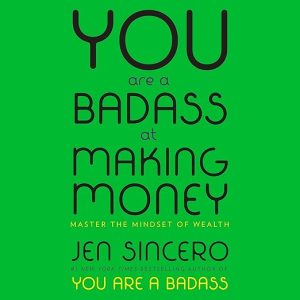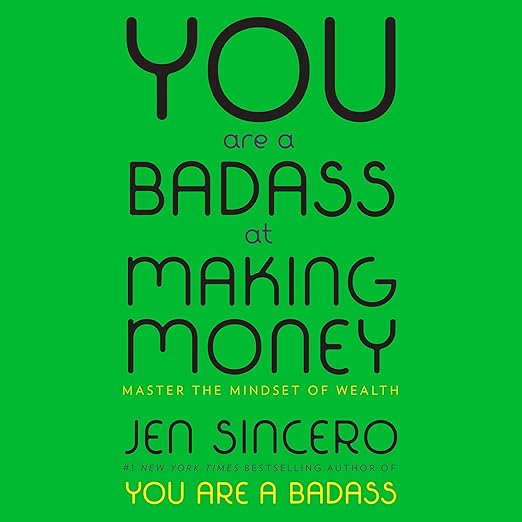
Quick Take
- Narration: Jen Sincero narrates her own book, and that choice matters more here than it would in most cases. Her irreverence and timing are impossible to replicate.
- Themes: Money mindset, limiting beliefs, the psychology of financial abundance
- Mood: Energetic, irreverent, and occasionally evangelical, with genuine humor cutting through the self-help earnestness
- Verdict: A money mindset book that works for people who need to change their relationship to wealth before they can change their bank account, and that is more self-aware about its own genre than most.
I first heard about this book from a colleague who described herself as someone who knew all the practical finance stuff but kept doing nothing with it. She had listened to You Are a Badass at Making Money twice in a single month, which I found more interesting than any five-star review. The kind of reader who returns to a book is telling you something the rating system cannot.
Jen Sincero is a funny writer. That is not a backhanded compliment in the way it sometimes is when applied to self-help authors. Her humor in You Are a Badass at Making Money is not decoration layered over earnest advice. It is the vehicle for the advice, the thing that gets the ideas past your defenses before you have a chance to dismiss them. Her central argument is that the obstacle between most people and financial success is not information or opportunity but mindset, specifically the collection of beliefs about money, worth, and deserving that accumulate across a lifetime before anyone thinks to question them.
Our Take on You Are a Badass at Making Money
Sincero is not writing a budgeting book or an investment guide. She is writing about the psychological preconditions for financial change. One reviewer, someone who described themselves as already having a positive attitude toward money, found the book less transformative than others because the limiting beliefs Sincero addresses were not beliefs that reviewer held. That is an honest and useful piece of self-assessment: if you already believe you deserve financial abundance and feel comfortable pursuing it, this book will confirm what you already think. If you carry real shame, fear, or ambivalence about money and wealth, which more people do than will admit it publicly, Sincero’s approach to dismantling those beliefs has a strong track record with readers who return to it. Her framework asks you to trace your money story back to childhood, to identify the specific moments where you learned that wanting money was greedy or embarrassing or somehow inconsistent with being a good person. That archaeology is the book’s most practically useful exercise, and Sincero delivers it without the clinical dryness that would make it feel like homework.
Why Listen to You Are a Badass at Making Money
Sincero narrating her own work is essential. Her voice carries the sass and self-deprecation that makes the book function. Her account of going from a woman living in a converted garage with tumbleweeds blowing through her bank account to someone traveling the world in style is funnier in her voice than it would be in anyone else’s. The timing is comedic in the technical sense: she knows when to land a point. At seven hours, the audiobook is long enough to develop the ideas through the personal essays and exercises Sincero weaves through the text, without becoming a slog. Penguin Audio made the right call letting her do this herself.
What to Watch For in You Are a Badass at Making Money
The book operates in manifestation-adjacent territory, and readers who are skeptical of concepts like energy, frequency, and the law of attraction will find sections that require a certain willingness to engage with ideas that do not have straightforward empirical grounding. Sincero does not pretend otherwise. She is explicit that her framework combines practical action with what she calls the spiritual side of money, and that combination is either the book’s strength or its weakness depending on where you stand on those ideas. One reviewer described her as bridging those who know about energy, frequency and manifestation and those who know nothing, which is a fair characterization of the book’s tonal positioning.
Who Should Listen to You Are a Badass at Making Money
This one is for people who have absorbed plenty of practical finance information and still feel stuck, who suspect the obstacle is internal rather than informational, and who can handle a coach who uses profanity as a stylistic choice and means it. Readers who need the next move to be a spreadsheet or an investment strategy should look elsewhere. This is not that book. It is a book about becoming someone who can execute on those practical moves, and for the readers who need that particular shift, it delivers it in a voice that is hard to ignore.
Frequently Asked Questions
Does You Are a Badass at Making Money contain practical financial advice, like specific investment strategies?
No. The book focuses almost entirely on money mindset and the psychological obstacles to financial success. For specific investing or budgeting strategies, you would need to supplement it with a personal finance title.
Is this book part of the You Are a Badass series, and do I need to have read the first book?
It is part of the You Are a Badass series but functions as a standalone. The first book addresses general self-improvement and mindset. This one focuses specifically on money. No prior reading is required.
How does Sincero’s self-narration affect the listening experience?
Substantially and positively. Her timing, irreverence, and genuine humor come through in the narration in ways that a third-party narrator could not replicate. Multiple listeners who have heard both print and audio versions prefer the audio specifically because of her performance.
Does the book address the law of attraction or manifestation concepts?
Yes, directly. Sincero integrates what she calls spiritual concepts around money, including ideas adjacent to the law of attraction, alongside more behavioral advice. Readers skeptical of those frameworks should go in knowing they are a core part of the book’s approach.