Quick Take
- Narration: Kevin Nye narrates his own work, and his voice carries the conviction of someone who has spent years inside these communities. The self-narration works.
- Themes: Housing-First policy, faith-based social action, evidence-based compassion
- Mood: Earnest and galvanizing, the kind of audiobook that makes you want to call your church council
- Verdict: A precise, research-grounded challenge to how Christian ministries approach homelessness, and a hopeful account of the organizations getting it right.
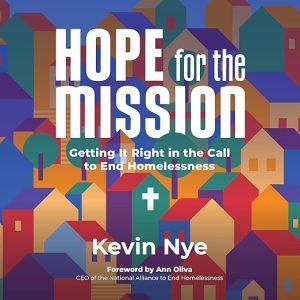
I came to this one through a conversation about the gap between intention and impact in charitable work, a conversation that has been circling my professional community for years. Kevin Nye’s first book, Grace Can Lead Us Home, had already made an impression on people working at the intersection of faith and social policy. Hope for the Mission is the practical companion: where the first book laid theological and theoretical groundwork, this one shows which organizations are actually embodying those principles and how they are doing it.
The argument at the center of this book is uncomfortable in the right way. Nye contends that gospel rescue missions, the dominant model of Christian ministry to unhoused people in North America for over a century, often perpetuate homelessness rather than ending it, because they prioritize evangelism over evidence-based solutions like Housing First. That is not a diplomatic way to open a book aimed at faith communities. It is also, by the evidence Nye marshals, a defensible one.
Our Take on Hope for the Mission
What distinguishes this book from a policy brief or an academic critique is that Nye combines the critical evaluation with genuinely hopeful stories. He profiles organizations like Beacon Interfaith Housing Collaborative in Minneapolis and Firm Foundation Community Housing in Hayward, California, as examples of faith-based groups that have aligned their practice with best evidence. He is not writing to condemn the church. He is writing to challenge it toward something more effective. One reviewer captured this well, describing it as insightful, inspirational, and invitational, a book equally useful to someone just beginning to engage with homelessness and someone who has worked with unhoused populations for decades. Another noted that Nye speaks honestly about the reality and challenges of homelessness while also presenting the reader with hope and practical information, which captures the balance the book works hard to maintain.
Why Listen to Hope for the Mission
Nye narrating his own work is the right call here. His voice is calm and grounded without being preachy, which matters enormously for material that could easily tip into sermonizing. Reviewers consistently note how human and grounded the book feels, and that quality comes partly from Nye’s willingness to center the lived experience of unhoused people rather than the perspective of the organizations serving them. When he writes that housing is what is primarily needed to end homelessness, and that the question is whether faith communities will organize their resources around that truth, the self-narration makes the challenge feel personal rather than institutional.
What to Watch For in Hope for the Mission
Listeners who come to this book as advocates for the traditional rescue mission model will find it challenging. Nye does not pull punches in his critique of organizations that prioritize evangelism over what he calls proven solutions. His framing is generous in tone but not in substance. He genuinely believes these models harm the people they intend to help. Readers who hold those institutional loyalties should go in knowing that the book will ask them to reconsider. At just over five hours, the book is also dense with case studies and organizational examples, which means it rewards listeners who are ready to engage actively rather than listen passively. One reviewer noted that Nye’s language around collective responsibility is pointed: the sin of homelessness is not individual laziness or drunkenness, but collective greed, inhospitality, and indifference. That framing will land differently depending on where you sit theologically, but Nye states it clearly enough that no one walks away without knowing where he stands.
Who Should Listen to Hope for the Mission
Church leaders, ministry staff, social work students, and anyone who has ever volunteered at a shelter and wondered whether the model was working will find this directly useful. The book is also valuable for policy-adjacent listeners who want to understand how Housing First principles translate into faith-based organizational practice. Secular readers who are simply curious about the evidence base for homelessness intervention will find the policy content substantive, though the book’s frame is explicitly Christian. Nye is not pretending to write for a general audience. He is writing for the church, and the specificity of that address is what gives the book its authority.
Frequently Asked Questions
Is Hope for the Mission accessible to readers without a strong faith background?
The book is explicitly written for faith communities and uses theological language throughout. The policy content on Housing First is substantive and applicable beyond that context, but the book’s frame and primary audience are Christian.
How does Hope for the Mission relate to Nye’s first book, Grace Can Lead Us Home?
Nye describes the first book as the head and heart of the work, covering theology and theory, and this book as the hands and feet, showing which organizations are putting those principles into practice. They are complementary but Hope for the Mission works as a standalone.
Does Nye criticize specific organizations by name?
He critiques the gospel rescue mission model broadly, and praises specific organizations by name as exemplars. He does not single out named missions for condemnation, though his critique of the model is pointed.
What is Housing First, and how central is it to the book?
Housing First is an evidence-based approach that prioritizes providing stable housing before addressing other challenges like addiction or mental health. Nye argues it is the most effective path to ending homelessness and uses it as the benchmark against which faith-based models are measured throughout the book.