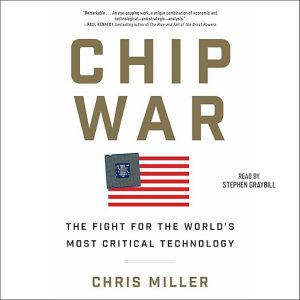
Paperback is the word that should stop a buyer halfway down this description. The copy for this audiobook announces that the author has added intriguing new material for the paperback, covering the newly passed CHIPS Act, fresh export controls on China and the effort to rally allies around chip technology. The recording itself reached the catalog in October 2022. Nothing on the record says whether twelve hours and thirty-eight minutes of Stephen Graybill includes that addition or predates it, and for a book whose entire value is timeliness, that is not a small ambiguity.
This Paperback's New Material May Be Missing
Set the edition question aside and this is the clearest available account of how a manufacturing process became a geopolitical instrument. A December 2022 entry, filed within weeks of publication, frames it precisely: a history of semiconductor manufacturing and of the intellectual currents that pushed the industry offshore, which then doubles as an explanation of the current friction between the United States and China. That entry singles out the pioneers, the long record of government involvement and the recurring cycles of intellectual property anxiety. Those three threads really are the spine, and they are why the book works as history and as briefing at once.
The counter is worth a glance before the badge is. Nine graders sit behind an average of 4.7 on a title the copy identifies as the Financial Times Business Book of the Year, which tells you this particular record is a small corner of a very large readership and not a referendum. Five written responses are visible, spanning December 2022 to January 2026, and they are unusually substantive for a business listing: three of them argue with the material and not with the star box.
Graybill Narrates Twelve Hours of Foundry Jargon
Glowing vacuum tubes open the most persuasive entry on this page, filed in March 2025, and it shows what the book does to the right listener better than any blurb could. That entry recalls a childhood memory of a father's vacuum tube radio, those glowing tubes replaced by something much smaller, and the arrival of the transistor set sometime in the sixties, when nobody could have imagined what circuits etched onto silicon wafers were about to do to the world. That is the book's actual achievement: it converts an industrial supply chain into a lifetime a listener can measure against their own.
Microchips are the new oil, the scarce resource the modern world runs on, and once that central claim lands, everything from missiles to microwaves to the electrical grid becomes part of the same story. The competitive geography follows naturally, with manufacturing drifting toward Taiwan, Korea and Europe while design stayed put, and China now spending more on chips than on any other imported product. What makes twelve hours of process engineering listenable is that almost none of it is told through the engineering.
Stephen Graybill holds the reading credit, and none of the nine people who graded this file has left a word about how the performance lands. What the material demands is manageable in principle and specific in practice: acronyms, company names and foundry jargon repeated across twelve hours, plus a cast of engineers and officials from four continents whose names have to stay distinct without a page to check.
One Country Reasonable, the Rest Cheating
November 2024 brought the two criticisms that matter, and both are structural. That four-star starts with currency: the account runs from the industry's infancy until 2022, and in a sector moving this fast, that entry already treats the book as a historical reference and not a current picture. Two years of export controls, foundry construction and policy reversal have happened since, and none of it is here. Anybody buying this for the present state of play is buying the wrong decade of it.
Framing is the second criticism. That same entry argues the book struggles to stay neutral, portraying the United States as consistently reasonable while other countries appear as cheating or dangerous, and notes the asymmetry in how American firms supplying the military are described against how Chinese technology companies are described. It is a fair reading of a book written from inside one of the two positions it covers, and it does not make the history wrong. It does mean a listener should treat the strategic conclusions as an argument with a nationality.
Copy on this page is the last thing to watch. Blurbs from three newspapers, an award citation and a paperback update notice are stacked into a description that never tells you what is in the file. Compare the release date against the edition the copy is selling before spending a credit, because the difference is a chapter on the American policy response and that chapter is the one buyers most want.
From Skeptic to Deep Industrial Knowledge
A January 2026 entry describes exactly the listener this converts: somebody who does not normally enjoy books of this nature, went for it anyway, came out with a much deeper knowledge of the subject and is now waiting for the next one. That is the strongest recommendation on the page and it is not from a specialist. If you have followed chip shortages, export bans and factory announcements in headlines without ever getting the underlying story, twelve hours here will reorganize all of it.
Investors, policy watchers and anyone working adjacent to hardware will find the industrial history genuinely useful. Skip it if you need current analysis, since the account stops in 2022, or if you want the engineering explained at a technical level, since the physics stays deliberately light. And if you already read widely on the subject, expect a superb synthesis of familiar material and not new reporting.
Before You Press Play
- Read by: Stephen Graybill reads it, and nobody on this page has weighed in on how twelve hours of acronyms and foundry jargon come across.
- At its heart: Semiconductor history, technology and national security, offshoring and supply chains, US-China competition
- Vibe: Propulsive, argumentative and unexpectedly personal
- Short version: The best available narrative history of the chip industry, sold on a listing that will not tell you which edition you get.
Does this audiobook include the extra chapter the description mentions?
Impossible to tell from the record. The copy advertises new material written for the paperback, covering the CHIPS Act and later export controls, while the recording is dated October 2022. No note on the listing reconciles the two, so check the publisher description on the product page before spending a credit.
Is the audiobook technical enough to lose a general listener?
No. The physics stays light throughout, and the working vocabulary is corporate and geopolitical, not electrical. Expect company histories, national policy and the economics of manufacturing, which is what keeps twelve and a half hours moving for a listener who has never touched a circuit diagram.