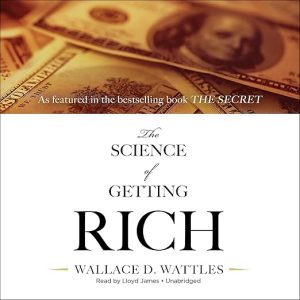
Quick Take
- Narration: Lloyd James reads Wattles with measured authority, giving the 1910 text enough gravitas to hold across its 145-minute runtime without over-dramatizing the rhetorical passages.
- Themes: prosperity consciousness, creative thought over competitive thought, gratitude as practical tool
- Mood: Earnest, declarative, and quietly motivational
- Verdict: A historically significant text that rewards engagement as philosophy rather than prescription, despite its confident claims to scientific certainty.
The Science of Getting Rich arrived on my listening list because I was curious about the foundation beneath The Secret, Rhonda Byrne’s 2006 phenomenon that sold tens of millions of copies and brought the Law of Attraction into mainstream consciousness. Byrne cited Wattles’s 1910 text as a primary inspiration, and reading the source material after the popular derivative is a useful exercise in understanding how ideas travel, transform, and occasionally get flattened in transmission. Wattles is doing something more specific and more philosophically grounded than what The Secret eventually became.
The central claim is stated without qualification: there is a science of getting rich, and it is as exact as algebra. Wattles argues that wealth follows from a particular way of thinking, what he calls creative thought as opposed to competitive thought, and from a set of practices involving gratitude, definite purpose, and the development of what he terms the certain way. The framework draws on the new thought movement of the early 20th century and has clear debts to writers like Ralph Waldo Emerson and Thomas Troward, though Wattles does not spend much time acknowledging his influences.
Our Take on The Science of Getting Rich
The book’s most interesting dimension is its ethical framework around wealth. Wattles argues explicitly against accumulating wealth through competitive extraction, taking from others rather than creating value. He insists that the person who gets rich in the certain way adds to the world rather than depleting it, and frames the pursuit of wealth as morally defensible precisely because it requires genuine creative contribution. One reviewer notes the book offers one of the best cases for the justifiable pursuit of wealth they have encountered, and for readers from backgrounds where money is experienced as spiritually suspect, that argument is the most substantive thing on offer here.
The claims to scientific certainty are harder to accept in 2026 than they may have been in 1910. Wattles asserts that following his method will produce wealth with mathematical certainty, which is a statement about cause and effect that no reader can validate from experience alone. The book works best when understood as an argument about mental discipline, attention, and the relationship between belief and action rather than as a literal prediction machine.
Why Listen to The Science of Getting Rich
At two hours and twenty-five minutes, this is one of the shortest significant texts in the self-help canon. Lloyd James’s narration is even and clear, giving the declarative prose the gravity it needs without adding interpretive flourishes that would feel inappropriate for the material. James has a long track record with classic and early-20th-century texts, and his familiarity with the rhetorical register of the era shows.
The brevity is both the book’s virtue and its limitation. Wattles states his principles concisely and does not spend time on case studies or extensive illustration. This makes for efficient listening but means that listeners looking for the kind of narrative anchoring that later self-help books use to make principles memorable will need to supply that themselves. Several listeners report returning to this text multiple times, which suggests it is the kind of short work that benefits from revisiting rather than a single linear pass.
What to Watch For in The Science of Getting Rich
The text is over a century old and the language reflects its era. Wattles uses male-defaulting pronouns throughout and the cultural assumptions embedded in his examples belong to Edwardian America. None of this makes the core argument inaccessible, but listeners should be aware that they are engaging with a historical document as much as a contemporary guide.
The theological dimension of Wattles’s argument is also more present than the Law of Attraction branding around his legacy might suggest. He grounds the certain way in a conception of an intelligent substance that pervades all things, a framework that sits somewhere between theology and early-20th-century metaphysics. Reviewers from religious backgrounds have found this dimension resonant; those committed to a purely secular framework may find it requires more translation than the text provides.
Who Should Listen to The Science of Getting Rich
Listeners curious about the intellectual roots of the modern prosperity and Law of Attraction movement will find this essential primary source material. Those who have engaged with The Secret and want to understand where its ideas originated will find Wattles more philosophically rigorous than what Byrne’s book became. Readers from traditions where the pursuit of wealth is complicated by spiritual concerns will find Wattles’s ethical argument around creative versus competitive thought worth engaging with. Skeptics of metaphysical claims about cause and effect should approach this as intellectual history rather than actionable guidance.
Frequently Asked Questions
Is The Science of Getting Rich essentially the same as The Secret?
Wattles is one of Byrne’s primary cited influences, and the Law of Attraction concept is shared between them. But Wattles is more philosophically specific, more focused on action and creative thought rather than visualization alone, and more explicit about the ethical dimension of wealth creation.
At two and a half hours, is this long enough to be genuinely useful?
The brevity is characteristic of Wattles’s style, he states principles directly without extensive illustration. Many listeners find multiple passes more useful than a single linear listen, and the short runtime makes that practical.
Does Lloyd James’s narration add anything to the experience of reading the text?
James brings appropriate gravity to the declarative prose without over-performing it. His familiarity with texts from this era means the rhetorical register lands naturally rather than feeling dated.
How does Wattles define the difference between creative thought and competitive thought?
Competitive thought, for Wattles, means seeking to take a larger share of existing wealth from others. Creative thought means generating new value and new opportunity. He argues the second is both more morally sound and more practically effective as a wealth-building framework.