Quick Take
- Narration: Picciurro self-narrates with the calibrated pacing of an experienced tax educator, knowing exactly which concepts need room and which do not.
- Themes: Taxes as your largest lifetime expense, proactive year-round planning versus reactive filing-season responses, the Teaching Tax Flow framework across different taxpayer profiles.
- Mood: Practical and clarifying, with the confidence of someone who has refined these explanations across many audiences.
- Verdict: A well-scoped audiobook that shifts how listeners think about their relationship with taxes rather than simply listing deductions, most valuable for listeners in the early stages of tax awareness.
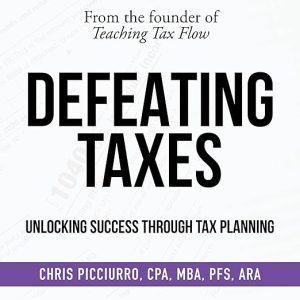
Chris Picciurro opens this audiobook with a claim that most tax books dance around but rarely state plainly: income taxes are, for most people, their largest lifetime expense. Not mortgage payments. Not healthcare. Not education. Taxes, compounded over a working lifetime of decisions made without a framework for managing them. That reframing, stated plainly in the first chapter, is the central intellectual move of Defeating Taxes, and it earns the rest of the audiobook's attention. Picciurro is a CPA with several additional credentials who has spent his career teaching what he calls the Teaching Tax Flow framework, and the self-narrated version of this book benefits directly from his experience explaining these concepts to real people in real financial situations.
I have spent time with a number of personal finance audiobooks over the years, and the ones that actually change behavior tend to share a quality: they do not just tell you what to do, they change how you think about the domain. Defeating Taxes is in that category. The goal is not to give you a list of deductions. It is to shift the relationship between you and the tax system from reactive to proactive, from something that happens to you once a year to something you are actively managing across every financial decision you make throughout the year.
Three Laws and Four Steps, Year-Round
The Teaching Tax Flow framework Picciurro introduces is built around three laws of tax planning and a four-step process that he walks through with the patience of someone who has taught this material in workshops and podcast episodes many times. The framework's core insight is that tax planning is a year-round project, not a filing season event. Most people engage with their taxes in the period between February and April, make a few decisions based on what happened last year, and then disengage until the following January. Picciurro shows systematically why this is expensive and what a different relationship with your tax situation looks like across a twelve-month cycle.
The case studies are among the most useful sections of the audiobook. Picciurro presents real scenarios across different taxpayer profiles, including W-2 employees, the self-employed, new retirees, and small business owners, and shows how the same framework produces different outcomes in each situation. This range is important: too many tax books are written for a single profile and require active translation for everyone else. The Teaching Tax Flow framework is designed to be profile-agnostic, and the case studies demonstrate that claim rather than merely asserting it.
Picciurro Narrates What Usually Confuses His Audience
Picciurro self-narrates, and this is one of the cases where self-narration is clearly superior to the alternative. He knows precisely which examples his audiences find confusing and which concepts need a second pass. His delivery has the quality of an experienced teacher who has refined his explanations across many iterations, and that refinement shows in the pacing: he does not rush the concepts that need room to land, and he does not over-explain the ones that are straightforward. One reviewer, herself a credentialed tax professional, described the book as written in 'clear, straightforward, down to earth language that anyone can understand,' and that quality is fully present in Picciurro's narration.
At just under four hours, the audiobook is designed to be actionable rather than comprehensive. Picciurro is explicit about this: he is not trying to write the complete guide to the tax code, he is trying to give you a mental model that will make every subsequent conversation with your accountant more productive. That scoping decision is correct for the format, and the audiobook length reflects the discipline with which Picciurro enforces it.
Rules Change Yearly, the Three Laws Don't
A few calibrations. The legal and regulatory landscape around taxes changes annually, and some of the specific provisions Picciurro references will have evolved by the time you are listening. He acknowledges this, framing the book as a framework rather than a current-year guide. The core principles around proactive planning, the three laws, and the four-step process remain stable even when specific rules change, but listeners who need current-year specifics should treat this as orientation and follow up with a current professional source.
The book's tone is emphatically pro-planning and implicitly assumes that most listeners are underpaying attention to their tax situation rather than over-optimizing it. This is probably an accurate assumption for the general audience, but listeners who are already working closely with a tax advisor and implementing year-round planning strategies may find the framework familiar rather than revelatory. The book is most transformative for listeners in the earlier stages of tax awareness.
One Mental Model for Four Kinds of Taxpayers
Employees who have never thought carefully about how their decisions, from retirement contributions to side income to real estate, affect their tax situation across the year will find this audiobook genuinely valuable. Self-employed listeners and small business owners who know taxes are an issue but have not implemented a proactive planning framework will get specific and applicable material. Newly retired listeners navigating the shift from W-2 income to mixed income streams are a well-served audience here. Tax professionals who work with the general public may find Picciurro's Teaching Tax Flow framing a useful complement to their own client communication approach, as the reviewer who is herself a credentialed EA noted. The audiobook is not for listeners looking for specific tax code research or current-year guidance on specific provisions, but for the vast majority of people who simply need a better mental model for thinking about taxes, it delivers one clearly.