Quick Take
- Narration: Selvakanthan reads the Tamil-language edition competently, but English-speaking listeners will find no value here; seek the original English recording instead.
- Themes: Timeless human behavior, risk and fear, decision-making under uncertainty
- Mood: Intellectually engaging in English; inaccessible in this edition for most listeners
- Verdict: Morgan Housel’s ideas are genuinely worth your time, but this specific audiobook edition is in Tamil and will not serve English-speaking audiences.
I first encountered Same as Ever in its English print edition on a long train ride, and I remember thinking it was the rare business book that felt less like a productivity lecture and more like a long conversation with someone who had thought seriously about how people actually behave. Housel’s central premise, that human nature stays constant even as the world around us transforms beyond recognition, is one of those ideas that sounds obvious until you sit with its implications for a chapter or two.
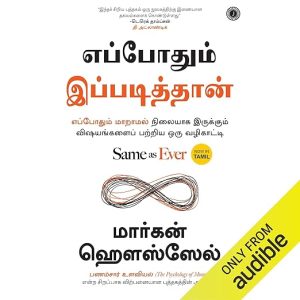
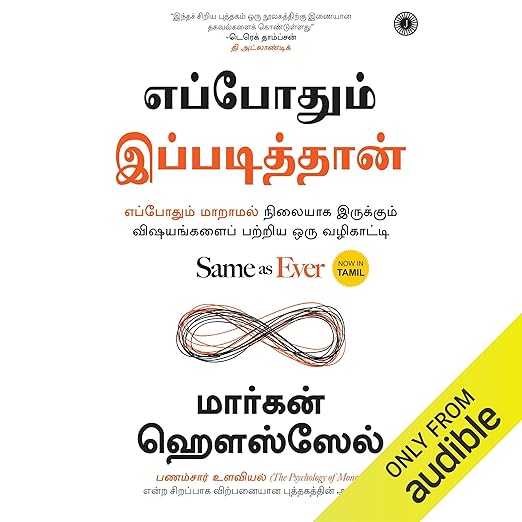
So when this audiobook listing appeared in the queue, I was genuinely curious. What I discovered, and what any prospective listener needs to know immediately, is that this edition is narrated by Selvakanthan in Tamil. This is not a minor formatting note. It is the entire listener experience. If Tamil is not your primary language, this recording will be completely inaccessible to you, regardless of how much you admire Housel’s thinking.
Our Take on Same as Ever
Setting aside the language issue for a moment, because the underlying book does deserve comment: Housel constructs his argument through a series of historical vignettes, moving from the invention of nuclear weapons to the founding of Amazon, from T.E. Lawrence to Jack Welch, demonstrating how the same emotional drivers, greed, fear, overconfidence, envy, show up in wildly different contexts across centuries. The project is less analysis and more pattern recognition, and it works because Housel resists the urge to prescribe. He is not telling you what to do with this insight. He is asking you to see it.
One review available for this edition describes it as a wonderful journey, noting that happiness never changes and all things have both good and bad. A second review, written in Tamil, appears to criticize the quality of the translation, urging readers to buy the English original instead. That advice is sound.
Why Listen to Same as Ever
If you are a Tamil-speaking reader and have been looking for an accessible version of Housel’s follow-up to The Psychology of Money, this recording at least provides that access point. The book’s framework, examining what does not change as a tool for making better decisions in an unpredictable future, translates reasonably well into a format that lends itself to reflective listening.
For everyone else, the English audiobook of Same as Ever exists through other channels and features a different narrator. That is the version worth tracking down. The ideas in this book are genuinely useful, and Housel’s prose has a clarity that rewards listening as much as reading. You just need to hear it in a language you can follow.
What to Watch For in Same as Ever
Housel does not offer a systematic framework so much as a loosely connected series of essays. Each chapter functions almost independently. This makes it easy to dip in and out, but it also means the book does not build toward a single culminating argument. Some readers find that liberating; others find it frustrating.
The book represents Housel’s attempt to distill what The Psychology of Money implied but never fully stated: that behavioral constants matter more for long-term outcomes than any particular market prediction or economic cycle. It works best if you have already read or listened to its predecessor.
One thing the book does remarkably well, even in translation, is resist the self-help genre’s usual trap of promising transformation. Housel is not selling a system. He is offering a lens. The distinction matters. Readers who come expecting actionable takeaways may leave disappointed. Readers who come expecting a reorientation of how they think about uncertainty and change will likely find what they are looking for.
Who Should Listen to Same as Ever
Tamil-speaking fans of Housel who want an audio version of this book will find this edition serves that purpose. English-speaking listeners, even devoted fans of Housel’s work, should seek out the English-language recording. The content is worthwhile; this particular production is simply not the right vehicle for most of this site’s audience.
Frequently Asked Questions
Is this the English audiobook of Same as Ever by Morgan Housel?
No. This specific edition, narrated by Selvakanthan and released in September 2025, is in Tamil. The product listing confirms this. English-speaking listeners should look for a different edition.
How does Same as Ever differ from The Psychology of Money?
The Psychology of Money focuses on how individuals relate to wealth and financial decisions. Same as Ever zooms out further, examining universal human behaviors across history, including risk, fear, overconfidence, and envy, using a wider range of historical examples from geopolitics and technology.
Is the Tamil translation of Same as Ever considered faithful to the original?
One Tamil-language reviewer on the product page directly criticizes the translation quality and recommends purchasing the English original instead. Without fluency in Tamil it is impossible to evaluate independently, but that concern is worth noting.
Does Same as Ever require background knowledge in finance to follow?
No. Housel explicitly avoids jargon and writes for a general audience. The book is structured as a series of historically grounded observations about behavior, not a technical analysis of markets. It is one of the more accessible books in the personal finance and investing genre.