Before You Press Play
- Read by: Will Collyer delivers a controlled, measured performance that handles the book's escalating complexity without losing pace or authority.
- At its heart: Financial fraud, global impunity, the performance of wealth
- Vibe: Coolly furious and relentlessly specific
- Short version: One of the essential financial crime audiobooks of the last decade, and Collyer's narration makes the institutional machinery feel as vivid as the excesses.
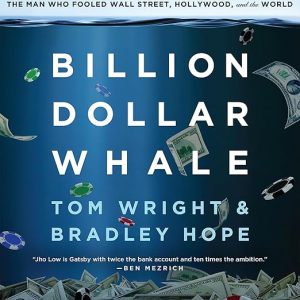
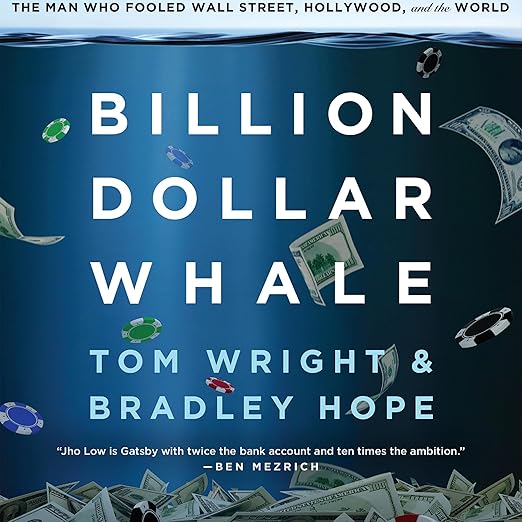
Jho Low's name appeared in my reading pile around the time a colleague pressed the book into my hands after a dinner conversation about financial crime. The audiobook version of Billion Dollar Whale had been sitting on my device for weeks before I finally committed to it during a long train journey, and within twenty minutes I had genuinely forgotten I was listening to journalism rather than a thriller. Will Collyer's narration locks you in from the first chapter, and authors Tom Wright and Bradley Hope have structured the material with the momentum of a heist film even though every extraordinary detail is meticulously sourced. This is financial crime reporting at its most controlled and its most enraging.
What makes this audiobook so effective is that the scope of Jho Low's fraud forces the listener to keep recalibrating. At first it seems like a moderately impressive hustle from a Wharton graduate with charm and contacts. Then the numbers start climbing. Then Goldman Sachs enters the picture. Then Malaysian sovereign wealth funds. Then champagne-drenched New York parties, a superyacht, and the co-financing of The Wolf of Wall Street itself, a film that satirizes the very greed Low was enacting in real life. By the midpoint of the audiobook, Low has become something genuinely strange: a character too outlandish for fiction who nonetheless walked through the front doors of the most respectable institutions in global finance.
Wright and Hope's Brisk, Factual 1MDB Account
Wright and Hope are Wall Street Journal reporters, and that background shapes everything about how this story is told. The prose is brisk and factual, but the facts themselves are so extraordinary that the book never needs to inflate its language. What the reader gets instead is clarity: a step-by-step account of how the 1MDB fund was created, how money was siphoned through a cascade of shell companies across multiple jurisdictions, and how regulators in the United States, Switzerland, and Singapore were either fooled or chose not to look too closely. One reviewer described the book as 'an imperfect but still essential read' and that captures something real. The 1MDB story is still unfolding in the courts, and the book's 2018 publication date means certain threads remain open. But the core account is devastating, and the audiobook format lets you absorb it at a pace that matches the breathless escalation of Low's ambitions.
Collyer Avoids the Equal-Weight Narration Trap
Will Collyer's performance is one of the genuine assets of this production. Financial nonfiction can flatten in audio when the narrator treats numbers and institutional names as equal-weight items to be read off a list. Collyer avoids that trap. He modulates pace when the complexity spikes, and he brings a dry, controlled energy to the scenes of Low's extraordinary social performances: the nights at 1Oak and Avenue in New York, the encounters with celebrities and royals who had no idea they were being bankrolled by stolen public money. For listeners who found Michael Lewis's Liar's Poker or John Carreyrou's Bad Blood compelling in audio, this sits comfortably in that company. The authors themselves draw that comparison, and it is not an overstatement.
One reviewer with deep knowledge of the 1MDB case flagged the book's limitations honestly: it is 'briskly reported' but the book leaves certain things unexplained, partly because at the time of writing certain information was not yet public. That is a fair caveat. If you want the definitive scholarly account of 1MDB, this is the beginning of your education rather than the end. But as a narrative reconstruction of how one man exploited the gap between global financial complexity and regulatory will, it remains the clearest account available in audio form.
Low Was Chasing Legitimacy Across Five Countries
Pay close attention to the Goldman Sachs chapters. The bank's role in facilitating the bond issuances that funded the fraud is the most structurally important element of the whole story, and Wright and Hope document it with particular care. A running theme also emerges about what Low was actually chasing: not simply money, but legitimacy and proximity to power. The Hollywood connections, the yacht, the art collection all serve a social function for a man who felt, despite his Wharton degree, that he was perpetually an outsider. That psychological thread gives the book depth beyond the transaction-by-transaction reconstruction of the fraud itself.
The audiobook also rewards listeners who pay attention to the geography. The money moves between Malaysia, Abu Dhabi, Singapore, Switzerland, and New York in patterns that initially seem chaotic. Collyer's measured pacing helps the listener track these jurisdictional hops, but it is worth staying alert during the chapters covering the various shell company structures. One reviewer noted that the authors provide 'basic explanations of mechanisms such as securities' for readers less familiar with financial markets, and those moments are well-handled without becoming condescending toward more experienced listeners.
The chapters covering Low's social ascent in New York deserve particular attention. The parties at venues like 1Oak, the art purchases, the movie financing all serve a function beyond excess: they are Low's method of acquiring social proof in circles where inherited legitimacy was the norm. Wright and Hope document this pattern with precision, showing how Low understood that certain kinds of celebrity adjacency could substitute, in certain rooms, for the kind of credentialed background that Wharton alone could not supply. Collyer reads these sections with a dry awareness that suits the absurdity of what was actually happening.
Fans of Bad Blood Will Find This Satisfying
This audiobook is well-suited for listeners who found Bad Blood, Den of Thieves, or Liar's Poker compelling and want to understand how similar dynamics play out at a sovereign, cross-border scale. It works for people with limited financial background because Wright and Hope have been careful with their explanations, but it also rewards listeners who already understand how bond issuances and shell company structures function. If you follow international financial crime, Southeast Asian politics, or the role of Western banks in enabling corruption, the detail here will satisfy rather than overwhelm. Those looking for a fully closed narrative with all threads resolved may find the 2018 endpoint slightly frustrating, given how much of the legal aftermath came later.
Good to Know
Do I need to know about Malaysian politics to follow this audiobook?
Not at all. Wright and Hope build the necessary context from scratch. The 1MDB fund, its political connections, and its stated purpose are all explained clearly in the early chapters, so listeners unfamiliar with Malaysian current affairs can follow without difficulty.
Is the audiobook narration difficult to follow during the financial and legal sections?
Will Collyer handles the technical content well. The authors have also structured those passages with accessible explanations, so even listeners without a finance background should be able to follow the shell company and bond issuance mechanics without pausing constantly.
Does the audiobook cover Jho Low's eventual capture or extradition?
The book was published in 2018, when Low was an international fugitive with criminal charges pending in multiple jurisdictions. It does not cover subsequent legal proceedings. Listeners interested in what happened after should supplement the audiobook with more recent journalism.