- Narration: Rob Shapiro brings the period to vivid life, capturing both the raucous energy of Your Show of Shows and the quieter, more troubled interior of a man who could do everything onstage except feel at ease in his own body.
- Themes: Television comedy history, Jewish American identity, the cost of genius
- Mood: Rollicking and elegiac in equal measure, with a sharp eye for the distance between performance and person
- Verdict: David Margolick's biography of Sid Caesar is the definitive account of television comedy's founding genius and one of the more psychologically acute showbiz biographies in recent memory.
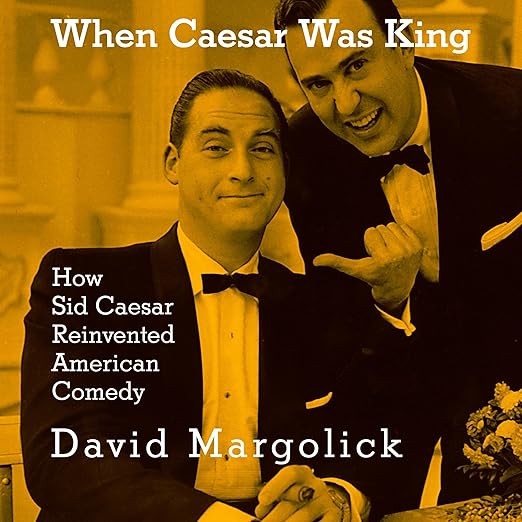
David Margolick's When Caesar Was King is the kind of audiobook that makes you feel the weight of something lost. Sid Caesar is not a name that resonates today the way it once did, and that gap between his historical importance and his current obscurity is one of the book's central subjects. By the spring of 1954, Caesar was the most influential, highly paid, and enigmatic comedian in America, with twenty million viewers tuning in weekly to his NBC extravaganza, Your Show of Shows. Within a decade, he was essentially off the air. Margolick, a longtime writer for the New York Times and Vanity Fair, constructs the most complete account of Caesar's life and career that exists, and the result is a Finalist for the PEN/Jacqueline Bograd Weld Award for Biography.
What Caesar's Gifts Cost Him
The biography earns its Finalist status through the depth of its research and the psychological complexity it brings to its subject. Caesar was capable of playing any character and making it funny: a befuddled game-show contestant, a pretentious German professor, a gumball machine, a bottle of seltzer. That last capacity, transforming inanimate objects into comic characters through pure physical and vocal authority, is the measure of his extraordinary gifts. Margolick does not simply catalog those gifts. He pursues the question of what they cost and what they could not fix. Introverted and volatile, ill at ease in his own skin, Caesar could terrorize his collaborators while reserving his harshest judgment for himself. The comedy was not a performance of wellbeing. It was what remained when wellbeing was absent.
Reviewer Rebecca L. wrote about how food runs through Caesar's comedy and how Margolick catches that, noting that pickles appear in the index. That is not a trivial observation. The urban Jewish culture from which Caesar emerged and which he performed for his mostly urban Jewish audience is one of the book's living subjects. His comedy was not just entertainment for that audience. It was a post-Holocaust symbol of security and a source of great pride. Margolick treats that cultural function with the seriousness it deserves without turning the biography into cultural criticism at the expense of the man himself.
Shapiro's Range, From Raucous to Painful
Rob Shapiro's narration is a significant part of why this particular biography works so well in audio. The material requires a narrator who can move between the raucous environment of the writers' room and the quieter, more painful interiority of a man beset by exhaustion, addiction, and his own impossibly high standards. Shapiro navigates that range with genuine skill. At thirteen hours and twenty-eight minutes, this is a long listen, and the narration's tonal flexibility is essential to sustaining engagement across the full runtime. Esquire characterized the biography as whip smart with a nuanced appreciation of Caesar's comedy and the overall atmosphere of TV's early days, and Shapiro's narration serves that nuance without overplaying it.
The disciples section of the book is among its most valuable contributions. Mel Brooks, Carl Reiner, Neil Simon, and the constellation of talent that came up through Caesar's writers' rooms are not just background figures here. Margolick traces the specific ways in which Caesar personally nurtured these careers and how the standard he set shaped what they became. Understanding the lineage from Caesar to Brooks to Reiner to Simon and beyond is essential for anyone who wants to understand the architecture of American comedy in the second half of the twentieth century. Caesar's influence is everywhere in that tradition, and it is largely unacknowledged at the popular level precisely because his own career collapsed so spectacularly.
Sympathy That Limits the Critical Distance
This is a biography with deep sympathy for its subject, and that sympathy occasionally limits the critical distance Margolick brings to the darker aspects of Caesar's life. The addiction and the volatility toward collaborators are documented, but the book is more interested in understanding them than in assessing their full consequences for the people around Caesar. Readers who prefer biographies that hold their subjects to fuller account may find the sympathetic framing occasionally insufficient.
The book's loving reconstruction of a New York City that has all but vanished is one of its genuine pleasures but also its greatest temporal specificity. The mid-century urban Jewish milieu that produced Caesar, his writers, and his audience is rendered with care and affection, and listeners who are unfamiliar with that world will get a vivid introduction. But the specificity of the cultural context also means the book rewards listeners who already have some sense of what Your Show of Shows meant and what it represented, rather than approaching Caesar as a name they are encountering for the first time.
Understanding American Humor's Architecture
Anyone with a serious interest in American comedy history, television history, or mid-century Jewish American culture will find this the most substantial and well-researched account available. Comedy fans who know Mel Brooks, Carl Reiner, and Neil Simon but have only a vague sense of where they came from will emerge from this audiobook understanding something essential about American humor's architecture. Listeners who enjoy biographies with genuine psychological depth and who appreciate the kind of cultural reconstruction that situates a life in its full historical context will find Margolick's work amply rewarding. Skip it if you want a light, celebratory showbiz story with minimal darkness. Margolick is too honest a biographer for that, and the subject is too complicated a person to support it.