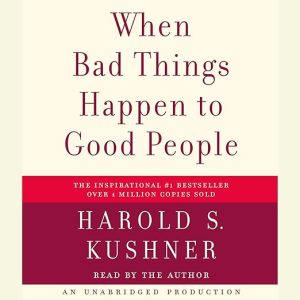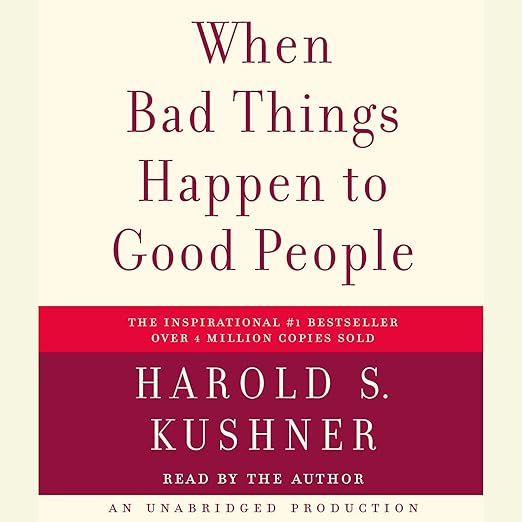
A hospital waiting room, 2 a.m., a December that would not improve. I'd carried When Bad Things Happen to Good People on my phone for months without starting it, the way you sometimes carry the book you know you'll need without being ready to need it. When I finally pressed play on Harold Kushner's voice, I understood immediately why this audiobook has reached four million readers: it begins with an author who has already been where you are. His three-year-old son was diagnosed with progeria, a degenerative aging disease. The boy died in his early teens. Kushner wrote this book in the years that followed, while still a practicing rabbi, still trying to make sense of theodicy not as an intellectual exercise but as a survival necessity.
Self-narration is again the right choice here. Kushner's voice is that of a man in his seventies speaking to you quietly, directly, and without the distance that professional narration would create. He doesn't perform grief or wisdom. He reports what he found when he looked for answers that could actually hold up, not in comfort but under pressure.
The central theological argument is both simple and, in Kushner's telling, genuinely radical. He rejects the most common theodicy, the idea that suffering is divine punishment or divine test, as morally untenable: it requires either that God is just and therefore victims somehow deserve their fate, or that God is all-powerful and chose not to intervene, which strains definitions of goodness beyond recognition. Kushner's resolution involves rethinking the nature of divine omnipotence itself, and for listeners who arrive with traditional frameworks, the argument is provocative in the best sense.
He is also honest about the limits of comfort. The book does not offer certainty, closure, or a resolution that makes suffering make sense. What it offers instead is companionship in the uncertainty, and a theological position that allows the grieving person to be angry at their situation without feeling that anger is heresy. That permission is, for many readers, the book's most important gift.
The Best Parts of When Bad Things Happen to Good People
The self-narration here does something particular that the page version cannot: it communicates the lived relationship between the author and his argument. When Kushner speaks about his son's illness and death, we find no performance in it. This is an audiobook where the author's voice functions as testimony, and testimony has a different weight than text.
The book has been in print for decades and continues to sell because it addresses something that religious and secular frameworks alike struggle with: the gap between what we are told should be true about the universe and what we actually experience. Kushner doesn't close that gap. He helps you stand inside it without being destroyed by it.
Reviewers have consistently described the book as arriving exactly when it was needed. One listener noted it helped them deal with 'my wife's sudden death and the emotional upheaval that came with it.' Another, having just experienced a traumatic life event, was directed to the book repeatedly by everyone around them. A third described Kushner's approach as 'well-reasoned, realistic, and yet still comforting.' That combination, rationality and consolation working together rather than against each other, is what makes the audiobook's four million readers comprehensible.
Where Harold S. Kushner Loses Some Ground
At four hours and forty-four minutes, this audiobook is compact. Kushner covers the major theodicy positions and their limitations efficiently, which means some philosophical threads are resolved more quickly than rigorous thinkers might prefer. Listeners with backgrounds in philosophy of religion will recognize positions being simplified; listeners in acute grief will probably find the pace appropriate rather than rushed.
The book is written from within the Jewish theological tradition, and Kushner is explicit about that framing. He draws on Talmudic scholarship and rabbinic literature throughout. For readers from Christian, Muslim, or secular backgrounds, the specific textual references may be unfamiliar, though the underlying questions and most of the reasoning translate across traditions.
This is a book about suffering without medical, clinical, or psychological framing. If what you need alongside theodicy is practical guidance on grief processing, mental health resources, or community support, Kushner's book is a philosophical companion rather than a complete response to loss.
The book's longevity is worth pausing on. First published in 1981, it has remained in print continuously and sold over four million copies across decades that have brought significant shifts in both popular theology and secular approaches to grief. That durability suggests Kushner identified something genuinely foundational rather than merely timely. Part of the explanation is practical: the central question, why do good people suffer, doesn't date. But part of it is the specific character of Kushner's answer, which avoids both the comfortable certainty of traditional theodicy and the cold comfort of secular nihilism. The audiobook's format preserves the intimacy of his voice across the decades since he first wrote these words, and that voice sounds no less present for the distance.
Should You Listen to When Bad Things Happen to Good People?
This audiobook is for anyone who has faced loss or tragedy and found that conventional religious explanations failed them, who wants to think seriously about God, suffering, and meaning without being asked to pretend that easy answers exist. Kushner's self-narration is irreplaceable here: you're not reading about his argument, you're sitting with him while he makes it, and that presence is the audiobook's defining quality.
It is not a crisis line, a grief workbook, or a pastoral care supplement. It's a book of ideas, delivered in the voice of a man who has used those ideas to survive something terrible and wants to tell you what he found. Skip it if you need practical resources rather than philosophical companionship. Return to it when you're ready to think rather than just to endure.
Is this audiobook appropriate for people who are not religious or are atheists?
Kushner writes from within Jewish theology, but the central questions, why good people suffer, and how to find meaning without blaming victims, translate across religious and secular contexts. Agnostic and atheist listeners have found value in the book.
How does Kushner handle the question of prayer and divine intervention in this audiobook?
He addresses both directly, and his position on divine intervention is among the book's most controversial points. He argues that God's power may not extend to overriding the laws of nature, which recasts what prayer means and what it can accomplish.
Is there a difference between the audiobook and print edition of When Bad Things Happen to Good People?
The content is identical, but Kushner's self-narration transforms the experience. What functions as a philosophical argument on the page becomes something closer to a conversation when delivered in his voice. The audiobook is the recommended format for listeners in acute grief.