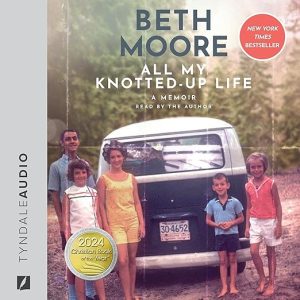
- Narrator: Beth Moore narrates her own memoir, an essential choice. Her Southern cadence, timing, and emotional honesty transform the text into something closer to testimony than audiobook.
- Subjects: Survival and resilience, faith under institutional pressure, the gap between public ministry and private struggle
- Tone: Candid, warm, and at moments genuinely arresting
- Bottom line: Moore's memoir is most powerful as an audiobook precisely because her voice carries meanings the page alone cannot hold.
There are books that exist in one form, and books that exist in another, and then there are books that were always meant to be heard. All My Knotted-Up Life belongs in that third category. I listened to it over two mornings, and what struck me immediately was how different Beth Moore's voice sounded from what I expected, not softer, exactly, but more uncertain than her public persona suggests. That uncertainty is the point. This is a memoir about the distance between who the world thinks you are and who you have actually been.
Moore is a figure who requires some contextual framing for listeners unfamiliar with evangelical Christianity in America. For nearly three decades, she was one of the most recognized women's Bible teachers in the country, affiliated primarily with the Southern Baptist Convention. The memoir chronicles her rise from an intern at a Houston church to a ministry that reached millions, but it also chronicles the cost of that visibility, the institutional silencing she experienced, and the childhood trauma that shaped everything that followed. ECPA named it Christian Book of the Year for 2024, which is a meaningful distinction in that publishing world.
Moore narrates with a storyteller's instincts and a preacher's sense of timing. She knows when to slow down, when to let a sentence land, and when to move quickly past something painful. The result is an audiobook that functions differently from the print version, the pauses carry weight, the humor lands with better timing, and the moments of genuine vulnerability feel immediate rather than curated. One reviewer described her as shattering the misconception that spiritual leaders must have flawless backgrounds, and the narration is where that shattering happens most viscerally. You can hear the effort it takes her to say certain things.
The Strengths
The book is organized around a central metaphor, the knotted-up life, the tangle of relationships and experiences and choices that do not resolve neatly, and Moore uses it with surprising discipline. This is not a chronological march through her biography. It is more like a series of illuminated scenes, some from her Texas childhood, some from the rooms where women were told to sit down, and some from the private prayer life that kept her anchored even when the institutions around her did not. The humor is real and well-deployed. Several reviewers mentioned being caught off guard by how funny the book is, and the audio version makes that humor land more naturally. Her descriptions of the Southern Baptist world she navigated, its hierarchies, its silences, its specific kindnesses and cruelties, are drawn with the precision of someone who loved it and was wounded by it simultaneously.
What to Watch For in All My Knotted-Up Life
Listeners who are not embedded in evangelical Christian culture may find some of the institutional detail, the specific denominational conflicts, the names of figures like Paige Patterson and John MacArthur, requires background knowledge to fully land. Moore does not spend extensive time explaining the political architecture of the SBC; she assumes some familiarity. For listeners approaching from outside that world, the personal and emotional narrative is fully accessible, but some of the specific grievances will be most legible to those who have followed evangelical American Christianity over the past two decades. The book is also not a tell-all in any sensationalized sense. Moore is candid, but she is measured about what she reveals and why.
Recommended For
This is an ideal listen for anyone who has followed Beth Moore's public career and wants to understand the private story that runs underneath it. It will also resonate with listeners who have navigated institutional religious structures, who have experienced the gap between what a faith community says it values and how it actually treats the people in it. For listeners who want a survivor's memoir rooted in faith rather than one that has abandoned it, this is one of the more honest examples of the form currently available in audio.