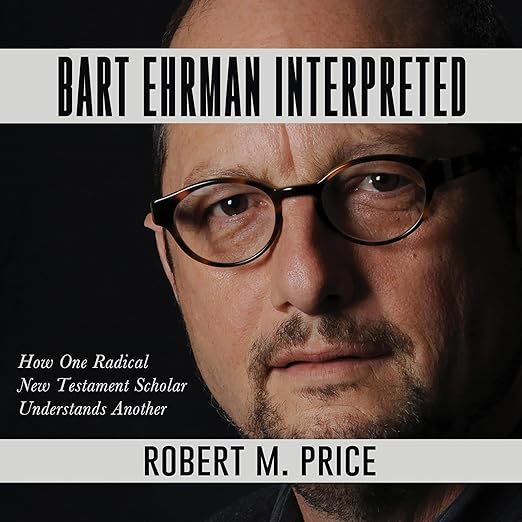
Two biblical scholars, considerable overlap, and a real disagreement running underneath the courtesy. Bart D. Ehrman has done more than anyone this century to carry questions of biblical criticism to a general readership, and Robert M. Price has written a book-length response to that whole body of work. The audiobook runs twelve hours and eight minutes, read by the author, and I should say at the outset that the publisher's description is a good deal more diplomatic about the disagreement than the book's own readers are. What the copy calls suggesting points at which Ehrman may be insufficiently or inconsistently critical turns out, in the reception, to mean something considerably sharper.
Price's Real Target Is Ehrman's Historical Jesus
Position is what the description will not say plainly. One four-star states it outright: the case Price builds is that much of Ehrman's support for a historical Jesus is questionable, and can be read as consistent with the mythicist argument instead. That is a substantially larger disagreement than the copy admits, and a buyer deserves to know it before committing twelve hours. It also calls Price prolific, well informed, witty and inclined to cut with a sharp knife, while insisting the treatment of Ehrman stays fair. Both can be true. Fair and fundamental are not opposites.
Scale is worth registering next. Twelve hours and eight minutes is a great deal of one scholar reading about another scholar, and the subject is not the historical Jesus in general but Ehrman's handling of him across a shelf of best-selling books. That makes this a second-order book: it assumes you have already met the arguments it assesses. The description says as much without saying it, opening on Ehrman's impact and his string of best-selling titles before it ever reaches Price. If those titles mean nothing to you, this is not where to start.
Respectful Disagreement, Anchored by One Small Anecdote
Tone is the reason it works, and one entry catches it exactly. Two favorite scholars, it says, who like all such people can never be expected to agree on everything, and what follows is called entertaining and enlightening, with Price showing respect throughout while pulling no punches on well thought out criticism. The combination is rarer in this field than it ought to be. Biblical criticism attracts polemic from every direction, and a book that argues hard while refusing to sneer is doing something worth twelve hours of attention.
Texture keeps the thing from becoming an abstraction. A five-star from 2022 singles out one anecdote as the favorite part of the whole book: a Greek woman worried that if Jesus did not rise this year, the crops would fail. That entry reads it as evidence that the dying-and-rising pattern was genuinely and intersubjectively sensed by people, and not merely a contrivance invented by religion's opponents. Whether or not you accept the conclusion, the anecdote shows what the book does well. The method works outward from a specific detail, and detail is what makes twelve hours of textual criticism survivable.
Price Writes and Reads His Own Rebuttal
Robert M. Price appears twice on this listing, once as writer and once as reader, which for a book of this kind is a real advantage, since nobody has to guess how a technical clause should be stressed when its author is the one saying it. The job is not small. Twelve hours of textual criticism means citations, transliterated terms, competing manuscript traditions and scholars arriving and returning by name, all of which have to stay followable with no page to glance at. Nobody on this page has assessed how the recording handles any of that, for a reason that turns out to be chronological.
Twelve Hours of Reviews That Never Heard It
Chronology is the first caution. This recording is dated February 2026, and the written column beneath it was complete years before anybody could have pressed play. Not a single entry could have heard a second of it. Under the badge sits the reception of a printed book, transplanted onto an audio listing, which is ordinary practice and still worth naming out loud. Judge the argument by those five entries, by all means. Judge the recording by nothing at all, because the page supplies nothing to judge it by.
Difficulty is the second, and a five-star supplies the warning with unusual honesty. That entry recommends the book warmly to anyone curious about how the biblical writings reached us, calls the research intense and extremely interesting, then adds that this is definitely college or graduate level writing, admitting to looking up a few words along the way. Twelve hours of that in audio, with no glossary and no way to reread a sentence, is a demanding proposition. A listener without grounding in biblical criticism should expect to work for it.
Shelf tags are the third, and they are simply wrong. The listing files this under history and religion with a tag reading Ancient, on a book about a living scholar's twenty-first-century publications; the ancient material shows up only as the subject those publications argue about. More seriously, no field on this page tells you where Price stands. A description mentioning a defense of Ehrman against conservative attacks, then softly noting points of insufficient criticism, omits the position that gives the book its whole reason for existing. Buyers learn that from the reception, not from the copy.
Read Ehrman First, Then Come Back for Price
Ehrman's own readers are the obvious audience, especially anyone who enjoys watching two well-matched specialists disagree in public with the gloves on. A four-star describes what the book actually offers as a set of alternative possibilities in the critical assessment of biblical history and textual analysis, mapping where the two scholars converge and where they diverge, and calls the result constructive and illuminating. That is a fair description of the product. It is an assessment, and it takes assessment seriously.
Twelve hours of specialist argument is not a casual purchase, so a listener new to the subject should read Ehrman first and come back afterwards. Anyone hoping to have the historical Jesus settled will be disappointed, since the book's business is showing where the arguments are weaker than they look. Believers looking for confirmation should check where this argument is heading before buying, not the diplomatic paragraph on the listing. What remains, for the right listener, is the best kind of second-order book: generous toward its opponent, and completely unwilling to let him off.
In Brief
- Performance: Twelve hours of citations, manuscript traditions and transliterated terms, delivered by the person who chose every one of them.
- What it covers: The historical Jesus, biblical criticism, mythicism, scholarly disagreement conducted with courtesy
- Feel: Rigorous, collegial and quietly combative
- Our call: The most serious available response to Ehrman's popular work, for listeners who have read him and want the other side argued properly.
Before You Listen
Who reads the Bart Ehrman Interpreted audiobook?
Robert M. Price reads his own book. One name occupies both the writing credit and the reading credit, so twelve hours and eight minutes arrive straight from the scholar making the argument, which counts for something on material this technical, where emphasis inside a citation is not left to interpretation.
Does the Bart Ehrman Interpreted audiobook attack Ehrman or defend him?
Both, in that order. The description says Price defends Ehrman's writing against conservative attacks and then argues that Ehrman is at points insufficiently or inconsistently critical. Expect a colleague's disagreement conducted in public, with the credentials of the person being disagreed with fully acknowledged, and not a takedown.
Will Bart Ehrman Interpreted work for a listener who disagrees with Price?
The publisher argues that it will, promising that no matter one's views toward Ehrman the book should prompt fruitful discussion of his work and of the debates around it. The approach is described as collegial and explicitly non-polemical, so a listener who ends up unconvinced still gets the argument laid out fairly.