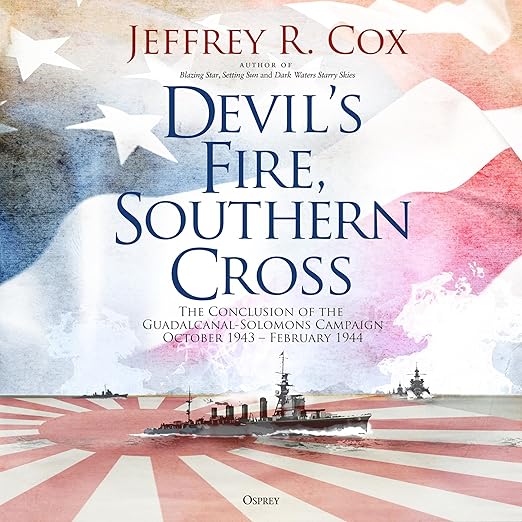
Jeffrey Cox closes his four-volume series on the Guadalcanal-Solomons Campaign with the same tension that defined the earlier books, which is the tension between operational chaos and the narrative clarity that hindsight makes possible. Devil's Fire, Southern Cross covers October 1943 through February 1944, the closing months of a campaign that both the US Navy and the Imperial Japanese Navy had repeatedly mismanaged before finally resolving in Allied favor. John Chancer reads it, and at twenty-eight hours and forty-one minutes this audiobook is not a casual commitment. I came to it having already spent time with Cox's earlier volumes, and returning to this series through Chancer's narration felt like re-entering a long, complicated conversation I was glad to be finishing.
Closing a Four-Volume Argument at Cape St. George
Cox's approach to military history is unusual enough to warrant naming directly. He combines first-rate scholarly research with what his publisher describes as a novelist's flair for the dramatic, and several reviewers have responded to this combination with qualified admiration. One five-star reviewer called it 'an extremely rare example of modern approach to history,' praising Cox's ability to marry deep knowledge of Pacific naval and military facts with 'style, language and humour.' A four-star reviewer, while praising the research, criticized 'the author's frequent sarcastic commentary' as a recurring distraction. Both reactions are identifying the same authorial feature and coming to different conclusions about whether it serves the work.
What Cox pulls off in Devil's Fire, Southern Cross is the closing of an argument that has been running across four volumes: that the US Navy came into the Guadalcanal-Solomons Campaign as the underdog and left it as a matured fighting force capable of near-textbook execution. The Battle of Cape St. George, which he discusses in detail, was described at the time as almost a perfect naval engagement, and Cox earns that conclusion by showing exactly how imperfect the preceding engagements had been. The intelligence thread, specifically the work of the United States Army Signals Intelligence Section and the Navy Communication Special Unit in intercepting and translating Japanese communications, runs through the final chapters as a structural explanation for the shift in Allied fortunes. Cox handles this material with appropriate precision without losing the reader in technical detail.
Chancer's Evenness Carries Twenty-Eight Hours of Battle
The audio format suits Cox's approach better than many World War II histories because his writing is paced for forward momentum. He does not linger in the archive. He builds toward engagement, then toward outcome, with enough character detail and institutional observation to maintain human scale across a very long run time. The Bougainville invasion, the Battles of Empress Augusta Bay and Cape St. George, and the parallel campaign in New Guinea all receive detailed treatment in these final chapters, and Chancer's narration maintains the thread across those overlapping operational contexts without losing the listener.
The fourth volume's particular strength is its structural coherence as a conclusion. Cox is wrapping up something he has been building toward for three previous books, and the satisfying argumentative completeness of the way Devil's Fire, Southern Cross arrives at its endpoint. The reviewer who called it 'the final one in the series regarding the Solomons Campaign' and documented its 'blow-by-blow account of the Bougainville Campaign, the New Guinea Campaign, various landings' was noting the breadth accurately: this is a comprehensive closing volume that does not shortchange any of the major operational threads.
Chancer's narration is effective for long-form military history. He reads with authority and clarity, differentiating between operational summary and character-driven anecdote without over-dramatizing either. For a twenty-eight-hour listen, that evenness is essential. A narrator who peaked too early or varied too dramatically would make the long stretches of tactical detail feel heavier than they are. Chancer maintains the kind of sustained professional attention the material needs.
Cox's Sarcasm Splits Readers Down the Middle
The sarcastic authorial voice Cox deploys is the element most likely to divide listeners. He uses irony and dry commentary to punctuate descriptions of command errors on both sides, and for listeners who come to military history expecting a neutral observational register, this reads as intrusive. For listeners who appreciate the judgment that comes from genuine expertise, it reads as earned commentary from someone who has studied these engagements closely enough to see the avoidable mistakes clearly. Neither response is wrong. If you found Cox's voice in the earlier volumes distracting, this fourth book will not have resolved that issue.
This audiobook is emphatically not a standalone entry point. The series argument, the character continuity, and the operational context all accumulate across the four volumes. A listener who picks up Devil's Fire, Southern Cross without background in the earlier books will have the tactical detail but not the comparative perspective that gives Cox's argument its force. Start with the first volume if you are new to this series.
Best for Series Veterans, Not Casual Newcomers
Listeners who have followed Cox's Guadalcanal-Solomons series from the beginning will find Devil's Fire, Southern Cross a genuinely satisfying conclusion: rigorous, readable, and comprehensive in its coverage of the campaign's final months. Students of Pacific War naval history and listeners interested in the intelligence dimension of the Allied advance will find the signals intelligence thread particularly rewarding. This audiobook is not suited to casual listeners or newcomers to the Pacific War period without substantial background. At nearly twenty-nine hours, it asks for the kind of investment that rewards preparation and prior context.