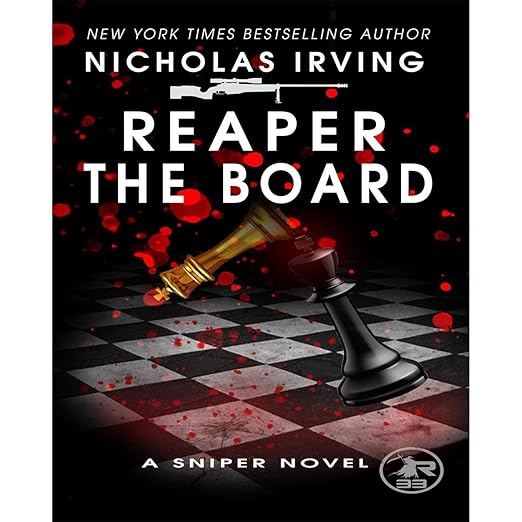
Two things on this listing point in opposite directions before a single minute of the audiobook plays. The title says memoir, the shelving agrees, and the tags read biographies and memoirs, history, military and war. The description says something else entirely: Vick Harwood is back from the dead, his exile in Mexico interrupted, his girlfriend Maria Constrera murdered by a government entity called THE BOARD, and a cross-border chase underway to dismantle it before it finishes what it started. That is a novel, and a fairly hard-charging one. Five hours and forty minutes is what the file amounts to, which is short for the plot it carries.
The Series Field Reads One, Reviewers Say Four
THE BOARD is the engine, and the copy is unusually forthcoming about it. Broad Oversight and Research Development, expanded inside the very sentence that introduces the acronym, exists to maintain and influence global economic demand and the people positioned at the top of it. Its agents sit inside the CIA, the NSA, the White House and British Secret Intelligence. Its methods, per the same paragraph, run to crime, drugs, human trafficking and the manipulation of foreign and domestic governments. None of that is subtle and none of it is meant to be. What the paragraph does establish is scale, a conspiracy wide enough that one man cannot simply out-shoot it, which is the load-bearing promise of the whole book.
Grammar gives away the sequel question. A description that opens with a character being back, from the dead, that is, describes a return, not an introduction, and the series field on this record reads one. The written column settles it. A four-star filed in April 2024 gives the title as Reaper: The Board, is glad the author wrote another Harwood story, and points anybody hunting military thrillers toward the four Reaper books. A January 2026 five-star calls this a favorite among the Reaper novels and hopes the ending leads to more of them. Both are describing a series already well underway, on a page that presents itself as a starting point.
The Writing Placing You at Harwood's Shoulder
Pace is what the column agrees on. A March 2026 five-star reports real difficulty putting it down, credits the writing with placing you at Harwood's shoulder, and recommends it as an introduction for anyone curious about the community the book depicts, singling out the brotherhood, the training and the life experiences dropped in as small pieces, never as lectures. That same entry flags a late twist it had not anticipated. Under six hours, this is a book you finish across two or three sittings, and whatever the shelving claims, it moves like a chase novel with a body count, because that is what it is.
Scope is the other draw. A conspiracy staffed from inside four separate intelligence and government bodies gives the plot somewhere to run, and the copy promises a race across a border, not a manhunt inside one city. Anyone who wants the sub-genre's furniture will find the full set: a protagonist with a skill set he keeps trying to retire, a private grief driving a professional mission, an organization accountable to nobody elected. A runtime this short also leaves no room for the sagging middle that ruins plenty of thrillers at twice the length. The plot never stops long enough to develop one.
Virtual Voice Testing Whether Delivery Survives Dialogue
Where a reader's name belongs, this record carries the words Virtual Voice. That is a synthesis label rather than a person, and it changes the purpose of a sample. With a credited narrator you are testing an interpretation. Here you are testing whether the delivery survives dialogue, an acronym expanded mid-sentence, and the jump between a beach in Mexico and a briefing room. Nobody who has written on this page has graded the reading at all, so the sample carries the entire burden of proof. Spend three minutes on a stretch of dialogue rather than on the opening paragraphs, which almost any voice can carry.
Copy-editing is the second thing to weigh, and the page raises it without prompting. A five-star from August 2024 scores the book eight out of ten and itemizes the deduction: numerous grammatical and spelling errors, plus a car described as a four-cylinder V6, an engine that cannot exist. The same entry found the ending a little rushed, and still liked the book enough to go and buy the author's autobiography afterward. None of that is fatal. It does matter more here than it would elsewhere, because a person reading aloud tends to smooth a typo over without comment, and a synthesis label promises nothing of the kind.
Shelving compounds the confusion. Biographies and memoirs is the primary category on this listing, history sits second, and the book being described is a thriller built around an invented agency. A search for the author's nonfiction lands here; so does a browse of the history shelf; neither search wanted this. The series number reads one, which the description's own first line contradicts. The badge, at least, is sound: 4.5 across ninety-four ratings is an ordinary average produced by an ordinary crowd, and no arithmetic objection arises. What those ninety-four people believed they were grading, on a page that disagrees with itself this thoroughly, is the harder question.
Works Considerably Better as a Second Book
Military-thriller readers with an evening free are the obvious audience, especially the ones who prefer the conspiracy end of the genre to the procedural end. An August 2025 five-star is worth weighing for exactly that reason: the reader admits books are no longer a habit, bought this one on the strength of the author's name alone, and finished it anyway. That is the profile the book serves best, somebody who wants forward motion and does not need the prose to do anything else. Anybody already following Harwood and waiting on the next installment is served too, whatever number this listing decides to assign it.
Pass on this one if you came for the memoir. Nothing in the description is autobiography, and a listener expecting a first-person account of a career will spend the whole file inside a thriller instead. Anyone who needs clean copy should weigh what the column reports, since errors on the page carry straight over into a synthetic reading with nobody standing by to catch them. And a listener who wants a self-contained story should note that the record's own opening line hands you a hero returning from a death you never witnessed. Approach it as book two of something and it works considerably better.
At a Glance
- Big ideas: Conspiracy thriller, an operator dragged out of retirement, revenge across a border
- Atmosphere: Fast, blunt and violent
- Worth it?: A propulsive short thriller wearing a memoir's title and a memoir's shelf tags, so be sure which book you are buying.
A Few Questions About The Reaper
Is this audiobook a memoir or a novel?
The description is a novel. It follows Vick Harwood out of exile in Mexico and against a covert body called THE BOARD, whose name the copy expands as Broad Oversight and Research Development. The category tags say biographies and memoirs, and the two do not agree with each other.
Who is credited with reading this audiobook?
The reader field carries the words Virtual Voice, which is a synthesis label and not a person's name. No performer is named anywhere on the record, and nothing written underneath it assesses the delivery, so the audio sample is the only way to judge before buying.
Do I need the earlier Reaper books before this one?
The series field numbers it first, but the copy opens on a hero returning from the dead and refers back to a murder that happened elsewhere. Prior events arrive as summary. You can follow the plot cold, though the past arrives as summary and never as scene.
Is the runtime enough for a conspiracy plot this wide?
Under six hours, which is brisk for a story spanning several agencies and two countries. The upside is momentum with no slack in the middle. The trade-off is that the organization gets described more than it gets dramatized, and secondary figures stay thin.