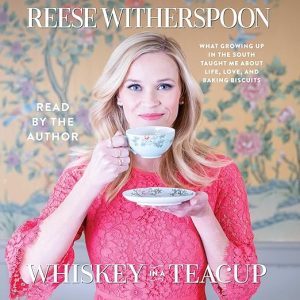
Reese Witherspoon's grandmother Dorothea gave her a phrase the Academy Award-winning actress and producer has clearly turned over many times: Southern women are whiskey in a teacup, delicate on the outside and fiery within. That tension between ornament and strength is the organizing idea of this audiobook, which Witherspoon narrates herself, and it arrives with the kind of relaxed confidence that only comes from someone telling stories about a world they genuinely love rather than performing nostalgia for publication. The self-narration is not a gimmick here; it is the whole point of why this works as an audio experience.
Whiskey in a Teacup sits at an interesting generic intersection. It is part memoir, part lifestyle guide, part cookbook, and part love letter to a specific regional identity. The print version is known for its photographs and recipes, which means the audiobook format is working with a deliberately text-forward presentation that requires Witherspoon to carry more of the weight through her voice alone. She compensates by leaning hard into the storytelling mode, filling in the visual gaps with anecdote and personal history that the photographs in the print book cannot provide. The result is a listening experience that feels more intimate than the print version can offer, even as it necessarily surrenders the book's considerable visual design elements.
What Makes Whiskey in a Teacup Worth Hearing
The central appeal of this audiobook is Witherspoon herself as narrator. She does not perform her Southern identity; she inhabits it, and the result is a listening experience that feels less like a celebrity book and more like spending two and a half hours with someone who has thought carefully about what home means and what it means to carry home with you wherever you live. The bluegrass parties, the fried chicken recipes passed down from Dorothea, the hot-roller technique she describes as only slightly insane, all of it lands with a warmth that reads as genuine rather than curated for a lifestyle brand audience.
The Dorothea stories are the strongest material in the book, carrying genuine tenderness that cuts through the lifestyle-guide framing consistently. The grandmother who distilled Southern womanhood into a single memorable metaphor emerges as a fully felt presence in the audiobook, which is no small achievement for a supporting figure who appears primarily through memory and recipe. Witherspoon's recollections of Dorothea's hosting philosophy, her sense of celebration as an everyday practice rather than a special-occasion performance reserved for company, give the book its emotional backbone and separate it from purely aspirational lifestyle content.
Listeners who have encountered Witherspoon primarily through her screen work may be surprised by how much genuine personality comes through in the narration. She is funny in a dry, self-aware way, particularly about her own attachment to Southern customs that might look excessive from the outside. The observation that there is a southern side to every place in the world works in her voice because it is clearly offered in a spirit of enthusiasm and genuine invitation rather than parochialism or regional superiority. The book wants you to find the equivalent of a midnight barn party wherever you are, and she makes that aspiration feel attainable rather than merely aspirational in the hollow lifestyle-content sense of the word.
Things to Know Before Starting Whiskey in a Teacup
The hybrid format creates practical considerations for audiobook listeners. The recipes are included and read aloud, which divides listeners cleanly. Some find it charming and useful; others will want a notebook handy or accept that recipe content works better in print. The party-planning sections describe decorating approaches and table settings with considerable visual specificity that audio cannot fully translate. If your primary interest is Witherspoon's personal stories and family memories, the audiobook delivers those fully. If you are hoping to extract workable recipes or visual inspiration from the lifestyle content, the print edition will serve you more completely.
At two hours and fifty minutes, the runtime is short enough that the book's selective depth feels appropriate rather than thin. Witherspoon is not writing a comprehensive Southern memoir; she is offering a curated selection of the traditions and memories that have shaped her, and the tightly edited length keeps the warmth from curdling into nostalgia or into the kind of aspirational lifestyle content that exhausts rather than refreshes. It is a book that knows exactly what it is and is confident that the thing it is has value.
Who Reese Witherspoon Is Writing For
This audiobook will appeal most to listeners who enjoy celebrity memoirs with a strong lifestyle and food component, who have an affinity for Southern American culture, or who are looking for warm and well-told personal stories with genuine emotional texture behind them. Fans of Witherspoon's professional work who want to understand more about the regional identity she expresses consistently in public will find it genuinely illuminating about where that identity comes from and what it actually means to her beyond branding. The book also works as an introduction to the kind of Southern entertaining tradition that Witherspoon has built her Hello Sunshine brand around; understanding where those aesthetic impulses originate makes subsequent engagement with her projects more coherent. Listeners who approach celebrity books with skepticism or who are looking for conventional memoir depth and sustained introspection may find the format too light and curated. The self-narration is a significant asset; this is very much a listening experience rather than a reading experience, and Witherspoon's voice carries the material in ways the text alone cannot replicate.
- Voice: Reese Witherspoon narrates her own book with the warmth and conversational ease of someone who genuinely loves the stories she is telling, and the Southern cadence in her voice is exactly right for this material.
- Big ideas: Southern identity and tradition, hospitality as care, family inheritance
- Atmosphere: Warm and celebratory, with a streak of genuine sentiment
- Worth it?: A personal and entertaining audiobook that delivers on its promise of Southern warmth, best appreciated by listeners who enjoy celebrity memoirs with strong lifestyle and food content.
Common Questions
Does the Whiskey in a Teacup audiobook include the recipes and lifestyle content from the print book?
Yes, the recipes and entertaining tips are read aloud, though without the photographs central to the print edition. Listeners interested primarily in the recipes may find it useful to have something to write with, or to use the audiobook as a companion to the print version.
Is the Whiskey in a Teacup audiobook worth it for listeners not particularly interested in Southern culture?
Witherspoon's narration and the personal family stories, particularly those about her grandmother Dorothea, carry genuine appeal beyond regional interest. The hospitality-and-tradition framing is warm enough that listeners from any background will find something resonant in it.
How does Reese Witherspoon perform as a narrator for her own audiobook?
Very naturally. The conversational ease and authentic Southern cadence in her voice suit the material exactly. It is one of those self-narrated celebrity books where the author's voice is an unambiguous asset rather than an awkward novelty.