Key Details
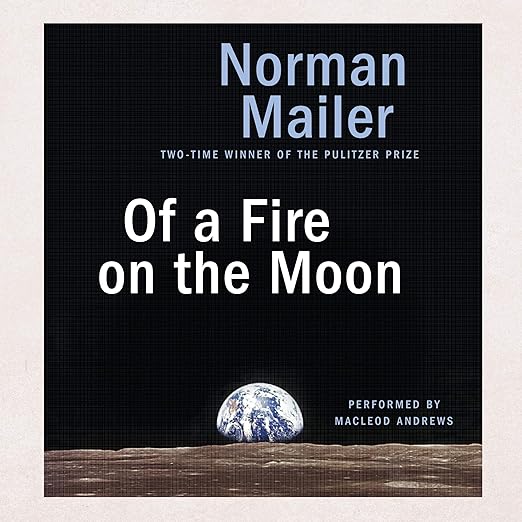
- Performance: MacLeod Andrews takes the entire seventeen and a half hours alone, Mailer's sentences and the mission-control exchanges alike, with no cast to hand the technical material to.
- What it covers: Apollo 11 as reportage, Cold War ambition, the reporter inside his own story, machinery and awe.
- Feel: Grandiose, self-aware, technically exact.
- Our call: Extraordinary writing about the moon landing wrapped around an author who never leaves the frame, and you buy both or neither.
Seventeen hours and thirty-two minutes is a long stretch to spend inside one writer's head, and a substantial part of this audiobook is exactly that. Norman Mailer went to Houston and Cape Kennedy in 1969 to cover the Apollo 11 mission for Life magazine, and what he filed was partly reportage and partly a running account of what the mission was doing to him. Anybody deciding whether to buy needs that fact before any other, because it is the fault line the reception column splits along, and no summary of the book mentions it.
The Cold War, God, Machinery, and Himself
Reportage is the spine. Mailer published these dispatches in Life between 1969 and 1970, and the publisher's description is accurate about what they hold: first-hand access inside NASA's operations in Houston and at Cape Kennedy, technical explanation of what the agency was attempting, and long passages placing the flight in human context. The last of those is where his reputation was made and where the trouble starts. A journalist covering a launch writes about a launch. Mailer wrote about the Cold War, American greatness, machinery, God and himself, in whatever order the material suggested, on the assumption that his own reactions constituted evidence about the century. Sometimes that assumption pays enormously. Sometimes it is a man talking about a man.
Classification on this record is peculiar enough to mention. The genre fields file a 1969 magazine assignment under biographies and memoirs, which is arguable, and under computers and technology, which is not. Beside them sits a tag reading Adventurers, Explorers and Survival. None of the three will bring the right listener here. A buyer browsing the technology shelf for a history of computing meets seventeen hours of literary journalism instead, and somebody hunting New Journalism, which is what this actually is, will never encounter it under these headings at all. Categories stop being cosmetic on a catalog of this size.
Speech Read Aloud, Returned to Itself
Prose is the reason to spend the time, and one five-star entry from a listener who had never read Mailer before puts the case well: the writing is stunning, and it takes the sterile step-by-step progress toward the moon and breaks it down practically moment by moment into descriptive prose, including a great deal of the actual transcript of conversations between the astronauts and mission control. That last detail matters more in audio than it does on paper. Transcript is speech that has been written down, and speech read aloud is transcript returned to its original condition. The exchanges between Houston and the spacecraft were spoken before they were printed, and hearing them gives back something the printed book can only represent.
Technical authority is the second surprise. Another five-star response, from a listener who expected an entirely different kind of writer, reports that Mailer handles the physical background and the engineering detail with such familiarity that he might have been a senior engineer employed by NASA and a participant in the Apollo project. That is a genuine feat of research, and it is why the book has outlasted nearly everything else written at the time. The technology of 1969 is hard to explain: the machine was enormous, the margins were minute, and the vocabulary was brand new. Mailer learned it thoroughly enough to make a reader who has never seen a rocket understand why one line on a checklist could decide the whole thing.
Pompous in the First Half, Interesting in the Second
Mailer himself is the objection, and two of the graded responses make it plainly. A four-star calls his vanity often unendurable and argues that by repeatedly putting himself in the middle as a yardstick he demonstrates his own irrelevance, adding, with visible exasperation, that the point did not need making over and over. A three-star is blunter: the first half of the book, about Norman Mailer, was pompous and annoying, and the second half, about Apollo 11, was interesting and informative. Both complaints are fair and both are inseparable from the book's method. His presence is not merely an accident of ego; it is the structural device by which a technological event gets converted into a human one. Whether the trade is worth seventeen and a half hours depends on your tolerance for the trader.
Chronology on this page is worth pointing out. Brilliance Audio released the recording on December 27, 2015, and two of the five written entries carry dates from earlier that same year. Those responses cannot be about this file. They were written about a printed or digital edition and later pooled onto the audio listing, which is not deception but filing: one reception column assembled across formats and displayed beneath a single score. It also explains the gap a buyer will notice. Nothing in this column addresses MacLeod Andrews or the reading, and seventeen and a half hours of long-sentence literary journalism is a demanding assignment for anybody, which makes that assignment the thing a listener is really buying.
The Immodesty and the Ambition Are the Same
People who remember the landing are the natural audience, and they know who they are. One five-star entry, filed under a headline reading Still relevant 45 years later, opens with a high school graduation in June 1969 and then the evening of July 20, watching television at a friend's house on a hot and sticky night in Northern New Jersey while Neil Armstrong stepped onto the moon at 10:18. The entry moves on toward what Kennedy had set in motion and the sentence goes no further on this page. That is somebody for whom the material is memory rather than history, and Mailer wrote precisely for that reader: a person who felt the event and wants an account large enough to hold what they felt.
Avoid it if you want the mission and nothing else. Plenty of Apollo books hand over the engineering and the countdown with no author in the frame, and a listener who resents the intrusion will be resenting it for a very long time here. Avoid it too if long sentences are difficult for you in audio, because these paragraphs are built to be read twice and a recording offers no graceful way back. Anyone who needs a neutral account of the period should look elsewhere as well, since neutrality was never on the table. Mailer wrote one of the strangest and most ambitious books anybody produced about the moon landing, and after seventeen hours the immodesty and the ambition turn out to be the same thing.