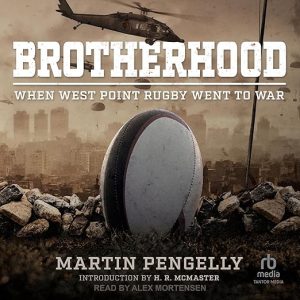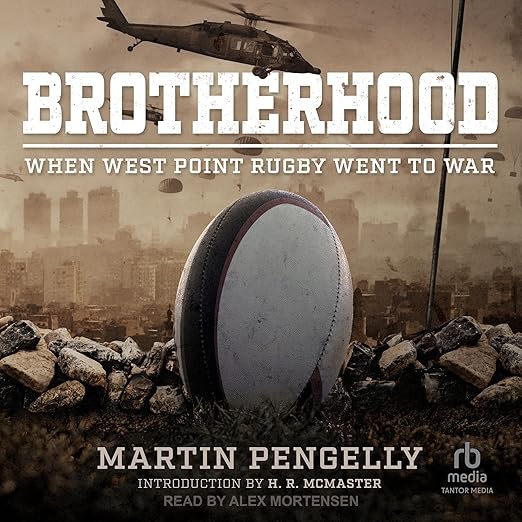
The particular craft of Brotherhood, Martin Pengelly's audiobook about the West Point rugby team of 2004 and what followed for those fifteen men, lies in how it refuses to collapse into either a sports story or a war memoir. Pengelly spent years following these men, earning the kind of access that only genuine trust produces, and the result is something more formally ambitious than most military biography: a book assembled from intimate portraits rather than chronological march, one that uses the rugby field as a way to understand the battlefield and vice versa.
The West Point rugby team of 2004 played together before 9/11 reshaped what their Army careers would mean. By the time they graduated, the world had changed around them, and the deployments that followed sent them to Afghanistan, Iraq, and Europe, into infantry roles and aviation, into direct combat and support positions far from the action. Pengelly tracks all of them, and the divergence of their paths is itself the book's central argument: that the same bond formed on a sports field produces very different kinds of loyalty and loss when tested by very different kinds of war.
One of the players died in Baghdad when his convoy hit an IED. Two others died away from combat, but no less tragically. Pengelly does not sensationalise these deaths. He earns them by making the living men so fully present that the losses land with the weight they deserve. Readers who have praised the book as 'well written and researched' and as capturing 'men who exemplify the best of our country' are responding to something real: Pengelly has done the reporting, and the reporting shows. This is not a hagiography, but it is a book written with genuine admiration for people who chose to serve under extreme circumstances.
Mortensen Keeps an Ensemble Cast Oriented
Alex Mortensen narrates, and his performance is effective for material that demands tonal range. The rugby sections require a different register than the combat sections, and Mortensen manages the shift without making it feel mechanical. He handles the proper nouns, the military terminology, and the player names with the clarity this kind of ensemble cast demands. At eleven hours, the audiobook asks for real investment, and Mortensen earns it by keeping the listener oriented across a large cast and considerable time span. His delivery in the grief-weighted passages is restrained in the right ways, allowing Pengelly's careful prose to carry the weight rather than performance.
Pengelly's own background as a rugby player gives the sport sections an authority they might otherwise lack for American readers encountering rugby as a relatively unfamiliar sport. One reviewer noted that the book rewards people who 'like and understand rugby and the military,' and that specificity is both the book's strength and the honest caveat: the sport is not translated for the uninitiated. The rules and culture of rugby are assumed rather than explained, and listeners who come in cold may occasionally find the sport sections opaque. The military sections are more accessible by design, given their cultural prominence in American nonfiction.
The Word Brotherhood Doing Serious Work
The book covers a long arc: from the pre-deployment years at West Point through the men's careers and, in some cases, their deaths. Pengelly weaves this chronology across multiple subjects simultaneously, and listeners who prefer strictly linear narrative structures may find the cross-cutting demanding. The choice to use intimate portraits rather than a single protagonist's point of view is a deliberate structural decision that pays off in emotional depth but asks more of the listener in terms of keeping the ensemble straight.
The title word 'brotherhood' is doing serious work here. Pengelly is examining what that bond actually means, and does not mean, when it is tested not just by sport but by years of separation, different deployments, different outcomes, and different kinds of survival. The book does not romanticise the concept. If anything, it complicates it in ways that feel more honest than most military narratives. The deaths of teammates in radically different circumstances than the battlefield make the word ring with additional dimensions that deserve attention.
Listeners approaching this audiobook after reading Sebastian Junger's Tribe or David Finkel's The Good Soldiers will find Brotherhood working in a similar register: intimate, carefully reported, and honest about the costs of service without reducing those costs to statistics or policy arguments. Pengelly's access gave him material that most military journalists do not get, and the book uses that material generously rather than saving it for dramatic moments.
The book's West Point setting also rewards some prior understanding of the academy's culture and the particular pressures it places on its cadets. Pengelly does not assume that knowledge, but listeners familiar with West Point's traditions and the 'Duty, Honor, Country' motto that runs through the book will find additional resonance in the ways rugby intersected with that institutional formation. The sport became, in Pengelly's telling, one of the places where the academy's demands took physical form and produced the specific kind of trust that combat would later test.
Quieter, and More Lasting, Than Either
This audiobook is for readers drawn to serious military memoir and sports biography who want both held in the same book without either being shortchanged. Listeners who already have an interest in rugby or West Point culture will get more from the sport sections, but the book's emotional core does not require that background. People who responded to Junger or Finkel will find Brotherhood working in a similar register. Skip it if you are looking for action-forward combat narrative or a straightforward sports-triumph story. This is quieter, and more lasting, than either of those.
The Short Version
- Narrator: Alex Mortensen handles a large ensemble across eleven hours with clarity and appropriate tonal range, managing the shift between sport and combat sections without strain.
- Subjects: military service and sacrifice, the meaning of brotherhood, sport as bonding and preparation
- Tone: Reflective and grave, with bursts of warmth in the West Point years
- Bottom line: A rigorously reported, structurally ambitious audiobook about men shaped by rugby and tested by war; Mortensen's narration keeps the large cast navigable.
Common Questions
Do I need to know rugby to follow this audiobook?
A basic familiarity helps. Pengelly does not explain the game for newcomers, so some sport sections may feel opaque if you have no rugby background. The military sections are more accessible, and the emotional core of the book comes through regardless.
Is this audiobook primarily a sports story or a military biography?
It is genuinely both, and the structure holds them in parallel. Pengelly uses the rugby team as the foundation for tracking what happened to fifteen men after graduation; some deployed, some saw action, some did not, and some did not come home.
How does the audiobook handle the deaths of teammates without becoming sensationalist?
Carefully and with restraint. Pengelly builds each person so fully before tragedy arrives that the losses feel personal rather than illustrative. Mortensen's narration in these sections is similarly measured, allowing the material to carry its own weight.
Is this audiobook comparable to other serious military memoirs like Sebastian Junger's work?
The comparison is apt. Brotherhood shares Junger's interest in the psychological and social dimensions of military bonds, and Finkel's The Good Soldiers is another close parallel: intimate portraits of individuals within institutional structures, with honest attention to cost.