The Short Version
- Performance: Charles Busch is credited as the reader of his own text, which is the steadiest fact on a record whose other fields contradict one another.
- What it covers: Backstage comedy, the Lincoln assassination seen from the wings, ambition and vanity
- Feel: Arch and theatrical, undercut by a listing you cannot trust
- Our call: A first-rate premise attached to a record that cannot tell you what you are buying, so verify before you pay.
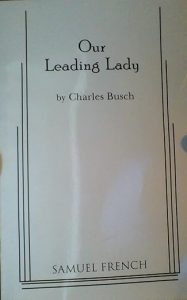
The publisher field on this record reads S. French, the release date reads January 2007, and the genre fields say biography, memoir and LGBTQ+. The runtime, meanwhile, says nine hours and twenty-two minutes, and the description sells a stage comedy. Those things do not describe one object. Anyone considering this audiobook should know that before anything else, because the description belongs to a stage comedy called Our Leading Lady while the title on the record is Leading Lady, and nothing on the page explains the difference.
Laura Keene's Season Interrupted by an Assassination
Washington, DC, in 1865 is the setting the description gives, and the premise is genuinely good. Laura Keene, the British-born stage actress, is running the company performing Tom Taylor's Our American Cousin at Ford's Theatre on the night Abraham Lincoln is shot by John Wilkes Booth. In classic Charles Busch fashion, the copy says, a presidential assassination is not merely a national tragedy but a vexing interruption in a powerful woman's quest for fame and glory. That is a real comic engine: the largest event in nineteenth-century American life, seen from the wings, by somebody whose first concern is the run of her show.
Three signals on this record point in three directions. The publisher abbreviation and the 2007 date belong to an acting edition, the slim paperback a theater company orders by the dozen. The classification, biography and memoir sitting beside performing arts and LGBTQ+, describes a life story rather than a period farce. And nine hours and twenty-two minutes is longer than any performance of a two-act comedy would run. The description carries a scar of careless handling too, with the play title and the theater name run together into a single word, which is the kind of damage that happens when copy is pasted between systems.
The Playwright Reads His Own Comic Timing
Comedy pointed at catastrophe is difficult to place well, and the angle the description promises is the one that works: not jokes about the assassination, but jokes about the people for whom the assassination was, first of all, an interrupted performance and a ruined season. Theater people are ideal material for that because their sense of proportion is professionally deranged. The event that ends a presidency also ends a run, and the second loss is the one the character in the middle of this play can actually do something about. That monstrous, sympathetic self-regard is what the copy means by classic Charles Busch fashion.
Busch is credited as both the writer and the reader here, and that pairing is one of the few coherent things on the record. A playwright reading their own comic dialogue holds an advantage no hired reader can buy, because the writer knows where the laugh sits, having built it, and knows which lines are load bearing and which exist only to set up the next one. Comedy of this arch, cultivated kind lives or dies on that timing. What the record does not tell you is which text is being read into those nine hours.
A Five-Star Review That Never Mentions Listening
A single five-star grade sits on the listing, filed in February 2014, calling the piece the best comedy of the last ten years, saying it rivals Noises Off, and then giving the whole thing away: do not miss the play if you get a chance to see it, or get the script listed above, because even at this price it is worth it. That is a verdict on a work of theater and a recommendation to buy a printed script. Nobody in those sentences is listening to a recording.
The Arithmetic That Doesn't Explain Itself
One rating produces the 5.0 badge, and a single voter choosing the top of the scale is arithmetically ordinary, so the number itself is not the problem. What cannot be established is the object the click was attached to. Where title, description, publisher, release date, runtime and genre all disagree, an anonymous five from 2014 is a verdict on something unspecified, and it is carrying the entire visible reputation of the page by itself.
Before buying, do the arithmetic the record will not do for you. The description would be exhausted long before nine hours of audio were, so either the recording holds a great deal that the copy never mentions, or the copy belongs to a different work by the same writer and was attached here by accident. Both are common where several editions of one author's catalog get merged under a single identifier. The product page, not this record, is where you should be able to find what the file actually contains and how long the thing being read is.
Buy the Busch Name, Verify Everything Else
Approach this as a Charles Busch purchase first, because that name is the one claim on the record that survives every contradiction. If the register appeals to you, arch, backstage, theatrically self-aware, the premise on offer is among the strongest in that mode: a woman for whom a national tragedy is primarily a scheduling problem. Historically curious listeners get something as well, since the events are real and the vantage point, the acting company whose performance was interrupted, is one that popular accounts of that night rarely bother to take.
Pass on it unless you are willing to verify what you are buying first. Anyone who wants the play as a play is better served by a printed text or a staged production. Anyone who wants nine hours of Busch reading should establish what those nine hours contain before paying for them. Until the fields on this record agree with one another, the safe purchase is the one made after the seller states plainly what is on the file.
What does the description on this audiobook actually cover?
A comedy set in Washington, DC in 1865, built around Laura Keene, the British-born actress whose company was on stage with Our American Cousin the night Abraham Lincoln was killed at Ford's Theatre. The assassination works as an interruption to her ambitions rather than as the subject of the piece.
Is Charles Busch reading his own work here?
The record credits Busch as both author and narrator, which is the steadiest pairing on the page. What the fields never settle is which work fills a runtime past nine hours, since the copy describes a stage comedy and no performance of a two-act play lasts anything like that.
Should I buy this audiobook without checking the product page first?
No. The fields fight each other: an acting-edition imprint, a 2007 date, a runtime no stage comedy could fill, and a classification pointing at memoir. The only written verdict on the page concerns a theater production and a printed script, so confirm what the file holds before paying for it.