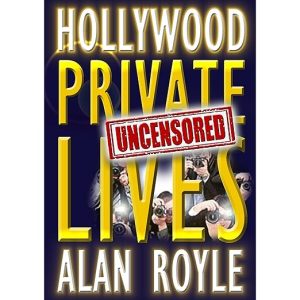
Gossip about dead film stars is a genre with a built-in problem, and Alan Royle's book runs straight at it. The promise is Hollywood's Golden Age minus the hype and hokum: private lives, private deaths, nine hours and forty-nine minutes of what the studios spent decades burying. What the audiobook does not tell you is who is reading it, since the narrator field names a synthetic reading rather than a person. It also does not tell you that every written opinion on the page was filed before this recording existed.
A Third of It, Maybe, and That's Fine
Somebody who finished it in November 2022 filed four stars and a warning in the same breath: a fun read, just do not take it seriously, and a frank admission of believing about a third of it. That is the most honest account of this book anybody has managed, its publisher included. Royle is not doing archival history. He is collecting the stories that circulated in and around the studio system and arranging them into a shape. Taken as that, it works well. Taken as anything sturdier, it falls apart immediately.
Nine hours and forty-nine minutes is a great deal of anecdote, and anecdote happens to be what audio does best. The material runs star by star rather than as a single argument, which means you can leave and return without losing a thread, and a chapter that bores you costs very little. Books of this kind are ruined by being read too attentively. Heard while cooking or driving, at roughly the pace of somebody telling you something across a bar, they land the way they were built to land.
A Second Version of Every Famous Death
November 2021 produced the enthusiastic case, five stars for what that reader called Hollywood gossip at its best: easy, entertaining, riveting, and notable for the way Royle supplies alternate scenarios in cases where a crime seems to have been committed. That last point is the real selling proposition. Plenty of books recycle studio-era rumor. Far fewer will set out a second version of a famous death and leave you to weigh it, and that willingness is exactly what makes the book both enjoyable and suspect.
Fine for Bulk, Bad for a Punchline
Golden Age Hollywood keeps its pull for a specific reason. The studios ran a publicity operation designed to control what the public was allowed to know about the people under contract, and Royle's entire subject is what that operation was holding down. Anyone arriving for scandal will be given scandal in quantity. Anyone arriving to understand how the scandal was managed, and by whom, will find that sitting underneath it, which is the more durable of the two pleasures on offer here.
Machine narration changes the calculation, though not only in the obvious direction. A generated reading is a poor match for material that depends on landing a punchline, and the tongue-in-cheek register this book runs in is exactly the register that needs a human sense of timing behind it. What synthetic reading suits reasonably well is bulk: nine hours and forty-nine minutes of names, dates and anecdotes, delivered evenly, at whatever speed you choose to set. Sample it first, because here the reading itself is the whole gamble.
Every Review Predates This Recording
Every written opinion on this page predates the recording. The audio edition was published in July 2025, no response was filed later than February 2023, and the earliest reaches back to 2016. Nobody who wrote here has heard this. That is not deception so much as format, since the reception column of an earlier text edition has been carried across onto an audio listing, which happens constantly and is almost never disclosed. It means the stars above those responses are grading a book, not a recording, and the distinction is the buyer's problem to solve.
One Click Can't Produce a Decimal Point
December 2019 brought the objection this book cannot answer, at three stars, from a reader who then argued the grade down to two without prompting. That account finished the book, skipped some late chapters out of boredom, and concluded the whole thing deserved less, on the grounds that people no longer alive cannot defend themselves against what might be sordid lies. The word chosen was sleazy. The example offered was Grace Kelly, and a tally of lovers the reader found arithmetically impossible for one lifetime.
Consider the number sitting under the stars. The badge reads 3.8 and the rating counter beside it reads one. A tenth of a star cannot arise from a single vote, because a decimal place requires a base wide enough for fractions to exist, and 3.8 needs at least five ratings before any average can reach it. Whatever produced that figure, it was not one person clicking on this recording. Treat it as decoration and go by the written column instead, thin and elderly as that column is.
For Rumor Lovers, Not Footnote Seekers
Studio-run Hollywood as one large brothel with not a lot of likable inhabitants is the sharpest summary of what you are buying, filed at four stars in November 2016 by a reader who called the book interesting anyway. That same response is unhappy about something else entirely, reporting many grammar and spelling mistakes, wondering whether the text transfers accurately between formats, and asking outright where the editors were. Nothing on this listing indicates whether that text was corrected before it was fed to a recording.
Come to it for the pleasure of a well-told rumor, and stay only if you can hold the material at arm's length for hours at a stretch. Anyone wanting sourced film history should look elsewhere, because nothing here is footnoted and the book never pretends otherwise. Anyone troubled by the ethics of publishing sexual allegations about the dead should also walk away, and that is a perfectly reasonable place to land. Curiosity about what the studios were burying is the only real reason to spend nine hours and forty-nine minutes here, and it happens to be a good one.
Who narrates this audiobook?
Nobody. The field where a performer would be credited reads Virtual Voice, so the recording was generated rather than acted, and no human reader is named anywhere on the page. Delivery carries more weight in gossip than in almost any other genre, which makes the sample the only honest test of whether this edition suits you.
Should I be uneasy about a book making sexual claims about people who have died?
It is a fair thing to weigh before buying. The premise is publishing what the studios suppressed about people who are largely gone, and nothing in the description suggests Royle pauses over the ethics of doing so. If that objection would trouble you, it will trouble you continuously rather than occasionally, starting in the first chapter.
Is this audiobook worth nine hours if I only care about the famous cases?
Probably not in one sitting. The material moves from figure to figure rather than building an argument, so it rewards dipping in far more than a straight run through does. Rumor gets numbing when it accumulates, and the cases you already half-know will be the ones you want to reach first anyway.