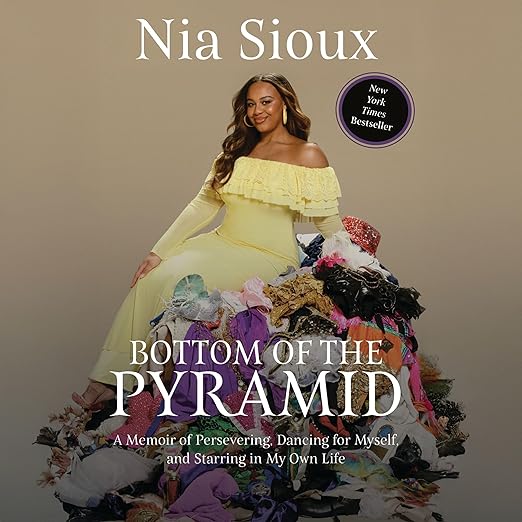
Nia Sioux was nine years old when she joined the cast of Dance Moms, one of the original girls in a show that would run seven seasons and generate years of cultural discussion about competitive dance, reality television, and the specific cruelties of being a child performer under sustained scrutiny. Bottom of the Pyramid, her New York Times bestseller memoir narrated in her own voice, takes the raw material of that experience and makes an argument about what was actually happening behind what viewers saw. This audiobook exists in a specific tradition of self-narrated memoirs where the author's voice is not an optional enhancement but the text itself.
Ostracized for an Aesthetic Not Built for Her
Publisher's Weekly described Sioux's memoir with unusual precision for a promotional blurb: "her harrowing reality TV ordeal cuts deep, and her subsequent self-assurance is endearing and infectious." The word "subsequent" is doing important work there. This is not a book that arrives at self-assurance as a vague destination. Sioux is specific about the path: the way her dance teacher's pyramid ranking publicly placed her at the bottom in front of millions of viewers week after week, the way she was "ostracized for not fitting into an aesthetic that wasn't designed for girls like her," the way her friendships and mental health deteriorated under the show's demands. The book earns its confidence because it accounts honestly for what confidence cost.
Reviewer CB's observation that the book is "brave, inspiring, raw, and moving" describes the emotional register accurately, but what distinguishes the work from the broader inspiration-memoir category is the specificity of its critique. The aesthetic that was not designed for girls like Sioux is not a vague complaint; it is a documented pattern of how competitive dance and its reality TV iteration have historically evaluated Black dancers against standards calibrated for a different body type. Sioux does not dwell in bitterness about this, which makes the analysis more pointed rather than less. The memoir threads the needle between bearing witness to real harm and insisting that witness is not the story's final word.
Unputdownable, Without a Narrator's Dramatization
The self-narration across six hours and fourteen minutes is crucial. Reviewer S. Bowman found the book unputdownable, finishing it in a single day. The audio pacing supports that experience. Sioux reads with the control of someone who knows exactly which sentences require emphasis and which need to land quietly, a skill developed through years of performance that translates directly to the recording booth. The passages about her mental health deterioration during the show's run are delivered without the dramatization that a professional narrator might instinctively apply, and that restraint is more affecting than performance would be.
The Argument Made Audible
The Amazon Kindle Customer who called this "an honest side of a very popular story" and noted Sioux's "maturity that is very present in the entirety of the novel" captures something specific about the memoir's narrative stance. Dance Moms generated enormous fan investment over its run, and a book written from resentment or for score-settling would have found an audience anyway. What Bottom of the Pyramid offers instead is reflection from someone who has genuinely processed the experience rather than simply documented it. That distinction matters across six hours of continuous listening.
The memoir's argument, that Sioux reclaims both the spotlight and her narrative by telling her version of events that never made it to the edit, is specifically well-suited to audio. On a television show structured around visual performance and producer-shaped narrative, the things left out of the broadcast were precisely the interiority, the off-camera conversations, the emotional realities that did not serve the drama. An audiobook of Sioux's own voice delivering the interior version of her experience is a formally fitting inversion of the television format that defined her public image. The format is not incidental to the argument; it is the argument made audible.
Affirmative, Not Forensic, and Not Seeking Pity
Listeners who approach this audiobook without prior knowledge of Dance Moms will find it accessible, but they will miss the specific context that makes certain revelations land. The show's culture was specific and documented, and Sioux's references to the pyramid ranking system, to particular competitions, and to the show's cast dynamics are grounded in a shared cultural reference point. A complete newcomer can follow the narrative, but regular viewers of the show will experience an additional layer of recognition when Sioux describes what the cameras did not capture.
The memoir concludes with an affirmative rather than a forensic stance, which is consistent with Sioux's stated intention of celebration rather than grievance. Readers who want an investigative account of Lifetime's production practices or a detailed exposé of specific individuals will find the book more interested in Sioux's internal journey than in institutional accountability. That is a deliberate choice about genre and tone, not a failure of nerve. Sioux states explicitly that she is not looking for pity, sympathy, or validation, and the audiobook holds to that intention throughout.
The Behind-the-Scenes Account Dance Moms Couldn't Give
Dance Moms viewers who want the behind-the-scenes perspective that the show structurally could not provide will find this audiobook the most substantive available account from an original cast member. Listeners interested in how reality television shapes and distorts its participants' self-perception will find Sioux's analysis unusually thoughtful for the genre. Anyone navigating their own experience of being measured against standards not calibrated for them will find the memoir's argument about defining success on your own terms grounded in specific rather than generic experience.
Listeners who want a traditional dance or performance arts narrative focused on technical achievement rather than personal reckoning may find the memoir more emotionally oriented than they expect. The dance content is present but serves the identity story rather than leading it. The audiobook is most powerful for listeners who come willing to hear the interior version of a public story they thought they already knew.
- Performance: Nia Sioux reading her own memoir is not a production choice, it is an essential component of the work. Her voice, the same voice that was systematically underestimated on television for seven seasons, is the argument the book is making.
- What it covers: Reclaiming narrative from reality TV, racial aesthetics and exclusion, resilience as active choice rather than passive endurance
- Feel: Direct and warm, with flashes of hard-won clarity that arrive when you least expect them
- Our call: Bottom of the Pyramid is a Dance Moms memoir that becomes something more precise once Sioux starts explaining what the cameras did not show, and the self-narration gives that precision an authority no hired voice could replicate.
Frequently Asked Questions
Does the Bottom of the Pyramid audiobook require familiarity with Dance Moms to be understood and enjoyed?
The memoir is accessible without prior knowledge of the show, but viewers of Dance Moms will experience an additional layer of recognition when Sioux describes events and dynamics from behind the scenes. The narrative stands alone, but the specific context enriches it considerably for fans of the series.
Why is Nia Sioux narrating her own audiobook significant beyond the typical author-reads-memoir choice?
Sioux spent seven seasons on a television show where her voice and narrative were shaped by producers and editing rather than her own choices. Reading her own memoir is the structural inverse of that experience: the same voice that was publicly underestimated now controls the pacing, emphasis, and interpretation of her own story. Publisher's Weekly noted the self-assurance as endearing and infectious in a way that specifically contrasts with the pyramid's judgment.
Is this audiobook primarily about competitive dance, or does it cover Sioux's career and identity more broadly?
The Dance Moms material occupies the memoir's core, but Sioux explicitly uses the experience as a lens for broader questions of identity, aesthetic exclusion, mental health, and reclaiming agency over one's own narrative. The competitive dance content serves the identity story rather than functioning as a technical memoir of a dance career.