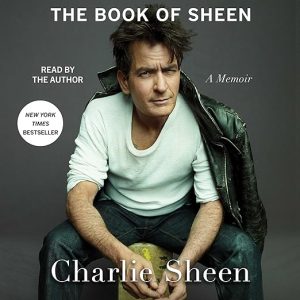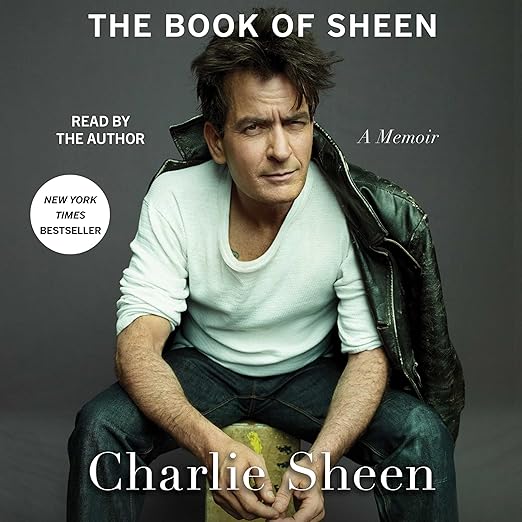
Charlie Sheen narrating his own life story is either a proposition that immediately appeals to you or one that makes you reach for the back button, and both reactions are reasonable. The Book of Sheen is a memoir by someone who has genuinely lived on the extreme edge of Hollywood excess, survived a public meltdown that became a cultural phenomenon, received an HIV diagnosis in the public eye, and come out the other side sober and willing to account for the wreckage. Sheen narrating it himself is the correct production choice, because the voice is the story, the audiobook works precisely because you cannot separate the person from the prose in a way that a third-party reader would expose.
The facts of Sheen's career are well known enough that the memoir's value lies not in revelation but in perspective and detail. He grew up on film sets, the third of four children of Martin Sheen, with brother Emilio Estevez and a roster of childhood friends who became household names, the Penn brothers, the Lowes. His early career in Ferris Bueller's Day Off, Platoon, and Wall Street established him as a serious dramatic actor before the sitcom years on Spin City and Two and a Half Men redefined him in the public mind. The memoir traces the arc from those serious early films through the 'extracurricular activities' that eventually became the defining public narrative, and the transition between those two versions of Charlie Sheen is where the book does its most interesting work.
A Voice That's Brash, Self-Aware, and Vulnerable
What reviewers consistently note about the memoir is the voice: 'brash, self-aware, and oddly vulnerable,' one put it. The self-awareness is the element that distinguishes this from celebrity confessionals that are really extended image rehabilitation exercises. Sheen is not trying to convince you that the public narrative was unfair. He is, to a considerable degree, confirming it while providing enough interiority to make the behavior comprehensible rather than simply scandalous. One reviewer described it as 'a raw, unfiltered, honest, and thoroughly entertaining memoir' where the author's 'unique voice and personality shine through every page.' That is an accurate description of both the written content and the audio performance.
The memoir is also funny, which should not be underestimated as a feature. Sheen has always had genuine comic intelligence, and the audiobook version allows that to surface in ways that print cannot fully capture. The timing of his delivery, the specific cadences of his humor, the moments where he steps back from the narrative to observe himself with wry distance, these work better in audio than they would on the page. The 8-hour-plus runtime is substantial but never tedious, because the voice keeps the energy moving even through passages that are covering well-documented ground.
More Platoon Than Two and a Half Men
One reviewer noted that Sheen 'spent a lot of time talking about Platoon' and wished for more coverage of Two and a Half Men. That is an honest observation about the book's proportions: Sheen's investment in his film work, and particularly in his father's Platoon legacy and his own participation in it, is evident in how much space the memoir gives to those years versus the television career. Listeners primarily interested in the sitcom era will find it covered but not at the depth some might want. Listeners interested in Sheen as a serious film actor from the Brat Pack adjacent era of 1980s Hollywood will find the early chapters rich with detail.
The HIV disclosure sections, the 'winning' period, and the implosion of the Two and a Half Men run are all present, and Sheen handles them with the clear-eyed candor the synopsis promises. The sober perspective from which he writes, he describes himself as now sober throughout, gives the narrative a reflective quality that distinguishes it from a purely in-the-moment account. He is not justifying; he is explaining, and the difference is palpable in the narration.
An Overstuffed Life, Not a Craft Failure
The book has a single existing rating in the data, so the critical consensus from listeners is not yet fully formed. What reviewers on record consistently praise is the voice and the candor; what they note as a limitation is the uneven coverage of different career phases. Sheen's attachment to the film work and his complicated relationship with the sitcom years means the memoir's center of gravity may surprise listeners who come in expecting a Two and a Half Men retrospective.
The 'overstuffed novel' quality the synopsis describes is real: Sheen's life contains enough material for several books, and the memoir necessarily compresses some threads while dwelling on others. The result reads episodically in places, with rich passages followed by summaries of longer periods. That is a structural feature of lives that have moved at this pace and density rather than a craft failure, but listeners should know the pacing is uneven rather than architecturally controlled.
Explaining the Persona, Not Rehabilitating It
Fans of 1980s Hollywood and the Brat Pack era who want the insider view from someone who was genuinely there will find the early chapters rewarding. Listeners drawn to celebrity memoir for the combination of candor and voice will find Sheen's self-narrated audiobook version of the genre among the more distinctive examples. Those interested in recovery narratives told without performative redemption arcs will appreciate the book's honest accounting.
Listeners primarily interested in the Two and a Half Men era or the public meltdown period as the narrative center should calibrate expectations, those years are present but not the book's center of gravity. Those put off by the public persona will not find the memoir designed to rehabilitate it so much as explain it.
Key Details
- Read by: Sheen narrating his own memoir is the correct choice, the voice is inseparable from the story, and his comic timing and self-aware delivery are significant assets the audio format captures better than print could.
- At its heart: Hollywood ascent and excess, the gap between public persona and private person, recovery and retrospect
- Vibe: Candid and often funny, with genuine vulnerability beneath the bravado
- Short version: A self-narrated Hollywood memoir that earns its candor rather than performing it, strongest for listeners interested in Sheen's serious early film career alongside the well-documented excess.