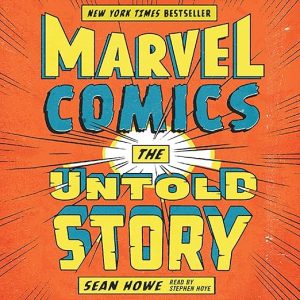
Who actually made the Marvel Universe, and what did it cost them? Sean Howe spent years reporting this book, and the audiobook version, narrated by Stephen Hoye, delivers that question across nearly eighteen hours with the controlled momentum of a very good long-form documentary. I came to Marvel Comics with the skepticism of someone who has read enough authorized corporate histories to know how carefully they tend to flatten the conflict. Howe's account does not flatten it. The conflict is the story.
Hoye is a reliable narrator of dense nonfiction: his pacing allows the listener to absorb names and dates without losing the thread, and he handles the crowded ensemble of Marvel's creative history with clarity. The book covers more than seventy years of institutional history and involves dozens of central figures, any of which could be lost in a lesser narrator's approach. Hoye keeps them distinct without resorting to character voices, which is the right call for this kind of history.
Lethem's Bunch of Weirdoes Who Changed the World
The audiobook's structural achievement is the way it balances institutional history and individual biography without letting either overwhelm the other. Martin Goodman's origins as a pulp publisher, Stan Lee's decades of editorial navigation, Jack Kirby's creative explosion and subsequent grievances, the artist disputes and contract battles and occasional chaos of the 1970s and 80s: all of it is threaded through a single continuous narrative that never feels like a listicle of events. Jonathan Lethem's blurb, describing it as the story of 'how a bunch of weirdoes changed the world,' captures the tone Howe achieves: it is affectionate without being uncritical.
The reviewer who describes the 1970s and 80s coverage as the book's strongest section is making an accurate observation. The pre-Fantastic Four era receives less detail than some listeners might want, but the decade from roughly 1974 to 1994 is covered in extraordinary depth, with behind-the-scenes drama around creator rights, distribution deals, near-bankruptcy, and editorial philosophy that makes the eventual Disney acquisition feel like the inevitable conclusion of decades of institutional instability.
A Three-Year Frenzy Under Work-for-Hire Rates
The audiobook draws on more than one hundred original interviews, which is a significant reporting investment, and the material surfaces throughout. Howe has access to people who were in the rooms where decisions were made, and those primary accounts give the book a texture that secondary histories cannot match. The disputes over creator credit and royalties that have shaped how the comics industry thinks about intellectual property are covered with a specificity that feels genuinely revelatory even for readers familiar with the broad outlines.
For listeners who grew up reading Marvel and now find themselves watching its properties dominate global cinema, this audiobook provides essential historical context. The characters and worlds that Stan Lee and Jack Kirby and Steve Ditko created in a three-year creative frenzy in the early 1960s, working for page rates under work-for-hire conditions that would become increasingly contested, are the foundation of a media empire whose origins are much stranger and more precarious than the official mythology suggests.
The People and Power Behind Marvel's Panels
At nearly eighteen hours, this is a substantial time commitment. Howe does not prioritize narrative propulsion over completeness, and some sections of institutional history, particularly the various ownership transitions and licensing deals of the 1980s and 90s, can feel dense even for engaged listeners. The reviewer who describes it as 'worthwhile though not brilliant' is reflecting this: the book rewards curiosity and patience but does not grip the way a tightly constructed narrative might.
Listeners primarily interested in the characters and stories rather than the business and creator history may find the institutional focus frustrating. This is ultimately a book about the people and power dynamics behind the work, not a guided tour of storylines and series. If that behind-the-curtain history is what you want, this audiobook is one of the most thorough available. If you want the stories themselves, this is not that book.
Hoye Tracks the Shift in Emotional Register
The audiobook also benefits from Hoye's ability to handle the tone shifts in Howe's writing. When the narrative moves from institutional analysis, the distribution deals and near-bankruptcies of the 1980s, to individual biography, Jack Kirby driving himself to the office despite a dispute that had not been resolved in years, the emotional register of the material changes, and Hoye tracks that shift. He is one of the more underrated narrators of complex nonfiction, and Marvel Comics is among his better pairings: the material rewards his particular skill set of organized clarity over theatrical interpretation.
Non-comics readers who are drawn to the book through the MCU films may find some sections unfamiliar in terms of the specific titles and creative personnel discussed. Howe does not assume encyclopedic comics knowledge, but he also does not stop to explain who every artist or writer is when they first appear. Listeners who keep a mental note of names as they appear and allow the narrative to fill in their significance over time will follow the book without difficulty. The story Howe is telling is ultimately about creative labor and institutional power, and those themes are legible without comics background.
Manageable at Eighteen Hours, Thanks to Hoye
Essential for anyone with a serious interest in American pop cultural history, comics history specifically, or the creator rights debates that continue to shape entertainment industry labor practices. Strong for longtime Marvel readers who want to understand the institutional context behind their favorite characters. Less suited to casual Marvel fans looking for story coverage or to listeners who find dense institutional history hard to sustain across long runtimes. Stephen Hoye's narration makes the eighteen-hour commitment manageable, but the content rewards those who come prepared to engage with a full-scale institutional biography.
Before You Listen
Does this audiobook cover the Marvel Cinematic Universe and the Disney acquisition?
Yes. Howe's history covers more than seventy years of Marvel's evolution, which includes the Disney acquisition and the run-up to the MCU. The book does not cover the individual MCU films in detail but provides the institutional context that explains how Marvel reached the point of acquisition.
Is this audiobook suitable for listeners who are Marvel fans but not comics readers?
Yes, though some familiarity with the key figures, particularly Stan Lee, Jack Kirby, and Steve Ditko, helps orient the institutional history. Howe provides enough context that the uninitiated can follow, but the book assumes the reader cares about the backstory rather than needing to be sold on Marvel's significance.
Is there a more recent audiobook on Marvel Comics history that might be more current than Sean Howe's account?
Howe's book was published in 2012 and covers through the early Disney era. More recent developments in the MCU and ongoing creator rights discussions are not covered. Listeners wanting coverage of events after roughly 2012 would need to supplement with journalism or more recent publications.