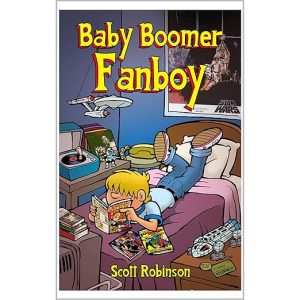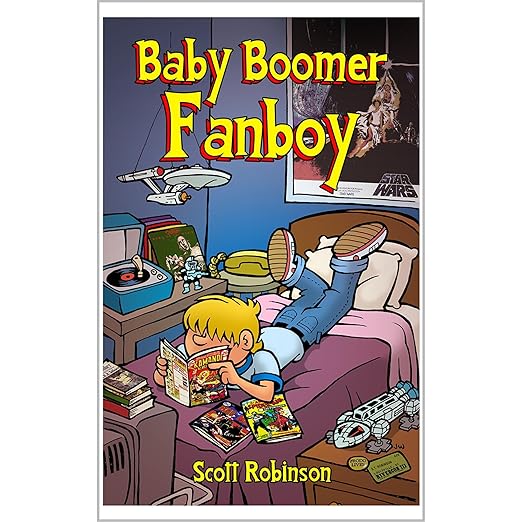
Nerd culture has its own creation myth, and it is usually told by someone too young to have lived through the years when being a science fiction fan was genuinely fringe. Baby Boomer Fanboy! by Scott Robinson is a welcome corrective: a memoir by a decorated veteran who was there when almost nothing existed on the shelf and the occasional silver-screen gem felt like a genuine cultural event. This audiobook, part of the 'Uncle Scott Overshares!' series, is exactly what its title promises: a warm-hearted, personal account of growing up in a nerd culture before nerd culture knew it was one. For listeners who belong to that same generation, the recognition value alone justifies the listen.
Robinson's central argument, framed conversationally throughout the memoir, is that the millennial and Gen Z generations have inherited a feast they did not build. Star Wars, Star Trek, comic book adaptations, fantasy television, immersive gaming: all of it exists because people from Robinson's generation kept faith with source material that was, at the time, commercially marginal and socially stigmatized. The book traces that history through personal experience: the first great in-print science fiction works that opened a generation to new possibilities, the bad TV sci-fi that was all you had for long stretches, the occasional film that arrived like a signal from a better future. Robinson maps the arc from fringe to mainstream with obvious affection and considerable wit, and the perspective of someone who was there for all of it gives the history an authenticity that outside cultural criticism cannot manufacture.
The memoir is also deliberately inclusive in its construction of who fan culture belongs to. The shout-outs to fanboys and fangirls of all ages that the synopsis promises are present throughout, and Robinson makes a point of acknowledging the women and the quieter voices who were part of the scene long before Hollywood decided it was a profitable demographic. That inclusivity gives the book a slightly different shape from the usual male-centered retrospectives about geek culture, and it is one of the memoir's more valuable qualities.
Technically Competent but Tonally Neutral
The audiobook is narrated by Virtual Voice, an AI-generated narrator, and it is worth being direct about what that means for a memoir of this kind. The warmth and self-deprecating humor that Robinson puts into his writing is delivered through a technically competent but tonally neutral voice, and the gap between the personality on the page and the vocal delivery is occasionally noticeable. A self-narrator with Robinson's evident storytelling personality would have been significantly more effective for material this dependent on voice and comic timing. That said, the writing itself carries enough energy and specificity that the memoir's appeal survives the narration choice. Robinson is genuinely funny in places and genuinely affectionate about his subject in a way that does not tip into sentimentality.
The structure of the book, organized as a cultural history mapped through personal anecdote, works well in audio format. The chapter-by-chapter movement through different phases of geek culture gives listeners natural stopping points, and the mix of memoir and cultural commentary keeps the pace moving across almost nine hours. Listeners with their own deep fandom histories will find the audiobook functioning as a kind of parallel track to their own memories, with Robinson's specifics prompting their own.
One Five-Star Rating and No Written Reviews
Listeners looking for deep critical analysis of the cultural shift from fringe to mainstream will find this memoir operating at a more personal and anecdotal level. Robinson is telling his story, not writing cultural theory, and the book's pleasures are the specific pleasures of memoir: recognition, affection, the sense of someone sharing a life lived with genuine passion. The AI narration is the most significant practical limitation. It handles the text cleanly but misses the comic timing and warmth that a skilled human narrator, or Robinson himself, would bring to the funnier passages.
With no listener reviews currently available and a single five-star rating, the external calibration picture is limited. The material itself is likable and the premise is genuinely interesting for the right audience, but the absence of a critical reception base means listeners are making a judgment call with less information than usual. The nine-hour runtime is also slightly long for a memoir that operates primarily through anecdote rather than sustained argument, and some stretches may feel more expansive than their content strictly requires.
It is also worth noting that Robinson writes as a decorated veteran, and that background surfaces in the memoir in ways that are not immediately obvious from the premise. His perspective on the culture he grew up in carries a strain of service-inflected pragmatism that grounds the nostalgia: he is not sentimentalizing a past that was uniformly good but describing one that was genuinely his, complicated and specific, and the difference between those two things is what separates memoir from mere recollection. The audiobook is warmer for that grounding, even if the Virtual Voice narration cannot fully deliver it.
A Comfortable, Good-Humored Listen Despite the Narration
Baby boomers and early Gen X listeners who grew up in the pre-franchise era of nerd culture will find the most immediate recognition here. Younger listeners curious about the cultural prehistory of the franchises they love will find an engaging first-person account from someone who was there before the mainstream arrived. Listeners who prefer heavily structured cultural history or critical analysis will want something denser; those who enjoy warm personal memoir with a clear cultural POV will find this audiobook a comfortable and good-humored listen, despite the limitations of the AI narration.
Common Questions
How does the Virtual Voice narration affect the memoir audiobook experience?
It limits it somewhat. The warmth and comic timing that Robinson's writing calls for come through in the prose but are not fully realized by AI-generated narration. The delivery is clean but lacks the personal quality that self-narration would bring to memoir material of this kind.
Does the audiobook cover specific science fiction and fantasy franchises, or is it more general?
Robinson references specific cultural moments including early Star Wars and Star Trek, as well as the broader history of in-print science fiction that preceded the film era. The coverage is organized through personal memory rather than as a comprehensive franchise history, which keeps it feeling like memoir rather than catalog.