In Brief
- Narration: Jonathan Davis handles a text built from letters and journals, where the job is keeping quoted voices distinct.
- Themes: Literary self-invention, the Lost Generation, betrayal of mentors, one novel's origin story.
- Mood: Gossipy, sharp, faintly prosecutorial.
- Verdict: Excellent on how a reputation gets built, provided you accept a biographer who is not on her subject's side.
Four point three stars, awarded by exactly one person. That is what the badge on this audiobook claims, and it is not a value a single voter can produce: one person picks a whole number, four or five, and nothing in between is on the menu. So the score at the top of this page describes something that did not happen. Set it aside entirely, because the actual information here sits lower down, in a written column that turns out to be far more interesting than the number floating above it.
Pamplona 1925 Is the Book's Real Hinge
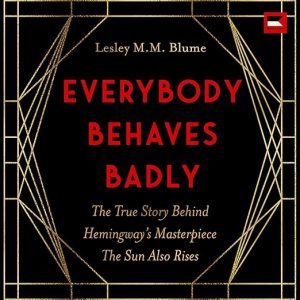
Summer 1925 is the hinge. Ernest Hemingway went to Pamplona for the running of the bulls, and the drunken brawls, sexual rivalry, midnight betrayals and midday hangovers of that trip went straight into a novel that changed what modern prose could sound like. Lesley M. M. Blume reconstructs how the trip became the book and, more pointedly, how the young writer built the persona that sold it: the bullfighting aficionado, the hard-drinking genius, the expatriate who always seemed to be at the center of something. The Lost Generation appears here not as a literary movement but as a group of people who were about to find themselves in print without having agreed to it.
Bias is the recurring complaint, and it is worth taking seriously because it comes with an argument attached. One four-star response praises the book as thorough, detailed and well written, says it would probably deserve five stars for how tightly it holds to the events around the writing of that one novel, and then objects to a persistent hostility toward its subject. The same account tracks the early Paris material, the cafes and bars, the advice sought from Gertrude Stein and Ezra Pound. That is a fair description of the tension in the book: a writer who is fascinating to read about and hard to like, in the hands of a biographer who has clearly made up her mind.
Davis Signals Speakers Without Quotation Marks
Quotation carries a large share of this book, which shapes the listening more than any other single factor. The description says the research draws on journals, letters and autobiographies from the artistic circles around Hemingway in the early 1920s, so the text is constantly moving between the biographer's voice and the voices of people she is quoting, several of whom disliked each other. Jonathan Davis has the reading, and material like this asks a narrator to signal register changes cleanly enough that you always know who is speaking without a set of quotation marks to look at. That is the skill worth listening for in the sample, more than accent work or dramatic range.
The most memorable figure in the book, according to one written response, is not Hemingway at all. That reader nominates Lady Duff Twysden, and describes her as the free-spirited woman the writer wanted and never had, someone he then attacked in his fiction and kept criticizing for years afterward while she declined to react. Whether or not you agree, the observation identifies what makes the book work: it treats the people who became characters as people first, with lives that continued after the novel was published and opinions about how they had been used.
Five Outlets, One Paragraph of Actual Content
Dates are the strangest thing about this listing after the badge. This recording appeared in April 2024, and four of the five signed reviews were filed before it existed, several of them years earlier. They are reviews of the book, not of the audio edition, which explains why none of them mentions the reading. One vote is all the counter has registered, and five people have nonetheless taken the time to write, so the number at the top and the text underneath it are measuring different things across different years. The column is the part worth your attention; treat the number as decoration.
Press notices make up most of the description, which is the next oddity down the page. Before you reach a single sentence about what happens in the book, you pass a Vanity Fair quote, a Minneapolis Star Tribune quote and a line from Gay Talese, and after the one paragraph of actual summary come two more from the Boston Globe and the Houston Chronicle. Five outlets, one paragraph of content. The reservations are real too. A three-star verdict comes from a professional writer who valued the book as a study of how a journalist became a novelist and still concluded that it did not meet the need behind the purchase. Expect a book about a career and a persona rather than a life.
One Summer, One Novel, One Reputation
Literary history is where this belongs, and it rewards anyone fascinated by the moment a writer decides who to be in public and then becomes it. It suits people who have read the novel in question and want the machinery behind it, and it suits people who have not, since the book explains what it needs as it goes. Eleven hours suits a subject this narrow, and the narrowness is the point: one summer, one novel, one reputation being manufactured in real time.
Steer clear if you want a full-life biography, because the frame closes shortly after the novel appears and nothing later gets more than a glance. Steer clear too if you admire Hemingway and would rather not spend eleven hours with an account of how he treated the people who helped him, since that treatment is the book's organizing theme rather than an aside. Cafe conversation is most of what this book is made from, so anyone who finds the who-said-what-to-whom detail a chore will find little else to hold onto.
Good to Know
Why is a book about Hemingway tagged under Architecture?
No good reason appears anywhere on the record. The topical tag reads Architecture while the genre shelf reads arts and entertainment, and the book is a work of literary history about a novelist and his circle. It is a filing error, and it means anyone browsing that category will meet something entirely unrelated.
How much of the audiobook covers Hemingway's later life?
Very little. The frame is deliberately tight around the summer of 1925 and the writing and publication that followed, so this is not a cradle-to-grave account. Later decades appear only where they bear on the reputation the book is tracking. Look elsewhere for a full-life biography.
Is the audiobook a fair account or an argument against its subject?
Closer to an argument. The publisher's own description highlights how ruthlessly Hemingway betrayed his mentors, skewered his friends in his fiction and pushed his career at any cost, which tells you where the book stands before you start. The research is not in dispute; the framing is.