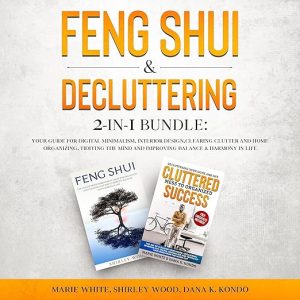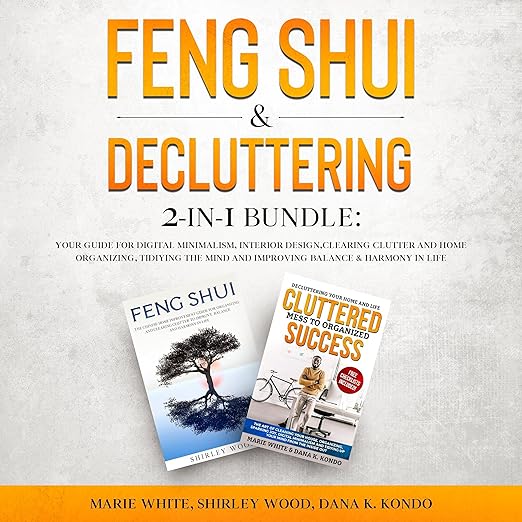
Feng Shui and decluttering have a way of showing up together on a bookshelf (or, in this case, in a single audiobook bundle) because they address the same root question: why does the space around us affect how we feel inside it? During a stretch when my apartment had started feeling less like a home and more like a storage unit with Wi-Fi, I queued up the Feng Shui & Decluttering 2-in-1 Bundle narrated by Amy Lovato, and six hours and twenty-one minutes later, I understood why I had been feeling stuck. The link between physical environment and internal state is older than Western psychology, and this bundle takes that link seriously.
Two Books, One Argument About Space
Marie White's two-book package does something that many home-organization titles fail to do: it connects the physical act of clearing space to something more internal. The first book, focused on Feng Shui itself, opens with the 12 core principles of the practice and moves outward to consider not just interior rooms but outdoor environments, which White argues are just as critical to the energy of a home. That is a point rarely emphasized in mainstream Western interpretations of the practice, and it gives the material an added layer of coherence. The companion volume, pitched as a bonus and subtitled around the idea of moving from a cluttered mess to organized success, serves as the practical counterpart: fewer philosophy, more checklist.
The bundle works because the two books talk to each other. The Feng Shui framework provides the why, and the decluttering guide provides the how. Listening straight through in one sitting, as I did over a long afternoon, creates a satisfying arc: you come away with both a way of thinking about your environment and a set of actions to take in it. Whether you find the more metaphysical aspects of Feng Shui compelling or approach it purely as a design methodology, the underlying logic that clutter and spatial imbalance produce mental noise holds up across either reading.
Lovato Keeps the Bagua Map Grounded
Amy Lovato's narration is a significant asset here. Her voice carries the right kind of authority: knowledgeable but not imperious, measured but not dry. She navigates White's explanations of concepts like the Bagua map and qi circulation without making them sound either mystical to the point of inaccessibility or clinically stripped of meaning. That balance is harder to strike than it sounds. Listening to Feng Shui content read aloud creates an interesting dynamic: you are absorbing principles about environmental calm while in motion, perhaps commuting or washing dishes. Lovato's tone makes that contradiction feel productive rather than ironic.
The audio format also suits the checklist-heavy sections of the decluttering guide better than you might expect. Rather than feeling like reading a grocery list aloud, Lovato gives each item just enough weight to let it land. By the time she reaches the section on best practices, the pace has settled into something that feels almost meditative, which is appropriate given the subject. The bundle's total runtime keeps things lean enough to hold your attention across the full listen without ever feeling padded.
One Five-Star Review, No Wider Consensus
The rating here reflects a single review at five stars, so listeners should set their expectations accordingly. This is not a title with a wide critical consensus behind it. What the synopsis promises is a modern translation of classical Feng Shui principles rather than a scholarly or historically exhaustive treatment. White is writing for people who want results in their home, not for practitioners seeking to debate the finer points of the five-element theory. Anyone looking for deep cultural or historical context around Chinese spatial philosophy will likely want to supplement this with other material.
The bundle's total runtime of just over six hours is on the shorter side for a combined two-book package. Each title is compact, and while that leanness keeps the content focused, listeners hoping for extended case studies or room-by-room walkthroughs may find themselves wanting more specificity. White gestures toward application without always landing on the granular level that some readers find most actionable. The decluttering bonus in particular reads like a brisk overview rather than an exhaustive system, which is worth knowing before you hit play.
That said, the compression works in the bundle's favor for a first pass. This is a good orientation to the subject, not a final word on it. Listeners who finish and want to go further will at least know which questions to bring to their next book on the topic, and they will have a working vocabulary for the principles they want to pursue in greater depth.
Too Introductory for Practitioners Already Embedded
This bundle is well suited for anyone at an early or intermediate stage of interest in home organization with a curiosity about the philosophical tradition behind Feng Shui. It works for listeners who want both a conceptual framework and practical direction in a single sitting. People already deeply embedded in Feng Shui practice or professional organizers will likely find the content too introductory. Those with no patience for any degree of spiritual or energetic framing around home design should probably look for a purely systems-based decluttering title instead. For everyone else, Amy Lovato's narration and White's clean structure make this an easy, productive listen. The bundle delivers a coherent arc across both titles without demanding more time than most listeners can spare in a single sitting.
Common Questions
Does the audiobook cover both books in full, or is one of them abridged?
Based on the runtime and synopsis, both books appear to be included in full. The Feng Shui volume covers all 12 core principles and outdoor applications, while the decluttering companion is included as a complete bonus title, giving you both a philosophical framework and a practical guide in one listen.
Do you need any prior knowledge of Feng Shui to get value from this audiobook?
No prior knowledge is required. Marie White approaches Feng Shui as a modern home practice and explains all core concepts from the ground up. The 12 principles are introduced in accessible language, making this a solid entry point for complete beginners.
Is this audiobook more practical or more philosophical in tone?
It leans practical while retaining a philosophical grounding. The Feng Shui portion introduces principles and their rationale, while the decluttering companion shifts into checklists and direct guidance. Together they balance the why and the how without going deep into the classical or historical dimensions of the tradition.
How does Amy Lovato's narration handle the more abstract Feng Shui concepts?
Lovato keeps a measured, grounded tone throughout, which helps the more conceptual sections land without feeling either overly mystical or flat. She handles the transitions between philosophical explanation and practical instruction smoothly, making for a consistent listening experience across both books.