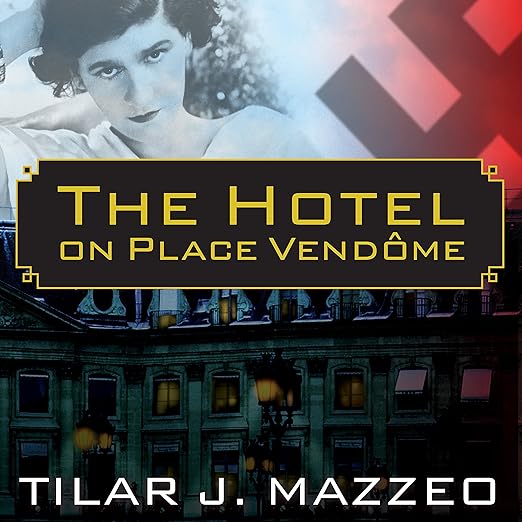
Paris fell in June 1940, and one luxury hotel was permitted to keep operating in the occupied city by direct order of Adolf Hitler. That single fact carries this entire audiobook, which runs eight hours and three minutes for Tantor Audio with Elizabeth Wiley reading. Tilar J. Mazzeo takes the Ritz on the Place Vendome, an address already synonymous with film stars, celebrity writers, American heiresses, playboys and princes, and follows it through four years in which German officers of the highest rank and celebrated French patrons slept under the same roof and drank in the same bar.
Goering's Headquarters Doubled as Chanel's Home
Mazzeo starts at the beginning, tracing the hotel from its opening in turn-of-the-century Paris, but the book's center of gravity is the occupation. The arrangement was grotesque and entirely functional: the Ritz served simultaneously as headquarters for senior German officers, including Hermann Goering, and as home to patrons such as Coco Chanel, whose wartime conduct remains one of the most argued-over questions in twentieth century fashion. Mazzeo moves through the suites, the bars, the dining rooms and the wine cellars, and what the book finds in each is a mixture of illicit affairs, deadly intrigue, real defiance and real treachery, frequently involving the same people.
A five-star from March 2014 took its title from a line about luxury staining everything, and the response is the sharpest reading of the book on this page. It observed that after the occupation ended, an implausible number of people claimed to have fought in the Underground, and quoted the book's verdict that most who tell you they were in the resistance are fabulists at best. It also confirmed the essential fact, that the Ritz was the only palace hotel open throughout the Occupation and served as Goering's headquarters, while insisting the stakes were horrifying and several of the figures involved faced torture or death.
The Hotel Itself Is the Main Character
The guest list is the engine. The December 2014 four-star identified the structural trick precisely, naming the hotel itself as the main character and cataloguing the residents who passed through or lived in its interiors: Hemingway, Coco Chanel, Robert Capa, Goering, Fitzgerald, Marlene Dietrich, and the Duke and Duchess of Windsor. That response also established the true span of the book, which reaches beyond the war years into the postwar decades and continues as far as 1969, considerably further than the occupation framing on the cover suggests.
Choosing a building as protagonist solves a problem that defeats most books about this period. A history of collaboration in Paris either becomes a prosecution or collapses into excuses, but a hotel makes no claims for itself. It simply records who came through the door, who paid, who informed, who hid someone upstairs, and who did all four in the same month. Mazzeo can therefore place a resistance courier and a senior German officer on adjacent pages without editorializing, and let the proximity do the work. The moral argument emerges from the floor plan. I came away far more interested in the staff than in the guests, which I doubt was the intention.
Eight Hours of French Names Moving Fast
Eight hours is compact for material this crowded, and that compression has consequences for a listener. Wiley is credited with a text thick with French place names, honorifics, hotel geography and a cast drawn from at least four nationalities, which is a specific technical demand rather than an interpretive one. Take the credit as the fact it is, and sample a few minutes if pronunciation matters to you. The runtime also means the book moves quickly, and names arrive faster by ear than they do on a page you can turn back.
One Review Grades a Parcel, Not the Prose
The scholarship is real, and part of it is unreachable in audio. A five-star from the United Kingdom, filed in May 2019, verified the research by turning to the notes and selected bibliography and citing the page range directly, pages 243 to 276, as evidence of professional work. That response also pinned the chronology precisely, from the hotel's inauguration on 1 June 1898 to the German advance of 10 May 1940 and onward to the building's eventual sale after the death of Ritz's son. Page citations are exactly what a listener cannot follow, and this record mentions no supporting document.
Treat the badge above the reviews with suspicion. The counter logs a single rating and the average reads exactly 4.0, which one four-star vote would produce, yet five written responses sit underneath it. One of those five, filed from Mexico in March 2020, is not about the book at all: it praises excellent service and unusually fast delivery, and that is an assessment of a parcel. The listing also strips the French circumflexes that the description itself keeps, so the title on the page and the title in the copy do not match.
Almost Every Chapter Ends on a Cliffhanger
Readers who want their history told as narrative will be well served. A five-star from May 2014 called this a marvelous account of the occupation of Paris between 1940 and 1944 that concerns itself less with the fighting than with the hotel's exotic residents, noting that the violence is present but muffled. It placed Mazzeo among the nonfiction writers who make their books read like novels, praised the skill and efficiency of the execution, and observed that almost every chapter ends on a cliffhanger, which is precisely the quality that makes a history work in audio.
Anyone researching Chanel, Hemingway or French collaboration seriously should pair this with the print edition for the notes. Listeners who prefer military history to social history will find the war happening mostly offstage, and readers wanting a settled judgment on who collaborated and who resisted will not get one, because the book's argument is that the Ritz made the distinction difficult on purpose. Eight hours of that ambiguity is the point, not a flaw.
Is this audiobook mainly about World War II or about the hotel itself?
Both, with the building as the organizing principle. Mazzeo begins with the Ritz's opening at the turn of the century and continues past the war into the postwar decades, but the occupation years supply the bulk of the material, since that is when German command and celebrated French patrons shared the same address.
How much does the book cover Coco Chanel's wartime conduct?
Chanel is named in the description as one of the hotel's exclusive patrons during the occupation, and that presence is part of the book's central juxtaposition rather than a side note. Expect the name to recur throughout as one thread among several rather than to receive a dedicated biographical treatment.
Does the audiobook include the source notes and bibliography?
Nothing on the record indicates a supporting document, and the print edition's notes and selected bibliography occupy pages a listener cannot turn to. If you plan to check sources or follow references, buy the printed text alongside the recording rather than relying on the audio alone.