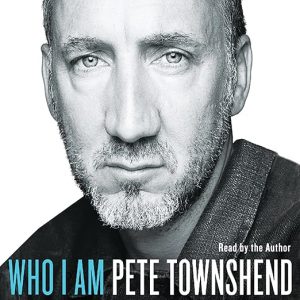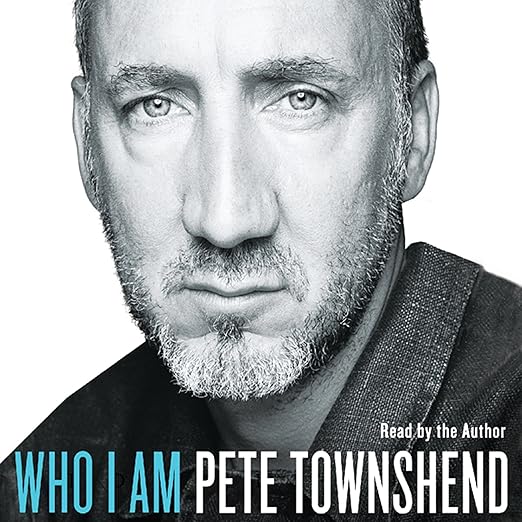
Which edition is being graded on this page? The question matters more than usual here, because the counter, the badge and the responses printed beneath them cannot agree on how many people are in the room, let alone on which release those people bought. The audiobook in front of you runs seventeen hours and fifty-six minutes and is read by Pete Townshend himself, and that is close to the only thing the record states without contradicting itself somewhere else. Everything around it, including a pile of responses filed from four different countries, belongs to some larger and untidier object that the platform has stacked under one product.
How Who I Am Holds Up
The jacket copy is a list, and the list is the argument. It runs through a Londoner and a Mod who wanted the band called The Hair, who broke his first guitar by accident in 1964, who heard the voice of God on a vibrating bed in rural Illinois, who invented the Marshall stack and the concept album, who speared Abbie Hoffman in the neck with a guitar head, who is partially deaf in his left ear, who nearly died four separate ways, who helped pull Eric Clapton out of heroin, and who is banned for life from a hotel chain. Then it closes on the tabloid scandal that has followed him since, and on a man who planned this book at twenty-one and finally published it at sixty-seven.
Two votes are on this record. Two people can hand over eight stars between them, or nine, or ten; eight displays as 4.0 and nine displays as 4.5, and no combination available to a pair of listeners produces the 4.3 printed above the title. Meanwhile five written responses sit below that counter, three of them filed outside the United States. The arithmetic and the comment column are plainly measuring different populations, and nothing on the page reconciles them. Anyone using the badge as a signal on a purchase this long is using a number that has come loose from its own evidence.
Why Who I Am Works as an Audiobook
Expectation is the thing the written column keeps adjusting. One October 2012 five-star calls the book excellent and frustrating in the same breath, argues that this is not the autobiography anyone would have expected from the man who led that band, and reaches for comparisons: Keith Richards funnier and with more bite, George Jones more rock and roll. That is a compliment shaped like a complaint. Townshend did not write the anecdote machine the material would have supported. He wrote something closer to a self-examination, which is the harder book and the reason the list on the jacket reads stranger than it sounds.
The narrator of record on this edition is the author, which changes the proposition entirely. A response filed from Italy in 2014 addresses him directly, praising the reading and the way he tells the story of his own life, and it is one of the few texts here that could only have been written by a listener. Seventeen hours of a memoirist reading his own accounting of addiction, deafness and public disgrace is a different experience from an actor performing it, and the deafness in particular gives the recording a quiet undertow: this is a man whose ears were damaged by the work describing the work.
Weak Spots in Who I Am
Edition stacking is the practical hazard. A November 2012 five-star filed from Japan describes a fifteen-CD set of about nineteen hours in which Townshend narrates his own life and calls it essential for fans. That is a genuine endorsement of an authored reading, and it is also a description of a physical release with an hour more running time than the file listed here. Shortened editions, reissues and disc sets routinely end up sharing one page, and the difference matters when the gap runs to an hour. Check the running time on whatever you are actually buying rather than trusting the reviews beneath it.
Assumed knowledge is the other caution. The four-star on this page arrived after a Keith Moon biography and a biography of Townshend himself, expected the London of the 1960s rendered as vividly as those books managed it, and did not get it; that reader adjusts, deciding the book is a route into a personality rather than a period. A response filed from France reaches the same conclusion from a different angle, judging the writing clear and easy even for a non-native reader while warning that it addresses an audience already initiated. Neither is a complaint. Both say this is a second book about The Who, not a first.
The Right Listener for Who I Am
Go ahead if you want the interior version of a story you already know from the outside. Anyone who has read around this band, who knows the outline of the smashed guitars and the balcony and the scandal, will find those events here with the interpretation attached rather than the anecdote, delivered by the person who has spent fifty years being asked about them. It suits listeners who like memoirs about creative process too, since the sculptor, the journalist, the dancer and the graphic designer Townshend nearly became are all in the book, and so is the librettist he actually did.
Steer clear if you want a band history, because the group is background scenery in long stretches and the copy never pretends otherwise. It is a hard first purchase for anyone new to the subject, and the running time makes casual sampling expensive. Anyone buying on the strength of the star display should also know that the display cannot be produced by the votes said to be behind it. What survives all of it is the voice: eighteen hours of a man who planned this book at twenty-one explaining himself at last, which is either exactly what you want or precisely what you were afraid of.
Before You Listen
How long is the audiobook and does it match the CD edition?
This file runs a little under eighteen hours, which is the only duration the record states. Confirm the figure shown at the point of purchase before buying, because the responses gathered underneath do not all describe the same release, and their running times differ from each other.
Does the audiobook cover The Who's full career?
Only as it intersects the author's life. The description is built around personal turning points, from breaking a guitar by accident in 1964 to the tabloid scandal that followed him for years, rather than around album cycles or tours. Treat it as memoir with a band in it, not band history.
Is any of the material likely to be difficult listening?
Yes. The copy itself lists four separate near-deaths involving drugs, drink and an airplane, helping another musician through heroin addiction, and a tabloid scandal the author says he still has explaining to do. No advisory of any sort appears in the copy, so decide in advance.