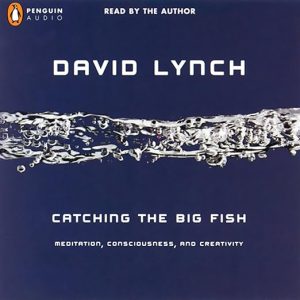
There is almost no point reviewing Catching the Big Fish with conventional criteria. It runs under two hours. It has no conventional argument. It consists of short reflections, some only a paragraph long, on creativity, meditation, and the process by which David Lynch turns ideas into films. I listened to it on a quiet Tuesday morning while making coffee, and then I listened to it again immediately after, which is not something I do with books. The second listen was different from the first in ways I still find hard to articulate.
Lynch's thesis, to the extent that the book has one, is that ideas exist at a level of consciousness that ordinary waking life cannot access, and that Transcendental Meditation, which he has practiced since 1973, opens a channel to that level. The fish metaphor in the title is his: ideas are like fish, he says, and bigger fish live deeper down. To catch big fish, you need to dive. Everything else in the book is an elaboration of or illustration of that central image. What makes the book interesting is not the argument, which is, in isolation, not especially original, but the specific mind doing the elaborating. Lynch's aesthetic, visible across his films from Eraserhead to Mulholland Drive, is one of the most distinctive in American cinema, and this book is a rare opportunity to hear him describe, in plain language, how that aesthetic is generated.
What We Made of It
Lynch narrating his own book is not the same as Lynch writing it. In text, the aphoristic quality of the reflections can feel either profound or thin depending on the reader's disposition. In audio, Lynch's voice, specific, deliberate, tinged with the cadences of someone who has done a great deal of interior work, gives the aphorisms weight they might not otherwise carry. He is not performing wisdom; he is simply describing his experience. The difference is audible. One reviewer described the book as reading "like you're having a short but intense one-on-one chat with Lynch," and in the audio version, that quality is amplified. The book is most honest about its own limitations: Lynch makes no claim that TM will produce the same results for everyone, only that it has worked for him.
Several reviewers noted the book's brevity with a kind of disappointment, they wanted more. That response is understandable but perhaps slightly misses the point. Lynch has made a deliberate object here, one that is closer to a long essay or an extended letter than to a conventional memoir. At under two hours, it does not overstay. It says what it has to say and stops. Given the genre of artist manifestos, which has a tendency toward self-inflation, that restraint is its own recommendation.
The self-narration is essential in a way that goes beyond the standard argument for author-read memoirs. Lynch's voice is a significant part of his artistic output, his cameos, his interviews, his public appearances all carry a recognizable quality of attention that is hard to describe but immediately identifiable. Hearing him read about the experience of diving deep for ideas in that voice connects the content to the larger body of work in a way that printed text, however well-designed, cannot replicate. If you are a Lynch admirer, this is the version to seek out. If you are simply curious about him, this is still where to begin.
Weak Spots in Catching the Big Fish
The book is not a comprehensive account of Lynch's filmmaking process, and listeners hoping for detailed commentary on specific films will be disappointed. He mentions films in passing, Elephant Man, Blue Velvet, Mulholland Drive, but does not dwell on any of them. The focus is interior: the practice of meditation, the quality of attention, the experience of catching an idea and knowing it matters. Listeners who do not practice TM or have no interest in it may find the central argument feels remote; Lynch is describing an experience rather than making a case for it.
Is This One for You?
Fans of Lynch's films are the obvious audience, but the book also speaks to any listener who has spent time thinking about the relationship between practice and creativity, whether that practice is meditation, exercise, or any other form of regular interior attention. At under two hours, it asks very little in return for what it offers. Those who find Lynch's films impenetrable or off-putting should not expect this book to resolve the question; if anything, it may make the films feel more intentional and therefore more demanding.
Quick Take
- Voice: Lynch reads his own reflections in the same unhurried, oblique register as his films, genuinely distinctive, occasionally hypnotic, not for everyone.
- Big ideas: Transcendental meditation as creative practice, idea-catching as craft, the interior life of the artist
- Atmosphere: Dreamy and fragmented, like a conversation with someone who sees things differently than you do
- Worth it?: A short, strange book that will either unlock something for the right listener or read as pleasant but insubstantial, the difference depends entirely on what you bring to it.
Common Questions
Does Lynch explain Transcendental Meditation in enough detail for someone who has never practiced it?
He describes the experience and its effects on his creative life, but this is not an instruction manual for TM practice. Listeners looking for a practical introduction to the technique will need to look elsewhere. Lynch is more interested in what the practice produces than in how to perform it.
At under two hours, does Catching the Big Fish feel incomplete?
Intentionally compressed rather than incomplete. Lynch has written a focused meditation on creativity rather than a comprehensive memoir, and the brevity is a deliberate feature. Several listeners reported returning to it multiple times, which suggests the short length rewards revisiting rather than expansion.
How much does this book reveal about Lynch's specific filmmaking methods?
Less than fans of his films might hope. Lynch discusses his general creative process, how ideas arrive, how he tests them, how meditation supports the work, but rarely gets specific about individual projects. The focus is on process at a level of abstraction rather than on particular productions.