
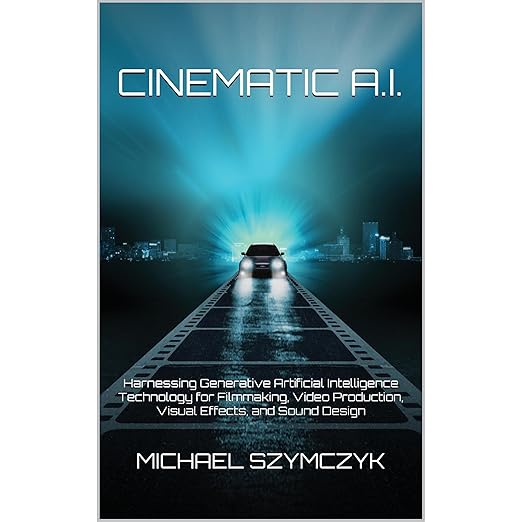
Somebody pasted a storefront header onto this record and nobody took it off again. The description attached to this audiobook opens with the words Book Description for Kindle Store, colon included, before a single sentence about filmmaking arrives. Small in itself, and it sets the tone for the rest of the page: an e-book listing lifted wholesale onto an audio product, a title field that drops the subtitle the copy is carrying, a series marker pointing at volumes nobody has linked, and a narrator field reading Virtual Voice. Two hours and twenty-six minutes, published April 12, 2025 by VIDART.
A Guide to AI Tools, Narrated by One
Sora, Runway and Kling AI are the three platforms the description commits to by name, and naming them is simultaneously the book's strongest move and its shortest fuse. A guide that tells you which tools to open is worth considerably more than one gesturing at a trend, and Michael Szymczyk goes specific throughout: generative platforms for cinematic visuals, AI cleanup for dialogue and noise reduction, previsualization and scriptwriting assistance, real-time rendering of environments and characters. Specificity of that kind has a shelf life measured in months rather than years in this particular field, and the record is stamped April 12, 2025, which is already some distance back.
Generative tools narrate a book about generative tools. The narrator field reads Virtual Voice, meaning the reading was produced by a text-to-speech system rather than by a person, and on this title that is less a defect than a demonstration of the argument. A guide claiming AI lets one filmmaker do the work of a department has used AI to manufacture its own audio edition, at a price a human reader across two and a half hours would never have matched. Listeners who struggle with synthetic delivery over long stretches at least have the runtime working in their favor, since this one ends before fatigue has much chance to set in.
The Ethical Chapter Outgrows the Tool Roundup
Michael Szymczyk organizes the material by production phase, which is the right spine for this subject. Pre-production takes scriptwriting assistance and previsualization. Production takes environment, character and effect generation, with an emphasis on simplifying visual effects work that used to require a specialist. Post takes audio cleanup, noise reduction and dialogue enhancement, sold explicitly as a way to avoid expensive re-recording sessions. The through-line is cost, since the copy promises professional-grade results at a fraction of studio prices, and a phase-by-phase arrangement lets a reader see exactly which line item disappears at which stage of the schedule. A reader who wants only the post-production material can find it without wading through everything else, which is not true of guides built as one continuous argument.
Independent filmmakers are the intended audience and the series title confirms it, since this record sits as the third entry in something called the Independent Filmmaking Series by Michael Szymczyk. The ethical chapter is what lifts the book above a tool roundup: the description commits to job displacement and questions of creative ownership as subjects rather than as footnotes, which is unusual in a guide whose entire commercial premise depends on those tools being adopted enthusiastically. A book that sells AI workflows and then spends real time on who loses work when they arrive is at least arguing in good faith with its own reader.
A Comprehensive Guide That Forgot Its Own Subtitle
Dating is the central risk with this purchase. A generative AI guide published in April 2025 is describing a landscape that has since moved underneath it: model versions turn over, pricing changes, platforms appear and get absorbed, and interface-level instructions age faster than any other kind of technical writing. The conceptual material will hold up considerably longer, meaning which phase of production benefits from which category of tool, and what the ethical exposure looks like for a small production. Buy it for the framework and treat the named platforms as examples of a category rather than as a shopping list to work through in order.
Metadata problems stack up on this page faster than on most. The title field says Cinematic A.I. and stops there, while the copy carries a full subtitle promising filmmaking, video production, visual effects and sound design, so anybody searching for AI sound design will never surface it. The series field marks this as the third installment without identifying the first two or pointing anywhere. The category tag reads Photography on a book entirely about moving images. And two hours and twenty-six minutes is a brisk runtime for something the copy calls a comprehensive guide covering every phase of production, complete with case studies and in-depth tool reviews.
Two Ratings Are the Entire Evidence Here
Filmmakers working alone or in very small teams are the obvious readership, and the cost argument aims squarely at them. Anybody who has priced a single visual effects shot or booked a re-recording session knows precisely which numbers this book is trying to delete. Video producers in marketing and corporate work, where budgets are tight and volume is relentless, will get proportionally more from the sound and cleanup chapters than from the effects ones. Students trying to work out which parts of the production pipeline are genuinely changing get a compact orientation for the cost of one evening. Anybody who has been told that AI is about to replace their department, and wants to know which parts of that claim are currently true, gets a specific answer here rather than a mood.
Producers wanting step-by-step interface tutorials should look elsewhere, because two and a half hours of audio cannot teach a node graph and no companion file is listed anywhere on the record. Avoid it as well if synthetic narration bothers you on principle, since that is exactly what the narrator field promises. Two ratings and no written responses is the whole of the evidence this page offers, leaving the purchase to rest on the premise, the runtime and the author's own series. Tool lists date quickly in this corner of the industry, and this one started dating the month it appeared.
- Subjects: Generative AI across the production pipeline, cost collapse for independent filmmakers, job displacement and creative ownership
- Tone: Brisk and pragmatic
- Bottom line: A useful framework for where AI enters each production phase, on a record whose specifics were dating the month it appeared.







