
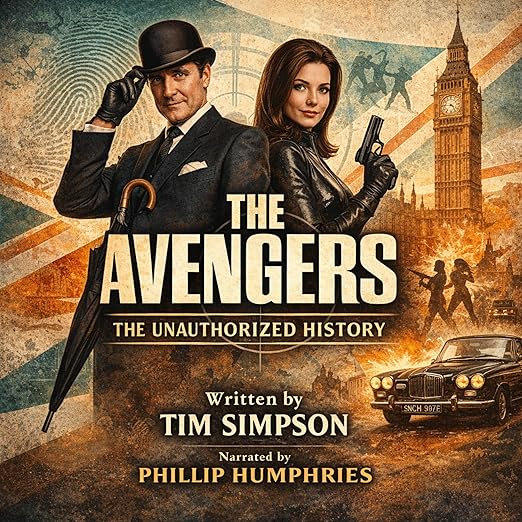
John Steed's umbrella and Emma Peel's leather catsuit occupied my imagination for a long stretch of evenings recently, as Phillip Humphries narrated Tim Simpson's unauthorized history through my headphones during a run of late nights when I needed something that rewarded actual attention. The Avengers audiobook is not background listening; it's the kind of cultural history that expects you to follow its argument, and it delivers enough genuine insight to justify that expectation.
Camouflage for Something Stranger and More Ambitious
Simpson's central argument is deceptively simple: The Avengers was never primarily a spy show. It was a cultural experiment that used the spy show's conventions as camouflage for something stranger and more ambitious, a sustained exercise in surrealism, class critique, and what Simpson calls quiet rebellion, delivered through wit and elegance in a format that Britain's living rooms could absorb without necessarily recognizing what they were receiving.
That argument gains persuasive force through Simpson's careful attention to the show's evolution. The austere, post-war origins he describes are genuinely different from the Emma Peel years that most viewers associate with the series, and tracing that evolution reveals how much the show was shaped by specific historical and cultural pressures rather than a fixed creative vision. The transformation from procedure to pop art is not accidental but earned through a particular combination of circumstance, talent, and institutional willingness to trust unusual choices.
Cathy Gale Finally Gets Her Due
The Emma Peel section gets the analysis it deserves. Simpson examines not just what made that era iconic but what made it possible: the cultural conditions, the specific qualities that Diana Rigg brought to the role, and the way the show constructed a form of female authority that contemporary television still struggles to match. His treatment of Cathy Gale, often overshadowed by Peel in retrospective accounts, is a useful corrective, restoring her significance to the show's development.
The 1990s cinematic afterlife, widely regarded as a failure, receives the sympathetic reading it rarely gets. Simpson doesn't pretend the film succeeded; he explains why it couldn't, given the conditions under which it was made and the properties of the original that were structurally impossible to translate into that format. That's more interesting than simple dismissal.
Humphries Narrates the Cold War Intelligence Angle
Phillip Humphries' narration suits the material's register: analytical, slightly dry, with an appreciation for irony that the subject requires. He reads Simpson's arguments with a clarity that keeps the cultural theory accessible to listeners who aren't specialists, and his handling of the book's more expansive claims about surrealism and intelligence culture gives them room to breathe without making them seem more certain than they are.
At three hours and forty-four minutes, this is a study that knows what it wants to say and says it without padding. Simpson doesn't cover every episode or exhaustively catalog every production decision; he's making an argument about the show's cultural significance, and he pursues that argument with discipline. Listeners who want an episode guide will be redirected; listeners who want to understand why the show worked the way it did will be well served.
The book's engagement with British intelligence culture as an aesthetic influence is one of its more unusual contributions. The connection between the Cold War's actual intelligence world and the show's particular flavor of stylized competence is not obvious, and Simpson's examination of it adds historical texture to what might otherwise be purely aesthetic analysis.
A Sustained Essay About Why the Show Worked
Simpson's approach is analytical rather than biographical or encyclopedic. Readers hoping for behind-the-scenes production detail, casting decisions, or the personal histories of the show's principal creators will find relatively little of that material here. The book is interested in cultural and aesthetic significance rather than production history.
Some of the claims about the show's cultural impact are presented with more confidence than the evidence fully supports. Simpson is making arguments, not just observations, and the argumentative mode occasionally runs ahead of its demonstration. Readers who engage with cultural history critically will want to hold some of the larger claims at slight distance while appreciating the genuine insights that support them.
The 1970s revival section, dealing with The New Avengers, receives less detailed treatment than the earlier periods. Fans for whom Purdey and Gambit are central to the show's legacy may find that phase somewhat underexamined relative to the attention given to the Peel era.
Phillip Humphries delivers a narration that matches the material's register almost perfectly. He has the dry authority of someone who has thought carefully about the show rather than merely loved it, and that restraint is exactly what Simpson's prose demands. The three-and-a-half-hour runtime means this audiobook functions best as a sustained essay rather than a comprehensive reference work. Listeners expecting episode-by-episode coverage will be surprised. What Simpson offers instead is a sustained argument about why the show matters, and that argument is more valuable than a catalogue would be. The sections on Emma Peel's cultural significance and on the show's use of surrealism as political language are particularly strong, and Humphries gives them the weight they deserve.
Why This Show and Not a Dozen Others?
This audiobook rewards listeners who come to it with either genuine familiarity with the original series or a strong interest in British cultural history of the 1960s and 1970s. Cold War cultural historians, students of television history, and fans of the show looking for a serious treatment of its significance will all find Simpson's study worth their time.
Listeners who enjoy cultural criticism that operates at the intersection of aesthetics, politics, and history will find this a satisfying listen. The book's engagement with surrealism as political language and its attention to what the show's female characters reveal about shifting gender dynamics make it more interesting than a conventional fan study. If you've ever wondered why The Avengers specifically, and not a dozen other spy shows, became iconic, Simpson has a considered answer.






