
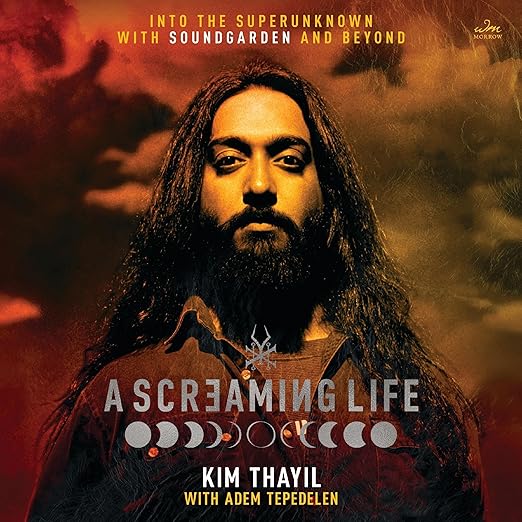
Guitarists do not usually get to write the band memoir. That job tends to fall to the singer, who owns the myth, or to a drummer with grudges and a long memory. Kim Thayil co-founded Soundgarden and played lead guitar in it, which puts him in the more interesting seat: close enough to every decision to know how it was made, far enough from the spotlight to have watched what the spotlight did to the people standing in it. His account runs twelve hours as an audiobook, and the vantage point alone makes it worth attention.
Thayil's Indian and Yamamoto's Japanese Roots
Seattle in the 1980s is where this starts, in the beer-soaked punk clubs where the band assembled before anyone had a word for what they were doing. The publisher's pitch credits Soundgarden with manifesting grunge and inventing a genre, which is the kind of claim that always sounds better in copy than in a room with sticky floors and forty people in it. Thayil's promise is the version from inside that room, told by someone who was carrying the amplifier rather than reading about it later.
Five names anchor the story: Thayil, founding bassist Hiro Yamamoto, Ben Shepherd, Matt Cameron and Chris Cornell. A band memoir written by one member is always a partial account, and the good ones know it. What the description sets up is a chronicle of how those specific people handled the triumphs and the pressure on the way to becoming a band other bands measured themselves against, which is a more honest frame than a definitive history would be.
Identity supplies the freshest material here, and it is the part most Soundgarden coverage has skipped entirely. Thayil's Indian heritage and Yamamoto's Japanese background shaped both what the band was and how the industry handled them, in a scene that was not built with either of them in mind. Two of the founders of a movement remembered as almost uniformly white are describing an experience nobody asked them about at the time. If the book delivers on that thread, it will be the reason this memoir outlasts the others on the shelf.
Twelve Generous Hours for Small Scenes
Music memoirs are among the most natural fits for audio, because so much of the material is anecdote, timing and voice. Twelve hours is a generous runtime for a band history, which suggests room for the small scenes that make these books worth having: the studio arguments, the tour logistics, the specific night when something changed. Rock memoirs go wrong when they compress into a list of album cycles, and length is at least a defense against that.
The Narrator Field Sits Completely Empty
Here is the problem, and it is not small. The listing credits no reader at all. The narrator field is empty, and for a memoir by a musician that is the single most consequential missing detail on the page. Fans of a band buy a memoir like this partly to hear a founding member in his own voice, with his own pauses over names that carry weight. A hired reader is a legitimate choice and often the better one over twelve hours, but buyers deserve to know which they are getting, and right now the page does not say.
What can be judged is the shape of the thing. A founding guitarist writing a full-length account of a band that ran from clubs to arenas has the material for a real narrative arc, and the description promises backstage access rather than a discography walkthrough. That is the right instinct for the format, since listeners retain scenes and lose track of catalog numbers.
An Exactly Round Twelve Hours, Unreviewed
Several rough edges on this listing are worth naming. Nothing has been rated or reviewed since the June 2026 publication, so no independent read exists yet in either direction. The publisher shown is William Morrow, a print imprint, with no audio division identified, and the runtime is recorded as an exactly round twelve hours, which is more often a placeholder than a measurement. None of that says anything about the book itself, but it does mean the page you are buying from has not been carefully assembled.
Only the View From Stage Left
A typographical fault sits in the copy as well, running two words together in the sentence that introduces the band members and the challenges they faced. Small, and easy to skip past, but it belongs to the same picture as the missing reader credit. The categorization is also odd: this is filed under arts and entertainment with a music tag and no memoir or biography classification anywhere, which will keep it out of the lists where most people find books exactly like it.
Then the question every band memoir raises. One member remembers a shared history, and the other people in it are not here to disagree. Thayil is the co-founder and lead guitarist, not the frontman, so the version of Soundgarden you get is the one visible from stage left. Expect a memoir with a point of view rather than an arbitrated record, and treat the parts where he assigns credit and blame the way you would treat any first-person account of a group project.
Guitar Players Get Gear and Tuning Detail
Soundgarden listeners are the obvious audience, and so is anyone whose musical education ran through the alternative rock of the 1990s and who wants the scene explained by a participant rather than a documentarian. Guitar players will get more than most, since a lead player's memoir tends to be specific about tunings, gear and arrangement decisions in ways that a singer's rarely is. The multicultural thread also makes this valuable to readers interested in who actually built American underground music.
Others should wait for details. If author narration is what you want from a musician's memoir, hold off until the listing names its reader, because twelve hours is a long time to spend with a voice you did not choose. Casual fans who know two singles and want a quick history will find this longer and more granular than they need, and anyone hoping for a definitive account of the entire band should remember that a memoir by one founder is exactly that, and no more.
The Short Version
- Themes: the birth of grunge in Seattle clubs, band brotherhood under pressure, Indian and Japanese heritage inside a white rock scene
- Mood: Loud, wry, backstage rather than stadium
- Verdict: A founding guitarist's view of a band worth hearing from, on a listing that has not yet named who reads it.
Before You Listen
Who narrates the A Screaming Life audiobook?
The listing does not say. The narrator field is blank, so buyers cannot tell whether Kim Thayil reads his own memoir or a professional performer handles it. For a musician's memoir that is the detail most listeners want confirmed before purchase, and it is worth checking the retailer page before committing twelve hours.
Is the audiobook worthwhile if you are not already a Soundgarden fan?
Partly. The scene reporting from Seattle's punk clubs and the account of two founders navigating a scene that did not look like them have broader interest than the discography does. Listeners with no attachment to the band should expect long stretches about specific records, tours and personnel decisions.






