
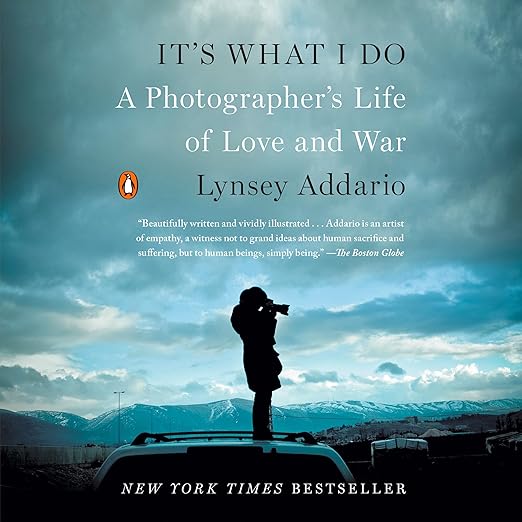
Addario's memoir earns its place among the finest war journalism audiobooks of the past decade, and the reason is specific: she narrates it herself. Lynsey Addario is a Pulitzer Prize-winning photojournalist who has documented some of the most brutal conflicts of the twenty-first century, and the quality that makes her photographs matter, the ability to be fully present in an extreme situation without flinching away from what it reveals, is the same quality that makes her voice on this audiobook worth nine hours of your time. She does not perform bravery. She simply describes what she found, and the gap between the casualness of the telling and the severity of the events is where the book's power lives.
The timeline spans from Afghanistan immediately after September 11 through Iraq, Darfur, the Congo, and the Libyan civil war, where Qaddafi's forces kidnapped her and three colleagues. Addario documents not just conflict but the specific visibility problem of the people inside it. Her work in Afghanistan under the Taliban captured lives that Western media ignored. Her images from Darfur showed burned villages to audiences who otherwise would not see them. That sense of photography as a form of accountability runs throughout the book as both artistic philosophy and personal motivation.
The memoir is also about being a woman in a profession that was explicitly not built for women. Addario navigated the boys' club of war photography without either pretending the obstacle did not exist or allowing it to define her career. Her account of that navigation is one of the book's most valuable threads, partly because it avoids both victimhood and triumphalism and stays in the more difficult register of actual professional experience.
Cinematically Compelling, One Reviewer Calls the Telling
The kidnapping in Libya is handled with a kind of controlled restraint that demonstrates everything about Addario's character as both a journalist and a writer. The facts are terrible: pro-Qaddafi forces detained her and three colleagues, and she describes the fear with precision but without melodrama. The restraint is not emotional numbness; it is the same discipline that allows a photographer to continue working in a situation that would send anyone without that training into paralysis. That quality permeates the entire memoir.
Addario's personal life is woven through the professional account without being sentimentalized. Her search for a relationship that could coexist with her career runs alongside the conflict reporting, and she is honest about how long it took to find the right partner, someone who understood that her work was not competing with their relationship but was integral to who she was. The arrival of her son near the book's end shifts the personal stakes without altering the professional commitment, and her account of becoming a mother while remaining a conflict photographer is among the most thoughtful treatments of that particular tension in memoir literature.
At nine hours, the audiobook is long enough to fully inhabit Addario's world across two decades of work. The self-narration means the listener is never separated from the voice that experienced what is being described. One reviewer described the storytelling as cinematically compelling, and that quality comes through in audio particularly well, because Addario's images are visual, but her descriptions of making them are sensory in multiple registers.
Addario's Voice Carries the Weight of the Room
The audiobook format amplifies what is already a compelling text. Addario's speaking voice carries the authority of someone who has been in rooms where people were dying and continued to do her job. That authority is not aggressive or self-aggrandizing; it is simply present, and it comes through in narration in a way that reading the same words in silence would not capture as fully.
For listeners interested in photojournalism as a practice rather than a concept, the book provides unusually specific insight into how war photography actually works: how Addario gained access, how she negotiated with subjects and soldiers, how she processed images under pressure, and how editorial decisions at major publications shaped which images reached audiences. That professional granularity sets the memoir apart from conflict books focused primarily on the journalist's emotional experience.
Listeners who are themselves navigating careers in creative fields where personal life and professional commitment create real friction will find Addario's account of that balance valuable beyond the specific context of war photography. She worked out, over years of trial and error, how to live fully in both registers, and the working-out is the book's most instructive thread.
Ending in Relative Peace, After Years of Turbulence
The book covers conflicts across roughly twenty years, and the chronological sweep means some periods receive more detailed treatment than others. Listeners who want deep engagement with a specific conflict, Afghanistan or Darfur in particular, will find Addario's account illuminating but necessarily selective given the scope of the whole memoir.
The kidnapping in Libya is graphic in some of its details. Addario writes without protective distance about what she experienced and witnessed. Listeners who find accounts of violence difficult to process should be prepared for those sections.
The memoir ends at a moment when Addario's personal life had reached a stable and relatively happy equilibrium. Some readers may find the resolution too neat given the emotional turbulence that precedes it. Others will find it earned. The endpoint is a matter of taste, but it is worth knowing that the book closes on relative peace rather than open uncertainty.
Neither Romanticizing Danger Nor Flattening It Into Trauma
Anyone with serious interest in photojournalism, conflict reporting, or the documentary traditions of visual journalism will find this audiobook essential. Addario is among the most important photographers working in conflict zones today, and her account of how she built that career is both instructive and honest about the costs.
Women navigating male-dominated professions will find Addario's account of her own navigation useful beyond the specific journalism context. She is not writing a manifesto or a self-help guide, but her example is precisely documented, which makes it more useful than prescriptive advice would be.
Listeners who want memoir that neither romanticizes danger nor flattens it into trauma will find Addario's register unusually calibrated. She has spent her career showing the world what is actually happening in places it would rather not look. This audiobook does the same thing for her own life.
Is It's What I Do audiobook suitable for listeners with no background in photojournalism?
Yes. Addario writes accessibly about her craft without requiring technical knowledge of photography. The book is as much a memoir about career, love, and professional identity as it is a photography-specific account, and those themes translate for any listener.
Who narrates the It's What I Do audiobook?
Lynsey Addario narrates her own memoir. Her delivery brings the same direct, unperformative quality that characterizes her photography to the audio experience. The nine-hour runtime passes efficiently because the narration is consistently compelling.
Does the audiobook cover Addario's kidnapping in Libya?
Yes. The kidnapping by pro-Qaddafi forces is covered in specific, honest detail. Addario describes the experience with controlled restraint rather than melodrama, but the content is graphic in places and listeners should be prepared for that.
How does the It's What I Do audiobook balance professional and personal material?
Addario integrates her personal search for a life partner that could coexist with her career throughout the professional narrative. The balance is skillful rather than compartmentalized, with personal and professional threads informing each other across the full arc of the memoir.







