The Short Version
- Narration: The narrator field names a fictional broadcaster, and the one listener who mentions the audio confirms the character reads it himself.
- Themes: A career comeback, a lighthouse restoration, dual narrative as a running joke, self-regard as a worldview
- Mood: Deadpan, preening, relentlessly quotable
- Verdict: Partridge at full length and in his own voice, funnier sentence by sentence than plot by plot.
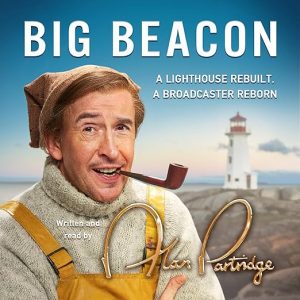
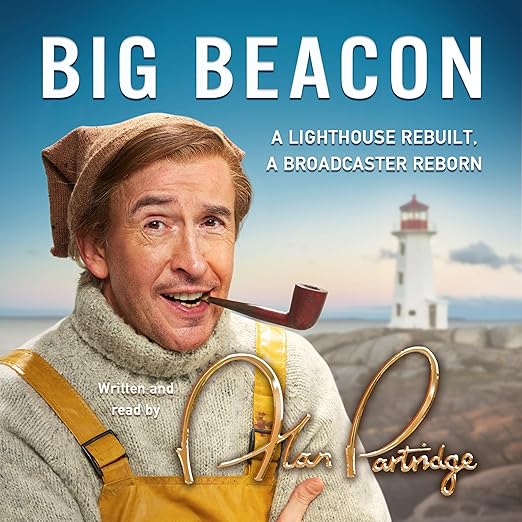
Both credit fields on this page name the same man, and he does not exist. Author: Alan Partridge. Narrator: Alan Partridge. That is the joke, and it also happens to be the honest way to catalog this audiobook, since the whole product is a fictional broadcaster from Norwich writing and then performing his own account of two comebacks. One of them is professional, a climb out of the wasteland of local radio back toward national television. The other involves a lighthouse in a small coastal village in Kent, restored by a selfless man motivated, he insists, by nothing beyond respect for a quietly heroic old building.
One Man, One Credit, Unreachable Math
Authorship is where the record and reality politely disagree. A four-star from June 2025 states the position most listeners already hold: books supposedly written by Alan Partridge carry the conceit that Steve Coogan wrote them, and this response suspects Coogan approved a manuscript rather than typing one. The same reader calls the result very funny and worthy of any Partridge fan regardless, which is the correct order of priorities. A listing crediting a character as its own author is a page-integrity oddity in strict terms and committed bit-work in every other sense. Nothing in the publisher's own copy acknowledges Coogan at any point.
Arithmetic on this page cannot be right. A 4.5 sits on top of a counter that reads one rating, and a single vote can only land on a whole star, four or five, never on a value parked between the two. That figure is simply unreachable at that population. Underneath it, five separate written responses have accumulated, spread across five different marketplaces, each carrying its own grade. So the page displays a score no lone voter could produce, above a count smaller than the number of people who took the trouble to write paragraphs. Whatever is being aggregated here, it is not the reception visible on the same screen.
Shallow, Narcissistic, Mean, and Somehow Lovable
Comedy this specific lives or dies on sentence construction, and one five-star written in March 2024 understands exactly that. It describes the overall style as a diary, praises the idioms and similes as brilliant enough to produce out-loud laughter, and identifies the trick that keeps the character viable: Partridge is shallow, narcissistic and mean, and somehow lovable through all three at once. That response also credits Coogan with writing seemingly effortlessly through Partridge's authorial voice. Effortless is carrying a great deal of weight in that sentence, because sustaining an idiot's prose style for nearly eight hours without the joke collapsing is an unusual technical feat.
Design is the other pleasure here, and the book explains its own device with precisely the vanity you would expect. The description announces an innovative dual narrative of the kind you sometimes see in films, then attaches a footnote promising the two strands will mirror each other so the parallels stay abundantly clear to the less able reader. A television comeback braided with a lighthouse restoration, each rescue commenting on the other, and a narrator too pleased with the architecture of it to leave the design unexplained. Publisher copy already in character before the book starts is a promising sign for the eight hours after. The Kent strand supplies the other half of that shape, with Partridge relocating to a small coastal village, battling through adversity, winning over a suspicious community, and ultimately, by his own summary of himself, proving what a quite wonderful man he is.
Measured Against Oasthouse, Filed Under Architecture
Calibration matters with this character, and a four-star from September 2025 supplies it in nine words, calling the book good but not as funny as the Oasthouse series. That measures Big Beacon against another Partridge product rather than against comedy at large, which makes it the calibration a buyer actually needs: the risk is not that the book fails, but that it lands slightly under the standard the character has already set for himself. Against that, the blurbs stacked at the top of the listing are hyperbole by design, promising the funniest thing ever committed to sound and an absolute dream. Publisher-selected praise remains publisher-selected praise.
Housekeeping accounts for two smaller oddities. The listing files this beneath an Architecture tag, the only element on the page taking the lighthouse strand literally, and it will deliver some baffled browsers. The publisher of record is Seven Dials, a print imprint, on a product whose own advance praise is explicitly about sound. No accompanying document is listed either, which for once costs a listener nothing, since a book built entirely on voice loses very little by having no pictures in it. Here the format is the point rather than a compromise, which is not something worth saying about many comic memoirs.
Partridge Reads Himself Perfectly, Fans Confirm
Devotees need no persuading, and a five-star filed two weeks after release hands them the one thing they want confirmed: the audio is read perfectly by Alan himself. That is what the credit implies and what the page never states outright, and it matters enormously, because a Partridge book read by anybody else would be a different and considerably worse object. Newcomers can begin here as well. The dual narrative explains itself, the lighthouse strand needs no background, and the character introduces himself at every available opportunity, being constitutionally incapable of doing anything else.
Cringe comedy will not suit every listener, and this runs close to eight hours of a man explaining his own brilliance to people who never asked. Anyone who finds sustained self-delusion exhausting rather than funny should sample first. Listeners outside the United Kingdom may also miss a share of the local radio and regional references, though the reception gathered on this page suggests that barrier sits lower than it looks. Anyone who does want it gets the character at full length, in his own voice, restoring a lighthouse nobody asked him to restore and then explaining the parallels in case you missed them.
Before You Listen
Who actually wrote and performs this audiobook?
Both the author field and the narrator field read Alan Partridge, a fictional broadcaster from Norwich. The book is written and performed entirely in character, which is why no separate writer appears anywhere on the page. Seven Dials is the publisher of record and the file runs 7 hours and 53 minutes.
Is prior knowledge of the character required before starting this audiobook?
Helpful, but not required. The description builds both strands from scratch, a television career rebuilt out of local radio and a lighthouse restored in a Kent village, and the narrator explains himself continuously. Existing fans will catch more of the self-importance, though nothing in the setup assumes prior viewing.
What is the dual narrative the description keeps mentioning?
Two stories running in parallel: a professional comeback from local radio back to national television, and the restoration of an old lighthouse in a coastal village. The copy promises the arcs will mirror one another, then adds a footnote spelling out the parallels for anyone who might otherwise miss them.