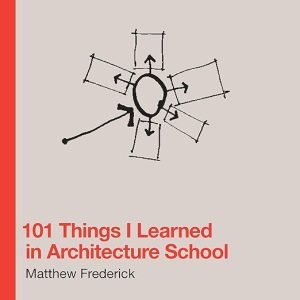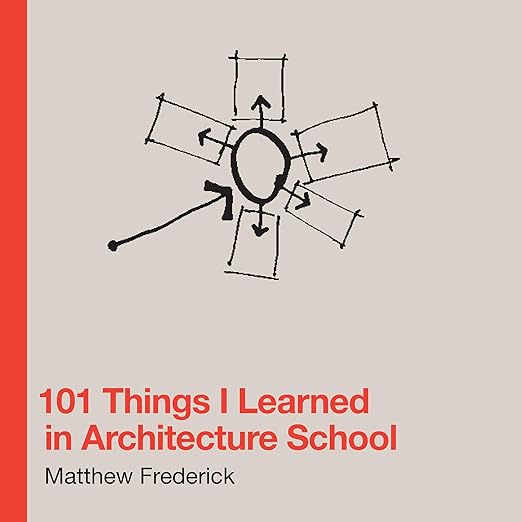
What happens to a book when you remove half of it? Not a rhetorical question about this audiobook, but a structural description of it. Matthew Frederick built 101 Things I Learned in Architecture School on a two-page unit: a short written lesson on one side, an illustration facing it, doing work the words deliberately decline to repeat. One lesson explains how to draw a line and is illustrated with examples of good lines and bad ones. Another warns about awkward changes in floor level and shows the television actor Dick Van Dyke in mid-pratfall. Strip the pictures out and what remains is a set of captions.
The Companion PDF Holds the Missing Half
Frederick's publisher does address the problem, in a note attached to the end of the description: buy the title and an accompanying PDF appears in your library alongside the audio. Take that seriously rather than as boilerplate. On most nonfiction a companion file is a courtesy holding a chart or two. Here it holds the missing half of all 101 lessons, and a listener who never opens it has bought a genuinely partial product. The consolation is that Frederick's writing is unusually self-sufficient for a design text. He is not describing pictures, he is stating principles that happen to be illustrated, and a good many of them survive the extraction more or less intact.
Closest to what the book is really doing is a September 2015 entry, four stars, filed by a painter rather than an architect. Each of the 101 things receives a page and an accompanying illustration, that reader notes, and the subject is design and, in equal measure, the mental process of developing a design. The second half of that observation explains why non-architects keep finding this useful. Frederick is teaching a way of thinking under constraint, where every decision forecloses other decisions and the foreclosing is the whole point. The description makes a similar claim in institutional language, calling the book a primer in architectural literacy that makes concrete what a curriculum leaves nebulous, but the painter's version is more honest about which part transfers.
One Minute Apiece, No Argument to Sustain
An hour and forty-five minutes across 101 lessons works out at roughly a minute apiece, which tells you nearly everything about the listening experience. Sean Pratt is reading a book with no argument to sustain and no narrative to carry, only 101 discrete units arriving one after another with nothing joining them but sequence. That is an unusual assignment. Pace it as continuous prose and the boundaries blur until the lessons run together into a wash; mark every transition too heavily and the thing becomes a list read aloud. Sample two consecutive lessons rather than one, because the gap between them is what actually needs judging.
Non-architects have the strongest case of all, and a May 2010 entry makes it plainly: five stars from somebody holding two degrees in art, describing a persistent sense of missing structure underneath the imagination, and saying this book put words to concepts already understood without their architectural origin ever being obvious. Worth naming that experience, because it is the real product on offer. Most people move through built space all day, register that one room is comfortable and another faintly hostile, and hold no vocabulary for the difference. Frederick supplies the vocabulary in one-minute pieces, and vocabulary is exactly what audio delivers well.
A 4.7 Average With Just One Rating
What the written column keeps grading, though, is an object. An August 2015 entry says so outright, five stars, describing the hardbound edition as pocket-sized and bound as much like a work of art as a practical guide, then noting how the book sets the Mies Van Der Rohe line about less being more against a contradicting piece of advice from Robert Venturi. Every part of that response concerns a physical article and pages placed opposite one another. A download is not pocket-sized, cannot be slid across a studio table to somebody else, and does not sit on a desk looking like the thing it is teaching.
Rating arithmetic on this page cannot mean what it says either. A 4.7 average sits above a counter reading one rating, and a single grade is a whole number by construction, four stars or five, never a value resting between them. Beneath that impossible pair, five separate write-ups have accumulated. Four of the five were filed before this recording existed at all, the audio having gone on sale in March 2025, so the column amounts to a print reputation borrowed wholesale by a new product. Not misconduct, and the reputation is thoroughly deserved. It simply means the page describes a book, while what lands in your cart is that book performed, plus a file.
A Studio Staple That Still Needs the PDF
Students currently inside an architecture program are the target readership, and the description all but names them, promising a book they will want in the studio and in their backpack and possibly out of sight of their professors. For them the audio works as a supplement rather than the main event: useful walking to campus, much less useful at the desk where the drawing happens. The wider audience is anybody who wants language for the built environment, and there the compact form becomes an advantage. Under two hours to acquire a working sense of how designers think about proportion, threshold, drawing and presentation is a bargain on any measure.
Buying this without opening the PDF is a mistake, and the print edition is the better purchase for anyone who knows they will not. The drawing lessons in particular cannot be assessed by ear however well they are described, since the description itself says the line lesson works by comparing good examples with bad ones, and a comparison you cannot see is not a comparison. Listeners hoping for a sustained argument about architecture will also come away short, because 101 short lessons is a format that resists building toward anything. Treat it as a reference to dip into, and it becomes one of the most efficient hours on the arts shelf.
Quick Take
- Performance: Sean Pratt reads 101 self-contained lessons at roughly a minute each, a job with no narrative to carry and nothing to manage but transitions.
- What it covers: Architectural literacy, drawing and proportion as habits of thought, design as decision-making under constraint
- Feel: Brisk, dry and quietly generous
- Our call: An excellent short primer, and only half a product for anyone who leaves the companion file unopened.
Is the audiobook usable without opening the companion file?
Partly. Lessons about proportion, presentation and the process of designing survive perfectly well as spoken argument. The drawing lessons do not, since the one on drawing a line depends on a comparison between good and bad examples that has to be seen. Expect a portion of the drawing material to arrive incomplete.
How is the audiobook best used, given how short it is?
Under two hours covering 101 lessons, which is about a minute each. That makes it a reference rather than a listen-through, and it rewards returning to individual lessons far more than a straight run from beginning to end. Treat it as something to revisit rather than something to finish.
Is this only for architecture students?
Not at all. The description names architecture graduates, from young designers through experienced practitioners, as returning readers, and the underlying subject is how designers think rather than how buildings get assembled. Anyone wanting language for why one room feels comfortable and another does not will find the lessons transfer easily.
Why does an architecture book illustrate a lesson with Dick Van Dyke?
To show what an awkward change in floor level does to a person. The description offers that lesson as an example of the method: a serious principle about spatial thresholds delivered through a comic image of the actor caught mid-pratfall. The whimsy is the teaching device rather than decoration around it.