Quick Take
- Read by: Jefferson Mays brings characteristic precision and warmth to Satow's research-dense material, making an eleven-hour listen feel consistently worthwhile.
- At its heart: Dynastic wealth and its discontents, New York as a theater of money, the lifecycle of iconic institutions
- Vibe: Elegant and investigative, with a journalist's nose for the scandal beneath the glamour
- Short version: A rigorous, well-narrated social history that uses one hotel address to map more than a century of American wealth culture.
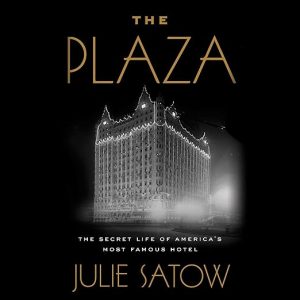
The Plaza audiobook found me on a slow evening in late autumn, and I'll admit I came to it with slightly lowered expectations. Hotel histories tend toward either starry-eyed nostalgia or dense institutional chronicle, and I've read enough of both to be cautious. Julie Satow surprised me within the first chapter. Her approach to the Plaza Hotel's century-long story has the structural intelligence of a good long-form magazine piece and the narrative pull of a social novel. Jefferson Mays's narration sealed it: I ended up listening through two evenings when I'd planned to stop after one.
The premise is deceptively simple. One address, Fifth Avenue and 59th Street, across more than a hundred years of American wealth, ambition, scandal, and reinvention. But Satow, an award-winning journalist, knows that the hotel's story only works as a prism for something larger. This isn't primarily a book about a building. It's a book about money: where it comes from, who holds it, how it moves through cities and institutions, and what it leaves behind when it moves on.
Wealthy Widows Kept the Plaza Solvent
Satow's research is formidable without being overwhelming. She traces the Plaza from Alfred Gwynne Vanderbilt's inaugural check-in in 1907, through the Gilded Age glitter and the Depression-era survival story (funded, fascinatingly, by a handful of wealthy widows who essentially kept the hotel solvent), through the Trump bankruptcy, through the conversion to condominiums that began hollowing out the building's communal character. Each ownership era is given its due, and each reveals something different about the era's relationship to inherited versus earned wealth, to foreign capital, to the use of iconic spaces as vehicles for financial schemes.
The dark corners Satow uncovers are genuinely surprising. The cold-blooded murder during the hotel's construction period. The Indian tycoon managing the Plaza from a prison cell in Delhi. The way anonymous shell companies have transformed historic guest rooms into empty investment vehicles, leaving parts of the hotel strangely lifeless. One reviewer described it as 'a history book that gets bogged down at times with the facts,' which is a fair critique for listeners who come expecting pure narrative entertainment. Satow is a journalist first, and she does pause at key points to contextualize the financial mechanisms rather than simply dramatize them. That rigor is exactly what I valued, but it's worth noting for listeners who prefer straight storytelling to informed analysis.
Mays Finds Pleasure in the Capote Chapter
Jefferson Mays is one of the best nonfiction narrators working in English-language audio, and his performance here is characteristically precise. Mays has the unusual ability to read densely researched material without making it sound like he's rendering an encyclopedia entry. Genuine pleasure comes through in his delivery during the Truman Capote Black and White Ball section, and he handles the more somber passages about financial predation with appropriate gravity. At eleven hours and thirteen minutes, this is a longer commitment than a standard narrative history, but Mays makes the runtime feel earned rather than padded.
The comparison that kept surfacing for me was to Michael Gross's '740 Park,' which uses a single Park Avenue building as a lens for examining dynastic wealth in New York. Satow's book operates in a similar register but with a more accessible tone and a broader temporal sweep. Where Gross digs deep into family genealogies and wealth-concentration data, Satow keeps the anecdote at the center. Both are worthwhile; they complement each other for listeners interested in New York as a geography of money.
Bogged Down in Facts, Light on Architecture
The middle sections of the audiobook are the densest. Satow covers multiple ownership transitions in the mid-twentieth century, and listeners who come for the Eloise-era glamour or the Trump-era spectacle may find some of this transitional material slow. One listener noted that 'it is a history book and does get bogged down at times with facts about the hotel and its guests.' That observation is accurate: this is not a breezy celebrity-gossip history. The financial detail is present and sometimes intricate. Give it thirty minutes to find its rhythm before deciding it's not for you.
The book also skews heavily toward the hotel's role in New York's social mythology rather than its architecture or interior design. Listeners hoping for a detailed treatment of the building's physical history, its design evolution, its restoration campaigns, will find that dimension somewhat peripheral. Satow's interest is in the social and financial drama, not the stonework.
Feels Shorter Than Its Actual Runtime
It is also worth noting what the audiobook captures that a print reading might underemphasize: the way Satow's prose is built for momentum. Her sentences carry the reader forward through dense financial and architectural history without the drag that often affects institutional biography. Mays understands this and matches his pacing to the prose's own cadence. The result is an audiobook that feels shorter than its runtime, which is one of the highest compliments available in the format. At eleven hours, it asks for commitment; it earns that commitment with consistent narrative pull.
Gilded Age Readers Over Architecture Buffs
Ideal for listeners who enjoy the New York literary nonfiction tradition, books that use a specific place or institution as a vehicle for understanding larger shifts in American culture and capital. Also excellent for anyone with an interest in the Gilded Age, the aesthetics of inherited wealth, or the way modern finance has reshaped iconic urban spaces. Less suitable for listeners who want pure entertainment biography without financial analysis, or those looking for architectural history in any technical sense.