The Short Version
- Voice: Virtual Voice AI narration handles the clear expository prose adequately at this short runtime, but listeners sensitive to synthetic delivery will prefer the print edition.
- Big ideas: Bauhaus design philosophy, the union of art and industry, democratic aesthetics and the modernist legacy
- Atmosphere: Compact and informational, suited to a focused commute rather than deep immersion
- Worth it?: A competent introductory audiobook on Bauhaus principles; works best for curious newcomers to design history who want orientation before diving deeper.
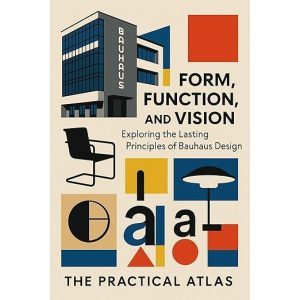
Bauhaus design has been discussed, dissected, and anthologized for over a century, so the challenge for any audiobook approaching the movement is to add something other than chronology. Form, Function, and Vision by The Practical Atlas, part of the Half Hour Help Art and Design Series, takes an avowedly compact approach: at just over eighty minutes, it aims to give listeners a workable understanding of Bauhaus principles without requiring prior immersion in design history. That's an honest brief, and the execution is largely adequate to it.
This audiobook arrives via Virtual Voice AI narration, and for a short nonfiction text about design history, that limitation matters less than it would for a character-driven work. The prose is clear and expository, organized around principles rather than personalities, and an AI narrator reading well-structured sentences competently can transmit content even without interpretive warmth. That said, listeners who find synthetic delivery distracting should factor the narration into their format choice.
Smartphone Interfaces Still Carry Bauhaus DNA
Walter Gropius founded the Bauhaus in 1919 with a specific and radical claim: that art, craft, and industrial production did not need to be separate disciplines, that the beautiful and the functional could be the same thing. Form, Function, and Vision traces this idea clearly through the school's origins, its core pedagogical philosophy, and its remarkable spread after the school was shuttered by Nazi pressure in 1933. The book's organizational logic is sound: it moves from philosophy to practice, covering architecture, furniture design, typography, and the influence of key figures including Gropius, Marcel Breuer, Wassily Kandinsky, Laszlo Moholy-Nagy, and Josef Albers.
What the book handles well is the argument for why Bauhaus matters today, not just as design history but as a living set of principles. The observation that smartphone interfaces, corporate logo systems, and sustainable architecture all carry Bauhaus DNA is made credibly rather than as casual claim. The chapter on how Bauhaus design was explicitly democratic, intended to bring good design to broad populations rather than wealthy patrons, is the most interesting in the collection. The idea that good design could be democratic and purposeful rather than reserved for elite consumption remains radical in application even when it has become commonplace as theory.
Kandinsky and Albers Get Only Passing Coverage
The Half Hour Help series premise means this is deliberately an entry point rather than a comprehensive study. The one available review notes that the chapters are 'short and direct,' with a 'compact dialect for the intended audience,' which is an accurate description of what the book accomplishes and what it doesn't attempt. Listeners who want a solid grounding in what Bauhaus was, who the key figures were, and why the movement still shapes contemporary aesthetics will find the material well-organized and clearly presented. The book doesn't dwell; it moves through its subject with the same economy it describes.
Where the book is less satisfying is precisely at the depth level. The treatment of individual figures is necessarily compressed: Kandinsky's theoretical contributions to color and form, Moholy-Nagy's experiments with light and transparency, and Albers's foundational work on color relationships are each given only passing coverage. Listeners who come away wanting more than they got are probably experiencing the audiobook working correctly, since orientation toward further exploration is the appropriate outcome of a fifty-minute introduction to a century-long movement's legacy.
At Eighty-One Minutes, Test the Narration First
The audiobook format has an inherent challenge with design-focused content: visual examples are the natural medium for discussing visual principles. The sole available review notes that 'images are helpful for visualization,' suggesting the companion print or e-book version may be the better primary format for listeners who want to see what the prose is describing. As a listening experience, the abstractions hold up reasonably well, but listeners who need to see a Breuer chair or a Moholy-Nagy light installation to understand what's being argued may find the audio-only version slightly frustrating. At eighty-one minutes, it costs little to test whether the narration serves the material for your particular needs.
Listeners coming with existing knowledge of modernism or 20th-century design history will likely find this too introductory to add much. Someone arriving with no prior context will find it a well-paced and clear orientation. The Half Hour Help series is honest about its scope in its title, which means the appropriate question before purchasing is whether the orientation function, rather than the depth function, is what you actually need right now.
Like a Documentary Before the Exhibition
Design students, architecture enthusiasts, and curious general listeners who want a quick orientation in Bauhaus history before exploring further will get genuine value from this audiobook. Those already familiar with Frank Whitford's comprehensive survey or the work of Elizabeth Otto and Patrick Rossler will find this too introductory. The Virtual Voice narration makes the print or e-book edition the better choice for listeners sensitive to synthetic delivery, but for content intake on a short commute, the audio format functions adequately. The book is best understood as a calibration tool before deeper reading rather than as a destination.
For listeners who want a comparative frame: this audiobook occupies a similar orientation function to the kind of short documentary introduction you'd watch before visiting a Bauhaus exhibition, enough to understand what you're looking at without substituting for the exhibition itself. Used that way, it earns its modest runtime and its modest scope alike.
Common Questions
Does this audiobook cover Bauhaus architecture specifically or is it more about graphic design?
It covers both, with chapters on architecture, furniture design, typography, and industrial design. The treatment of architecture includes Gropius and Breuer's work, but listeners wanting deep coverage of any single discipline should note the book's explicitly introductory scope.
Is the audiobook format effective for a design history book where visuals usually matter?
Partially. The prose is clear enough to follow the arguments without images, but the companion print or e-book edition will be richer for anyone who needs to see the chairs, buildings, and posters being discussed. The audio works better for the philosophical and historical chapters than for the visual analysis sections.
At eighty minutes, is this audiobook long enough to be worth buying?
That depends on what you want from it. The Half Hour Help series is designed for listeners who want quick competence in a subject rather than expertise. If you want a working understanding of Bauhaus principles you can apply or discuss, the eighty-one minutes delivers that. If you want historical depth, you'll need to supplement it with additional reading.