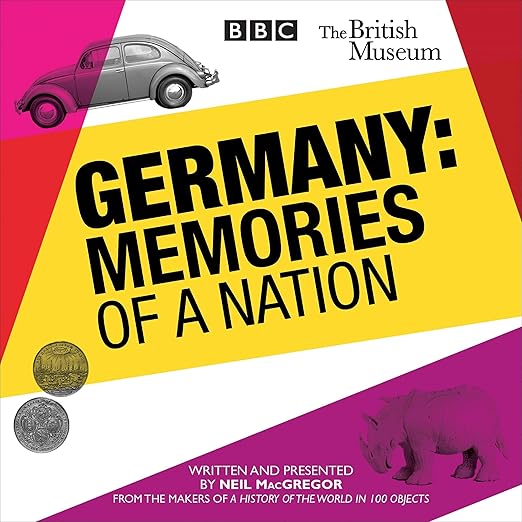
Neil MacGregor's Germany: Memories of a Nation begins from a deceptively simple observation: no coherent, overarching narrative of Germany's history can be constructed. Not because the evidence is thin, but because the country itself has always been constitutively plural. Its frontiers have shifted with every generation; Konigsberg, where Immanuel Kant lived and wrote, is now Kaliningrad in Russia. Strasbourg, where Goethe discovered the distinctiveness of German art and architecture, now lies in France. For most of the past five centuries, Germany was composed of dozens of separate political units, each with its own distinct history. The audiobook explores what remains when you strip away the idea of a unified national story and look at what the people who lived through it actually shared.
MacGregor self-narrates, which is the right decision. His voice carries the measured, curious quality he developed over decades at the BBC and as director of the British Museum, and the approach in Germany: Memories of a Nation is directly continuous with A History of the World in 100 Objects. Both books use material culture, specific objects and places, as the frame for historical analysis. The difference here is that MacGregor is analyzing a culture he is both inside and outside of: a Briton working with German material, speaking to an international audience about something that many Germans themselves find difficult to narrate without anxiety. His outsider authority is one of the book's assets, and his narration captures that careful positioning.
From Gutenberg's Press to Buchenwald's Gates
The objects MacGregor chooses carry significant range. Gutenberg's 15th-century invention of modern printing is the starting point, establishing Germany's foundational contribution to the dissemination of knowledge. From there he moves through Dresden porcelain and Dresden rubble, through Bauhaus design and the German sausage, through the crown of Charlemagne and the gates of Buchenwald. The juxtaposition of those last two items, the medieval symbol of European Christian civilization and the entrance to a concentration camp, captures the book's central tension without resolving it. MacGregor is not interested in providing resolution. He is interested in showing how such wildly different things could both be authentically German in different periods, and how contemporary Germany holds all of it.
At just under seven hours, this audiobook compresses what is a visually rich book into a purely spoken form. Reviewers of the physical edition consistently praise the illustrations, maps, and visual components, and it's worth noting that the audio adaptation necessarily loses those elements. The argument still holds without them, and MacGregor's descriptions are precise enough to give you the visual picture, but the printed book and the audio version offer meaningfully different experiences. The audiobook is particularly strong in the biographical sections, where MacGregor's discussion of figures like Kant, Goethe, and later artists and architects benefits from being heard rather than read.
Why the Postwar Chapters Carry the Most Weight
MacGregor's method, which he used to great effect in A History of the World in 100 Objects, creates a particular kind of intimacy between the listener and the historical material. By grounding abstract arguments about national identity and cultural memory in specific, tangible things, he makes ideas accessible without simplifying them. The discussion of Bauhaus design and its political context is a good example: MacGregor connects the aesthetic philosophy to the social ambitions behind it, and then to the political circumstances that ended it, in a way that makes the stakes of the design history genuinely clear. In audio, that argument unfolds at the pace MacGregor intends, without the temptation to skip ahead.
The final portion of the book, dealing with postwar Germany and the contemporary Federal Republic, carries particular weight. The question MacGregor poses at the outset, how much do we really understand this new Germany, and how do its people understand themselves, returns with more force after everything that has preceded it. The audiobook earns that return because MacGregor has spent six and a half hours building the cultural context that makes the question meaningful.
MacGregor's Refusal to Offer a Redemptive Ending
Listen for the moments when MacGregor allows the ambivalence of the German historical experience to sit without resolution. He is not building toward a redemptive conclusion, and the audiobook's greatest quality is its refusal to offer one. The Charlemagne crown and the Buchenwald gates are both there. The Bauhaus and the Third Reich occupy the same century. The book's honesty about the coexistence of these realities, and about how German cultural memory has learned to hold them, is where the historical thinking is most sophisticated.
The sections on geography and the instability of German frontiers are foundational to everything that follows, and listeners who absorb those sections early will find the later object-by-object analysis more coherent. The fragmentation is not incidental to the argument; it is the argument. MacGregor's self-narration paces these foundational sections carefully, giving them the weight they need before the book moves into its more episodic structure.
Listeners Who Already Loved the Objects Book
This audiobook is for listeners drawn to cultural history that takes objects and places seriously as historical evidence. Fans of MacGregor's A History of the World in 100 Objects will find the same method applied with the same rigor to a single national culture rather than the breadth of human civilization, and the comparison reveals what the method can do at that focused scale. Listeners with an existing interest in German history, art, or culture will find the treatment complementary to more traditional historical accounts.
Those looking for a political or military history of Germany will need different books. MacGregor explicitly notes that this is not a history in the conventional sense; it is a cultural memoir, as one reviewer accurately described it, and its goals are accordingly different. The absence of a linear narrative is a feature of the approach rather than a gap in the coverage.
Quick Take
- Performance: Neil MacGregor's self-narration brings the same calm authority he developed over decades of public broadcasting at the BBC, and his measured pace suits the meditative, object-by-object structure of the book.
- What it covers: The fragmented nature of German national identity, objects as historical witnesses, the persistence of cultural memory
- Feel: Contemplative and intellectually rich, with the unhurried confidence of public scholarship at its best
- Our call: MacGregor's cultural archaeology approach to Germany is a model of what this kind of book can be, and his self-narration makes it feel like an extended conversation rather than a lecture.
How does the audiobook version compare to the physical book, which reviewers praise for its illustrations and maps?
The audiobook necessarily loses the visual components, which are significant in the physical edition. MacGregor's descriptions are precise enough to convey the visual substance, but readers with a strong interest in the material culture dimension of the argument will want the physical book alongside the audio.
Is Neil MacGregor's self-narration in the Germany audiobook comparable to his BBC radio delivery?
Very much so. His pacing, tone, and the quality of careful intellectual curiosity he brings to each subject are consistent with his broadcast work. Listeners familiar with A History of the World in 100 Objects will recognize the voice immediately.
Does this audiobook address the Nazi period and the Holocaust, and if so, how does MacGregor handle those sections?
Yes, those periods are addressed, particularly through the gates of Buchenwald as a central object in the book's later sections. MacGregor handles them with the same analytical precision he brings to every other element, without either avoiding the gravity or allowing it to become the book's only frame for German history.